Mark W. Spong - Robot Modeling and Control
Здесь есть возможность читать онлайн «Mark W. Spong - Robot Modeling and Control» — ознакомительный отрывок электронной книги совершенно бесплатно, а после прочтения отрывка купить полную версию. В некоторых случаях можно слушать аудио, скачать через торрент в формате fb2 и присутствует краткое содержание. Жанр: unrecognised, на английском языке. Описание произведения, (предисловие) а так же отзывы посетителей доступны на портале библиотеки ЛибКат.
- Название:Robot Modeling and Control
- Автор:
- Жанр:
- Год:неизвестен
- ISBN:нет данных
- Рейтинг книги:4 / 5. Голосов: 2
-
Избранное:Добавить в избранное
- Отзывы:
-
Ваша оценка:
Robot Modeling and Control: краткое содержание, описание и аннотация
Предлагаем к чтению аннотацию, описание, краткое содержание или предисловие (зависит от того, что написал сам автор книги «Robot Modeling and Control»). Если вы не нашли необходимую информацию о книге — напишите в комментариях, мы постараемся отыскать её.
, students will cover the theoretical fundamentals and the latest technological advances in robot kinematics. With so much advancement in technology, from robotics to motion planning, society can implement more powerful and dynamic algorithms than ever before. This in-depth reference guide educates readers in four distinct parts; the first two serve as a guide to the fundamentals of robotics and motion control, while the last two dive more in-depth into control theory and nonlinear system analysis.
With the new edition, readers gain access to new case studies and thoroughly researched information covering topics such as:
● Motion-planning, collision avoidance, trajectory optimization, and control of robots
● Popular topics within the robotics industry and how they apply to various technologies
● An expanded set of examples, simulations, problems, and case studies
● Open-ended suggestions for students to apply the knowledge to real-life situations
A four-part reference essential for both undergraduate and graduate students,
serves as a foundation for a solid education in robotics and motion planning.
Robot Modeling and Control — читать онлайн ознакомительный отрывок
Ниже представлен текст книги, разбитый по страницам. Система сохранения места последней прочитанной страницы, позволяет с удобством читать онлайн бесплатно книгу «Robot Modeling and Control», без необходимости каждый раз заново искать на чём Вы остановились. Поставьте закладку, и сможете в любой момент перейти на страницу, на которой закончили чтение.
Интервал:
Закладка:
Recall that the matrix  in Equation ( 2.9) represents a rotational transformation between the frames o 0 x 0 y 0 z 0and o 1 x 1 y 1 z 1. Suppose we now add a third coordinate frame o 2 x 2 y 2 z 2related to the frames o 0 x 0 y 0 z 0and o 1 x 1 y 1 z 1by rotational transformations. A given point p can then be represented by coordinates specified with respect to any of these three frames:
  ,
,  , and
, and  The relationship among these representations of p is
(2.13) 
(2.14) 
(2.15) 
where each  is a rotation matrix. Substituting Equation ( 2.14) into Equation ( 2.13) gives
(2.16) 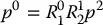
Note that  and
and  represent rotations relative to the frame o 0 x 0 y 0 z 0while
  represents a rotation relative to the frame o 1 x 1 y 1 z 1. Comparing Equations ( 2.15) and ( 2.16) we can immediately infer
(2.17) 
Equation ( 2.17) is the composition law for rotational transformations. It states that, in order to transform the coordinates of a point p from its representation  in the frame o 2 x 2 y 2 z 2to its representation
  in the frame o 0 x 0 y 0 z 0, we may first transform to its coordinates
  in the frame o 1 x 1 y 1 z 1using
  and then transform
  to
to  using
using  .
.
We may also interpret Equation ( 2.17) as follows. Suppose that initially all three of the coordinate frames coincide. We first rotate the frame o 1 x 1 y 1 z 1relative to o 0 x 0 y 0 z 0according to the transformation  . Then, with the frames o 1 x 1 y 1 z 1and o 2 x 2 y 2 z 2coincident, we rotate o 2 x 2 y 2 z 2relative to o 1 x 1 y 1 z 1according to the transformation
  . The resulting frame, o 2 x 2 y 2 z 2has orientation with respect to o 0 x 0 y 0 z 0given by
  . We call the frame relative to which the rotation occurs the current frame.
Example 2.5.
Suppose a rotation matrix  represents a rotation of angle ϕ about the current y -axis followed by a rotation of angle θ about the current z -axis as shown in Figure 2.8. Then the matrix
  is given by
(2.18) 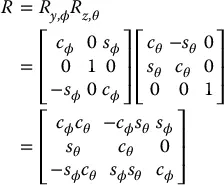
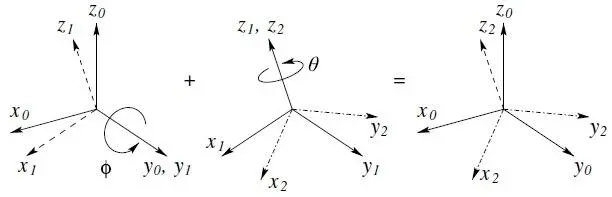
Figure 2.8 Composition of rotations about current axes.
It is important to remember that the order in which a sequence of rotations is performed, and consequently the order in which the rotation matrices are multiplied together, is crucial. The reason is that rotation, unlike position, is not a vector quantity and so rotational transformations do not commute in general.
Example 2.6.
Suppose that the above rotations are performed in the reverse order, that is, first a rotation about the current z -axis followed by a rotation about the current y -axis. Then the resulting rotation matrix is given by
(2.19) 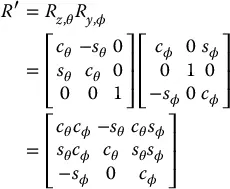
Comparing Equations ( 2.18) and ( 2.19) we see that  .
.
2.4.2 Rotation with Respect to the Fixed Frame
Many times it is desired to perform a sequence of rotations, each about a given fixed coordinate frame, rather than about successive current frames. For example we may wish to perform a rotation about x 0followed by a rotation about y 0(and not y 1!). We will refer to o 0 x 0 y 0 z 0as the fixed frame. In this case the composition law given by Equation ( 2.17) is not valid. It turns out that the correct composition law in this case is simply to multiply the successive rotation matrices in the reverse orderfrom that given by Equation ( 2.17). Note that the rotations themselves are not performed in reverse order. Rather they are performed about the fixed frame instead of about the current frame.
Читать дальшеИнтервал:
Закладка:
Похожие книги на «Robot Modeling and Control»
Представляем Вашему вниманию похожие книги на «Robot Modeling and Control» списком для выбора. Мы отобрали схожую по названию и смыслу литературу в надежде предоставить читателям больше вариантов отыскать новые, интересные, ещё непрочитанные произведения.





Обсуждение, отзывы о книге «Robot Modeling and Control» и просто собственные мнения читателей. Оставьте ваши комментарии, напишите, что Вы думаете о произведении, его смысле или главных героях. Укажите что конкретно понравилось, а что нет, и почему Вы так считаете.