Daniel J. Duffy - Numerical Methods in Computational Finance
Здесь есть возможность читать онлайн «Daniel J. Duffy - Numerical Methods in Computational Finance» — ознакомительный отрывок электронной книги совершенно бесплатно, а после прочтения отрывка купить полную версию. В некоторых случаях можно слушать аудио, скачать через торрент в формате fb2 и присутствует краткое содержание. Жанр: unrecognised, на английском языке. Описание произведения, (предисловие) а так же отзывы посетителей доступны на портале библиотеки ЛибКат.
- Название:Numerical Methods in Computational Finance
- Автор:
- Жанр:
- Год:неизвестен
- ISBN:нет данных
- Рейтинг книги:4 / 5. Голосов: 1
-
Избранное:Добавить в избранное
- Отзывы:
-
Ваша оценка:
Numerical Methods in Computational Finance: краткое содержание, описание и аннотация
Предлагаем к чтению аннотацию, описание, краткое содержание или предисловие (зависит от того, что написал сам автор книги «Numerical Methods in Computational Finance»). Если вы не нашли необходимую информацию о книге — напишите в комментариях, мы постараемся отыскать её.
Part A Mathematical Foundation for One-Factor Problems
Chapters 1 to 7 introduce the mathematical and numerical analysis concepts that are needed to understand the finite difference method and its application to computational finance.
Part B Mathematical Foundation for Two-Factor Problems
Chapters 8 to 13 discuss a number of rigorous mathematical techniques relating to elliptic and parabolic partial differential equations in two space variables. In particular, we develop strategies to preprocess and modify a PDE before we approximate it by the finite difference method, thus avoiding ad-hoc and heuristic tricks.
Part C The Foundations of the Finite Difference Method (FDM)
Chapters 14 to 17 introduce the mathematical background to the finite difference method for initial boundary value problems for parabolic PDEs. It encapsulates all the background information to construct stable and accurate finite difference schemes.
Part D Advanced Finite Difference Schemes for Two-Factor Problems
Chapters 18 to 22 introduce a number of modern finite difference methods to approximate the solution of two factor partial differential equations. This is the only book we know of that discusses these methods in any detail.
Part E Test Cases in Computational Finance
Chapters 23 to 26 are concerned with applications based on previous chapters. We discuss finite difference schemes for a wide range of one-factor and two-factor problems.
This book is suitable as an entry-level introduction as well as a detailed treatment of modern methods as used by industry quants and MSc/MFE students in finance. The topics have applications to numerical analysis, science and engineering.
More on computational finance and the author’s online courses, see www.datasim.nl.
Numerical Methods in Computational Finance — читать онлайн ознакомительный отрывок
Ниже представлен текст книги, разбитый по страницам. Система сохранения места последней прочитанной страницы, позволяет с удобством читать онлайн бесплатно книгу «Numerical Methods in Computational Finance», без необходимости каждый раз заново искать на чём Вы остановились. Поставьте закладку, и сможете в любой момент перейти на страницу, на которой закончили чтение.
Интервал:
Закладка:
(2.39) 
The solution of Equation (2.39)is given by:
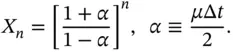
We see that  is bounded if and only if
  and this implies
 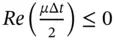 (recall that
  is a complex number) where
  means ‘real part of
  ’.
’.
This example leads us to our first encounter with the concept of stability of finite difference schemes. In particular, we define the region of absolute stability of a numerical method for an IVP as the set of complex values of  for which all discrete approximations to the test problem (2.37)remain bounded when
  tends to infinity. For example, for the trapezoidal method (2.39)the left-half plane is the stability region.
Theorem 2.1 (The Root Condition).A necessary and sufficient condition for the stability of a linear multistep method (2.32)is that all the roots of the polynomial  defined by Equation (2.34)are located inside or on the unit circle and that the roots of modulus 1 are simple.
We now discuss convergence issues. We say that a difference scheme has order of accuracy  if:
if:

where  approximate solution of (2.32),
  exact solution of (2.31), and
  is independent of
  .
.
We conclude this section by stating a convergence result that allows us to estimate the error between the exact solution of an initial value problem and the solution of a multistep scheme that approximates it. To this end, we consider the  -dimensional autonomous initial value problem:
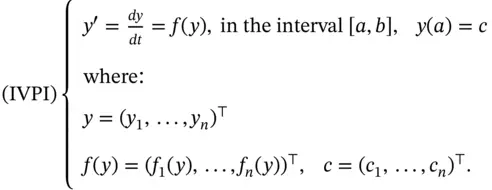
By autonomous we mean that  is a function of the dependent variable
  only and is thus not of the form
  . The latter form is called non-autonomous .
We approximate this IVP using the multistep method (2.32). We recall:
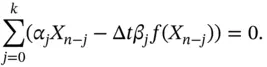
Theorem 2.2Assume that the solution  of the
  is
is  times differentiable with
  and assume that
  is differentiable for all
  .
.
Suppose furthermore that the sequence  is defined by the equations:
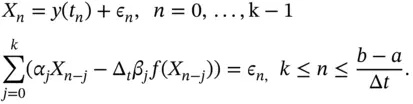
If the multistep method is stable and satisfies:

where C is a positive constant independent of  , then there exist constants
  and
and  such that for all
  :
:

In all cases we define the norm  for a vector
  as:
as:
Интервал:
Закладка:
Похожие книги на «Numerical Methods in Computational Finance»
Представляем Вашему вниманию похожие книги на «Numerical Methods in Computational Finance» списком для выбора. Мы отобрали схожую по названию и смыслу литературу в надежде предоставить читателям больше вариантов отыскать новые, интересные, ещё непрочитанные произведения.











Обсуждение, отзывы о книге «Numerical Methods in Computational Finance» и просто собственные мнения читателей. Оставьте ваши комментарии, напишите, что Вы думаете о произведении, его смысле или главных героях. Укажите что конкретно понравилось, а что нет, и почему Вы так считаете.