David Linden - Touch
Здесь есть возможность читать онлайн «David Linden - Touch» весь текст электронной книги совершенно бесплатно (целиком полную версию без сокращений). В некоторых случаях можно слушать аудио, скачать через торрент в формате fb2 и присутствует краткое содержание. Год выпуска: 2014, ISBN: 2014, Издательство: Penguin Books Ltd, Жанр: Психология, Биология, sci_popular, на английском языке. Описание произведения, (предисловие) а так же отзывы посетителей доступны на портале библиотеки ЛибКат.

- Название:Touch
- Автор:
- Издательство:Penguin Books Ltd
- Жанр:
- Год:2014
- ISBN:9780241184059
- Рейтинг книги:4 / 5. Голосов: 1
-
Избранное:Добавить в избранное
- Отзывы:
-
Ваша оценка:
Touch: краткое содержание, описание и аннотация
Предлагаем к чтению аннотацию, описание, краткое содержание или предисловие (зависит от того, что написал сам автор книги «Touch»). Если вы не нашли необходимую информацию о книге — напишите в комментариях, мы постараемся отыскать её.
Dual-function receptors in our skin make mint feel cool and chili peppers hot. Without the brain’s dedicated centers for emotional touch, an orgasm would feel more like a sneeze—convulsive, but not especially nice. From skin to nerves to brain, the organization of our body’s touch circuits is a complex and often counterintuitive system that affects everything from our social interactions to our general health and development.
In Touch, neuroscientist and bestselling author David J. Linden explores this critical interface between our bodies and the outside world, between ourselves and others. Along the way, he answers such questions as: Why do women have more refined detection with their fingertips than men? Is there a biological basis for the use of acupuncture to relieve pain? How do drugs like Ecstasy heighten and motivate sensual touch? Why can’t we tickle ourselves? Linking biology and behavioral science, Touch offers an entertaining and enlightening answer to how we feel in every sense of the word.
Touch — читать онлайн бесплатно полную книгу (весь текст) целиком
Ниже представлен текст книги, разбитый по страницам. Система сохранения места последней прочитанной страницы, позволяет с удобством читать онлайн бесплатно книгу «Touch», без необходимости каждый раз заново искать на чём Вы остановились. Поставьте закладку, и сможете в любой момент перейти на страницу, на которой закончили чтение.
Интервал:
Закладка:
Pain is not a single, discrete sensation, even when experienced at a single moment in time. We know from our real-life experience that it can have different qualities. In describing the sensory qualities of pain, people use terms like sharp , throbbing , flashing , burning , tingling , dull , aching , heavy , and stinging (figure 6.3). How do these different types of sensation emerge? There are three main categories of pain sensor: mechanical, thermal, and polymodal. We conjecture, but don’t really know, that the particular sensory qualities of pain arise from both the pattern of neural activity and the relative degree of activation of each of these three pain sensors, perhaps combined with or compared to nonpain touch signals from the same location on the body.
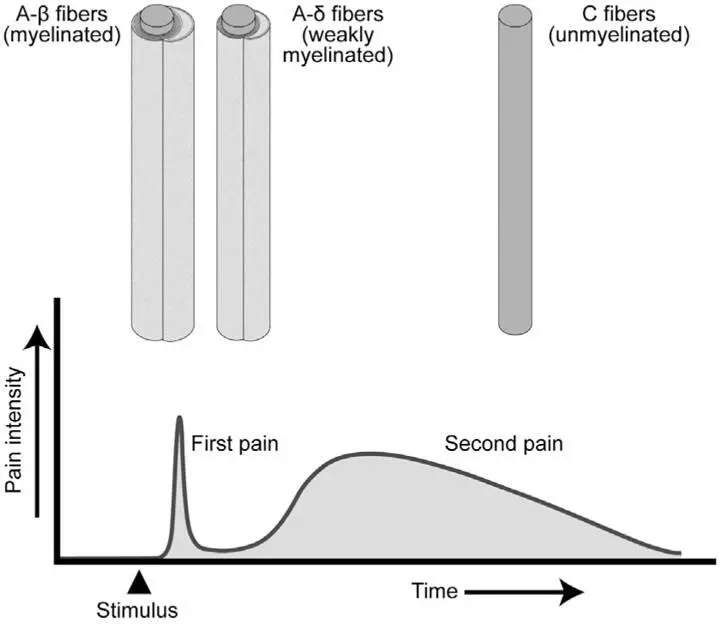
Figure 6.2First pain is brief, well localized, and discriminative, while second pain is diffuse, emotionally laden, and persistent. First pain is carried by medium-diameter weakly myelin-wrapped A-delta fibers and large-diameter myelin-wrapped A-beta fibers, while second pain is conveyed by unmyelinated small-diameter C-fibers. One of the ways we know this is by using a ligature that will compress and block the A-fibers while sparing the C-fibers. This will eliminate the experience of first but not second pain. In case you’re wondering, the SCN9A gene is expressed in both the A-fiber and C-fiber pain neurons, so people with congenital total insensitivity to pain lack both first and second pain and people with paroxysmal extreme pain disorder have enhanced first and second pain.
Unlike the sensors for pressure, vibration, texture, and caress that have specialized structures or elaborate associations with hair follicles, pain-sensing neurons use simple, unadorned free nerve endings. In the skin these free nerve endings penetrate the epidermis. Mechanical pain sensors are most easily activated by intense pressure: If you cut your finger with a knife, or stub your toe while walking, or pinch your skin in a zipper, your mechanical pain sensors will send signals to your brain. Some of these sensor molecules are embedded within the free endings of A-delta fibers, so this information will be conveyed quickly. Thermal pain sensors are also located in the free endings of a different group of A-delta fibers and respond to temperatures below approximately 42°F or above approximately 115°F. 6There is also a subset of C-fiber endings that respond more broadly—to thermal, mechanical, or chemical stimulation (like strong acids or bases). These polymodal pain sensors are responsible for the second wave of pain, and their wider susceptibility to different types of pain helps to explain why this second wave is less qualitatively specific than the first. 7
The cell bodies of the A- and C-fibers that carry pain signals are located in the dorsal root ganglia and enter the spinal cord in a region called the dorsal horn (figure 6.4). This is similar to the anatomy of the sensory nerves for fine touch and caress, as discussed in chapters 2 and 3. The C- and A-delta pain fibers make excitatory connections with neurons located in the dorsal horn. There are different layers within the dorsal horn, containing neurons that receive different types of touch information, including proprioception (carried by superfast A-alpha fibers), fine mechanosensation (carried by fast A-beta fibers), caress (carried by a different population of slow C-fibers), and pain. For our purposes it’s not necessary to examine the detailed anatomy of these layers. 9There is an important general principle to keep in mind, however: While the various streams of different types of touch stimuli (pain, fine touch, caress, etc.) are generally kept separate while coursing through the spinal cord to the brain, there is some notable mixing of signals. 10For example, a type of neuron in the spinal dorsal horn called a wide-dynamic range neuron integrates pain and fine touch information. This blending of pain with nonpain signals in the spinal cord may account for why an action like rubbing a smashed elbow can temporarily dull the pain of that injury.
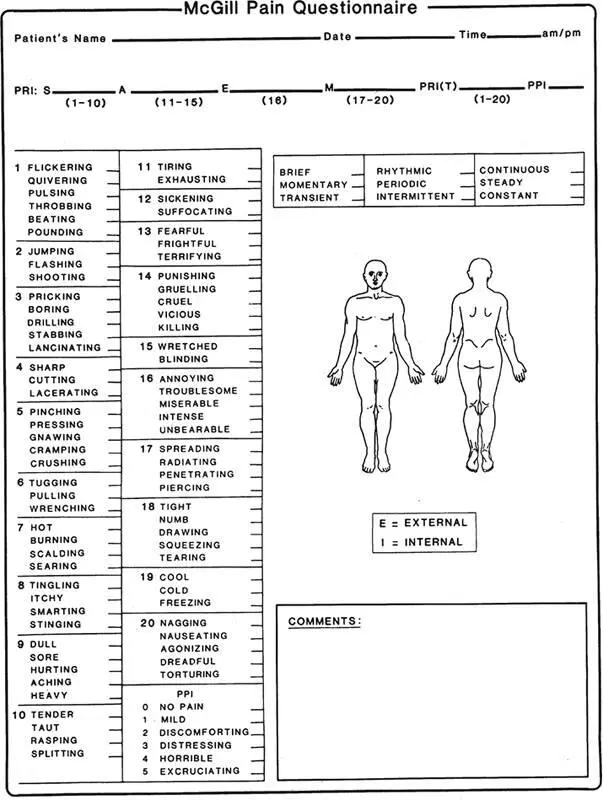
Figure 6.3The McGill Pain Questionnaire was developed by Dr. Ronald Melzack to try to encompass the variety of pain experience in a clinical setting. 8Groups 1–10 are sensory descriptors, 11–15 are emotional, and 16 is evaluative. Groups 17–20 are miscellaneous and have aspects of all three of the other categories. Copyright R. Melzack, 1975; reprinted with permission.
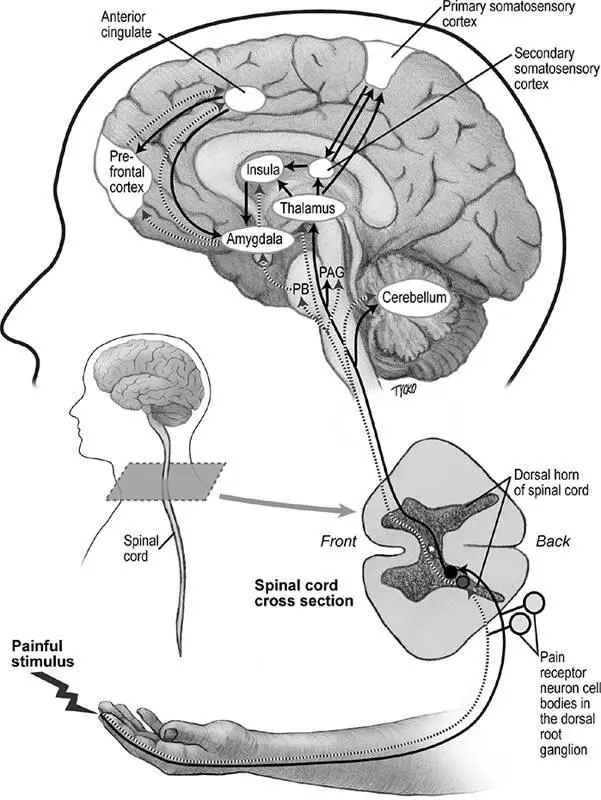
Figure 6.4Two major pathways conveying pain information to the brain. The fast sensory-discriminative pain pathway (solid black line), mostly carried in the spinothalamic tract, passes through the thalamus to engage the primary and higher somatosensory cortices. The slow affective-emotional pathway (dashed line) runs in part through the spinomesencephalic tract, via the parabrachial nucleus, and engages the amygdala, the insula, and the anterior cingulate cortex. © 2013 Joan M. K. Tycko
These wide-dynamic range neurons’ integration of various types of pain signal can at times lead to sensory illusions. For example, some wide-dynamic range neurons in the spinal dorsal horn receive pain information from both the viscera and the skin. Sufferers of angina (pain from insufficient blood flow to the heart muscle) often experience pain that feels as if it were coming from the left arm, even though that limb is uninjured. This “referred pain” is a clear demonstration of the general principle that we cannot always accurately decode the sensory world. In this case, the wiring diagram of the spinal cord is built in a way that creates confusion—which begs the question: Is there an advantage to having pain signals converge and create ambiguity? The short answer: We don’t know.

There is no single brain area that is responsible for registering pain. Rather, pain perception is distributed over a group of brain regions, each involved in a different aspect of the pain experience (figure 6.4). There are at least five different neural pathways that carry pain information from the neurons of the spinal dorsal horn, but we’ll focus on only three of these. 11The first, the spinohypothalamic pathway, activates the hypothalamus, a structure at the base of the brain, to produce rapid, subconscious, pain-evoked alterations in heart rate, body temperature, breathing, core muscle contraction, and hormone secretion. The fibers of the second, the spinothalamic pathway, originate in neurons in the spinal dorsal horn, cross the midline, ascend in the spinal cord, and then make synapses in the thalamus. The thalamic neurons in turn send fibers to the primary and secondary somatosensory cortices. If an electrode is placed in the spinothalamic tract and a few of its fibers are briefly activated, a highly localized, well-defined painful sensation will be evoked.
When brain scanning was performed in association with a painful stimulus, it was found that the first wave of pain was primarily correlated with activation of the spinothalamic tract and its targets, the primary and secondary somatosensory cortices. The second wave of pain was most clearly associated with activation of a third ascending pathway, called the spinomesencephalic tract, which activates the parabrachial nucleus in the brain stem and, through further synaptic relays, the insula, amygdala, and anterior cingulate cortex. 12Why are such neuroanatomical details important? The reason is that these spinomesencephalic tract targets in the brain are involved in emotional and cognitive pain responses. Their activation does not encode the precise location or quality of pain, but, rather, gives pain its characteristic negative emotional tone. They also integrate pain sensation with other information about the situation at hand: Am I safe or under threat? Was that pain anticipated or a surprise? What are the future implications of this pain? 13
Читать дальшеИнтервал:
Закладка:
Похожие книги на «Touch»
Представляем Вашему вниманию похожие книги на «Touch» списком для выбора. Мы отобрали схожую по названию и смыслу литературу в надежде предоставить читателям больше вариантов отыскать новые, интересные, ещё непрочитанные произведения.












Обсуждение, отзывы о книге «Touch» и просто собственные мнения читателей. Оставьте ваши комментарии, напишите, что Вы думаете о произведении, его смысле или главных героях. Укажите что конкретно понравилось, а что нет, и почему Вы так считаете.