David Linden - Touch
Здесь есть возможность читать онлайн «David Linden - Touch» весь текст электронной книги совершенно бесплатно (целиком полную версию без сокращений). В некоторых случаях можно слушать аудио, скачать через торрент в формате fb2 и присутствует краткое содержание. Год выпуска: 2014, ISBN: 2014, Издательство: Penguin Books Ltd, Жанр: Психология, Биология, sci_popular, на английском языке. Описание произведения, (предисловие) а так же отзывы посетителей доступны на портале библиотеки ЛибКат.

- Название:Touch
- Автор:
- Издательство:Penguin Books Ltd
- Жанр:
- Год:2014
- ISBN:9780241184059
- Рейтинг книги:4 / 5. Голосов: 1
-
Избранное:Добавить в избранное
- Отзывы:
-
Ваша оценка:
Touch: краткое содержание, описание и аннотация
Предлагаем к чтению аннотацию, описание, краткое содержание или предисловие (зависит от того, что написал сам автор книги «Touch»). Если вы не нашли необходимую информацию о книге — напишите в комментариях, мы постараемся отыскать её.
Dual-function receptors in our skin make mint feel cool and chili peppers hot. Without the brain’s dedicated centers for emotional touch, an orgasm would feel more like a sneeze—convulsive, but not especially nice. From skin to nerves to brain, the organization of our body’s touch circuits is a complex and often counterintuitive system that affects everything from our social interactions to our general health and development.
In Touch, neuroscientist and bestselling author David J. Linden explores this critical interface between our bodies and the outside world, between ourselves and others. Along the way, he answers such questions as: Why do women have more refined detection with their fingertips than men? Is there a biological basis for the use of acupuncture to relieve pain? How do drugs like Ecstasy heighten and motivate sensual touch? Why can’t we tickle ourselves? Linking biology and behavioral science, Touch offers an entertaining and enlightening answer to how we feel in every sense of the word.
Touch — читать онлайн бесплатно полную книгу (весь текст) целиком
Ниже представлен текст книги, разбитый по страницам. Система сохранения места последней прочитанной страницы, позволяет с удобством читать онлайн бесплатно книгу «Touch», без необходимости каждый раз заново искать на чём Вы остановились. Поставьте закладку, и сможете в любой момент перейти на страницу, на которой закончили чтение.
Интервал:
Закладка:
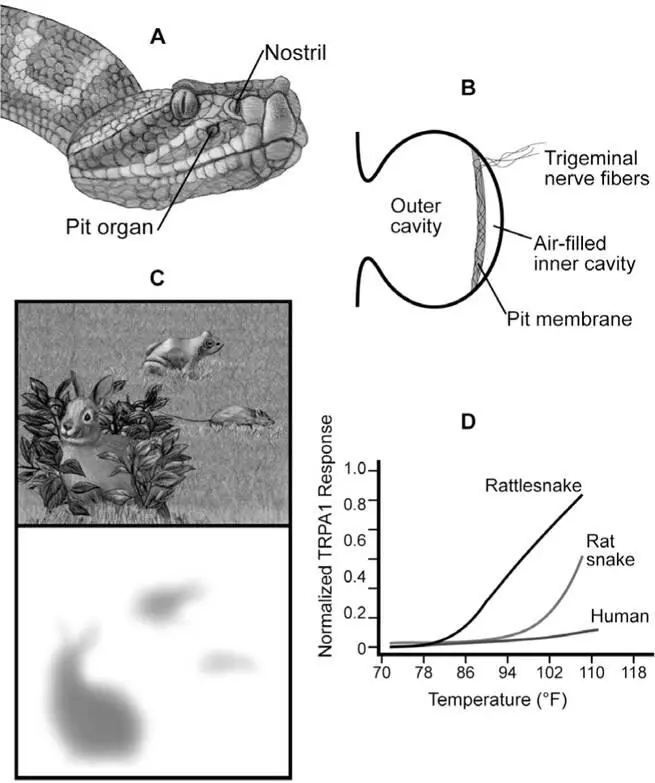
Figure 5.4The rattlesnake can detect infrared radiation using its pit organ, which contains a modified temperature-sensitive form of TRPA1. (A) The pit organ is located between the eye and the nostril. (B) A cross-section of the pit organ shows how it functions as a crude pinhole camera to localize prey. Nerve fibers from cells in the trigeminal ganglion branch in the pit membrane, which is stretched like a drumhead over an air-filled apace. (C) An artist’s rendering of the visual (top) and infrared (bottom) sensory worlds of the rattlesnake. These two streams of information are aligned and combined in the snake’s brain. Note that the snake can detect the vague outline of the warm rabbit with infrared sense even when it is hidden in a bush (or it is dark outside). The snake’s infrared sense can be used to detect not only warm objects against a cooler background but also cool objects against a warmer background, like the frog emerging from a pond onto sun-warmed grass. (D) TRPA1 from a rattlesnake is genetically modified so that it can be activated at temperatures above 86°F. TRPA1 from a rat snake, a species without infrared sense, is only weakly activated by warming, and human TRPA1 is not activated at all. Panels A, B, and D are adapted from E. O. Gracheva, N. T. Ingolia, Y. M. Kelly, J. F. Cordero-Morales, G. Hollopeter, A. T. Chesler, E. E. Sánchez, J. C. Perez, J. S. Weissman, and D. Julius, “Molecular basis of infrared detection by snakes,” Nature 464 (2010): 1006–11, with permission of Nature Publishing Group. Panel C is adapted from E. A. Newman and P. H. Hartline, “The infrared ‘vision’ of snakes,” Scientific American 246 (1982): 116–27, with permission of Macmillan Publishers.
One might guess that the molecular sensor that detects infrared radiation in the pit organ of the rattlesnake is the same supersensitive form of TRPV1 that’s used by vampire bats. However, when David Julius and his colleagues examined the trigeminal ganglia (where the sensory neurons that innervate the pit organ reside), they found that TRPV1 was not enriched there, as one would expect if it were the pit-organ infrared sensor. However, they surprisingly did discover that the wasabi receptor, TRPA1, was elevated four-hundred-fold in the snake’s trigeminal ganglion. This was an odd finding, because mammalian TRPA1 is not activated by heat at all. When human and rattlesnake TRPA1 were expressed in kidney cells, heat was shown to activate rattlesnake TRPA1 at temperatures above 86°F; however, human TRPA1 was almost entirely insensitive to heat. Rat snakes, which do not possess facial infrared-sensing organs, have a form of TRPA1 that is only weakly heat-sensitive. 23If we have come to think of TRPA1 as the wasabi sensor, it is only because we happened to study mammalian TRPA1 first. If we had a more vipercentric worldview, we’d say that TRPA1 is a heat sensor that can also be activated by wasabi and garlic.
Boas and pythons are from a snake lineage that is approximately 30 million years older than the pit vipers. They also have infrared-sensing pits, typically thirteen per side, located in two rows, one above and one below the mouth. The openings of these pits are not constricted and so they do not function like pinhole cameras. Rather, each pit has a slightly different field of view based upon its position on the snake’s face. From behavioral tests we know that pythons and boas are not as sensitive to infrared radiation as rattlesnakes are, so it was not entirely surprising to find that TRPA1 from pythons was less heat-sensitive than that of a rattlesnake but more sensitive than rat snake TRPA1. When the sequences of the TRPA1 genes for humans, pythons, and rattlesnakes are compared, one can see that modification of TRPA1 to render it heat-sensitive evolved twice in the snake lineage: once in the ancient boas and pythons, and then again in the more modern pit vipers. 24Sometimes the process of random mutation and natural selection will yield a related molecular and structural solution to a problem (like infrared sensing) in different organisms, millions of years apart. This is the wonderful process of convergent evolution.
Not all creatures use their infrared detectors to find prey. For example, most animals run or fly away from forest fires, but the fire beetles of North America (called Melanophila ) are drawn toward them. It’s not a desire for self-immolation that compels them, however. The beetles arrive at the site of a fire just as the flames have subsided and then copulate in the comfortably still-warm ashes. The female then deposits her eggs under the charred bark of newly burned pine trees. When the fire beetle larvae hatch the following summer, they can feed on the charred wood. (Living wood has chemical defenses that make it inedible to the larvae.) In some cases fire beetles have been drawn to other hot sites, including factories and even a football game held in a stadium where lots of the spectators were smoking cigarettes. Perhaps the most dramatic infestation of this type occurred in the Central Valley of California in August 1925. When a huge fire consumed an oil tank near the town of Coalinga, huge numbers of fire beetles began to swarm toward it. Newspaper reports of the time estimated that millions of fire beetles converged on Coalinga and remained for several days after the fire was extinguished.
Because Coalinga is situated in an arid valley, the best guess is that these beetles came from a site in the western foothills of the Sierra Nevada mountains, approximately eighty miles away. Melanophila beetles have a single infrared-detecting pit on each side of the abdomen. Many years later, when Helmut Schmitz and Herbert Bousack of the University of Bonn performed calculations to estimate the amount of infrared radiation that would have fallen on these sensors at a distance of eighty miles, they found that it was so small, it was embedded within ambient thermal noise produced by the fire beetle’s body. The nervous system of the fire beetle has a difficult engineering task to extract this tiny signal and use it to trigger migratory behavior. To date we do not know if the infrared sensors of the fire beetles use TRPV1 like vampire bats, TRPA1 like rattlesnakes, or an entirely different mechanism—perhaps not even a member of the TRP family at all. 25

If you type the word paradise into a Google Images search, the result will be a screen filled with one hundred different images, each one of which will be a view of a tropical beach. What’s the explanation for that? In part—at least for people living in affluent societies—a tropical beach suggests a leisurely vacation. But why, then, doesn’t the search term paradise bring up pictures of other popular vacation spots, like New York City, or a ski resort, or Disneyland? The reason is the weather: Paradise is a place where our bodies don’t have to work very hard to maintain our core temperature of approximately 99°F. We humans and other homeothermic animals (mammals and birds) cannot tolerate deviations of our core temperature of more than a few degrees. If it’s hot, we engage in both reflexive and voluntary activities: We sweat, vasodilate, have a cold drink, or jump in a swimming pool to cool our core. If it’s cold, we shiver, vasoconstrict, and put on a sweater. These homeostatic reflexes and behaviors require that we constantly monitor our internal core temperature and the temperature of the outside world as sensed through the skin. We need to know when our skin is cold or hot enough to require a physiological response to maintain our core temperature within a narrow range. The thresholds of human TRPM8 and TRPV1 are well calibrated for this task: TRPM8 is activated at temperatures below 78°F, and TRPV1 is activated at temperatures above 109°F.
Читать дальшеИнтервал:
Закладка:
Похожие книги на «Touch»
Представляем Вашему вниманию похожие книги на «Touch» списком для выбора. Мы отобрали схожую по названию и смыслу литературу в надежде предоставить читателям больше вариантов отыскать новые, интересные, ещё непрочитанные произведения.












Обсуждение, отзывы о книге «Touch» и просто собственные мнения читателей. Оставьте ваши комментарии, напишите, что Вы думаете о произведении, его смысле или главных героях. Укажите что конкретно понравилось, а что нет, и почему Вы так считаете.