David Linden - Touch
Здесь есть возможность читать онлайн «David Linden - Touch» весь текст электронной книги совершенно бесплатно (целиком полную версию без сокращений). В некоторых случаях можно слушать аудио, скачать через торрент в формате fb2 и присутствует краткое содержание. Год выпуска: 2014, ISBN: 2014, Издательство: Penguin Books Ltd, Жанр: Психология, Биология, sci_popular, на английском языке. Описание произведения, (предисловие) а так же отзывы посетителей доступны на портале библиотеки ЛибКат.

- Название:Touch
- Автор:
- Издательство:Penguin Books Ltd
- Жанр:
- Год:2014
- ISBN:9780241184059
- Рейтинг книги:4 / 5. Голосов: 1
-
Избранное:Добавить в избранное
- Отзывы:
-
Ваша оценка:
Touch: краткое содержание, описание и аннотация
Предлагаем к чтению аннотацию, описание, краткое содержание или предисловие (зависит от того, что написал сам автор книги «Touch»). Если вы не нашли необходимую информацию о книге — напишите в комментариях, мы постараемся отыскать её.
Dual-function receptors in our skin make mint feel cool and chili peppers hot. Without the brain’s dedicated centers for emotional touch, an orgasm would feel more like a sneeze—convulsive, but not especially nice. From skin to nerves to brain, the organization of our body’s touch circuits is a complex and often counterintuitive system that affects everything from our social interactions to our general health and development.
In Touch, neuroscientist and bestselling author David J. Linden explores this critical interface between our bodies and the outside world, between ourselves and others. Along the way, he answers such questions as: Why do women have more refined detection with their fingertips than men? Is there a biological basis for the use of acupuncture to relieve pain? How do drugs like Ecstasy heighten and motivate sensual touch? Why can’t we tickle ourselves? Linking biology and behavioral science, Touch offers an entertaining and enlightening answer to how we feel in every sense of the word.
Touch — читать онлайн бесплатно полную книгу (весь текст) целиком
Ниже представлен текст книги, разбитый по страницам. Система сохранения места последней прочитанной страницы, позволяет с удобством читать онлайн бесплатно книгу «Touch», без необходимости каждый раз заново искать на чём Вы остановились. Поставьте закладку, и сможете в любой момент перейти на страницу, на которой закончили чтение.
Интервал:
Закладка:
Vampire bats are amazing, and not only for their fanciful roles in horror films. 18We’ve discussed them briefly earlier in the context of their social grooming to solicit a shared blood meal (chapter 1), but now let’s examine their tactile specializations for feeding. Vampire bats have a unique ecological niche: They are the only known mammals whose entire food supply consists of blood from warm-blooded animals (other mammals and birds). Some species of bat will eat insects or fruits, but vampire bats can only swallow liquids and will starve to death before they will consume a nonblood meal. Vampire bats fly to select target prey and typically alight on their backs or the crests of the necks. They then proceed to search for a suitable spot to carefully bite and extract about two teaspoons of blood. They search for a place that’s not encumbered by too much hair or fur and where blood vessels run close to the surface of the skin. This search for a buried blood vessel is the moment when the ability to detect heat at a distance is particularly useful. Ludwig Kürten and Uwe Schmidt of the University of Bonn have brought vampire bats into the lab and shown that they can detect the infrared radiation emitted from living human skin at a distance of about 6 inches. 19
Many species of bat have a facial structure called a nose leaf, which is thought to aid in the echolocation of prey, but only vampire bats have a set of three nasal pits surrounding the nose leaf (figure 5.3). The skin of these pits is thin, hairless, and devoid of glands, making it an ideal location to house infrared sensors. The pits are also separated from the surrounding parts of the face by a layer of dense connective tissue that serves as a thermal insulator. As a result, the temperature of the nasal pits is about 84°F, substantially cooler than the 99°F temperature of the surrounding skin. This allows the heat sensors in the nasal pits to distinguish between the heat of prey and the heat of the bat’s own face.
So what sensor does the vampire bat use to detect infrared radiation? We already know that TRPV1 in humans and mice can detect temperatures greater than 109°F, but clearly that’s insufficiently sensitive. To identify the infrared sensor in vampire bats, David Julius, Elena Gracheva, and their colleagues performed a clever experiment. They gathered vampire bats and fruit bats (which can’t sense infrared radiation). Then they carefully dissected out the clusters of neuronal cell bodies that innervate the face (the trigeminal ganglion) and analyzed their expression of the TRPV1 gene. They found that there are actually two different forms of TRPV1 expressed in trigeminal ganglion sensory neurons: a long form, which has the conventional heat threshold of 109°F, and a short form, which is activated at a much lower temperature, about 86°F, just above the resting temperature of the nasal pits. Fruit bats have only the long form in their trigeminal ganglia, while vampire bats have both, in roughly equal measure. 20
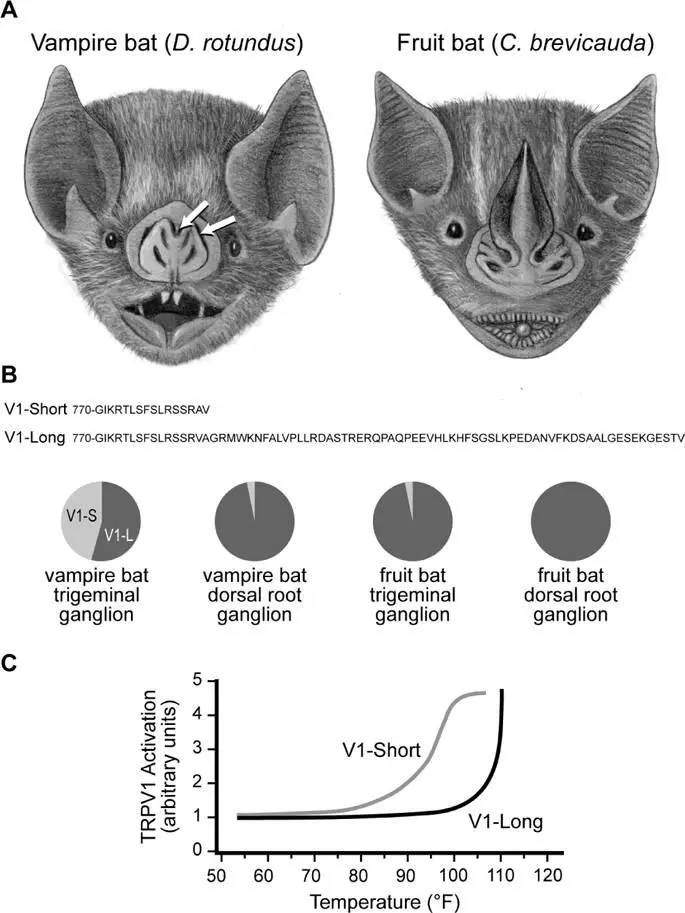
Figure 5.3A modified supersensitive form of TRPV1 allows vampire bats to detect infrared radiation. (A) Vampire bats, which can detect infrared radiation, have nasal pits, indicated by arrows, while fruit bats, which cannot detect infrared radiation, do not. (B) The amino acid sequence of the carboxy-tail-end of two alternatively spliced forms of TRPV1, the super-heat-sensitive short form and the normally heat-sensitive long form. The short form is highly expressed in neurons from the trigeminal ganglion that innervate the face (including the nasal pits) but not in the dorsal root ganglion neurons that innervate the body of the vampire bat. (C) When artificially expressed in kidney cells grown in a dish, the supersensitive short form of TRPV1 begins to be activated at 86°F while the long form is activated only at temperatures above 109°F. Adapted from E. O. Gracheva, J. F. Cordero-Morales, J. A. Gonzales-Carcacia, N. T. Ingolia, C. Manno, C. I. Aranguren, J. S. Weissman, and D. Julius, “Ganglion-specific splicing of TRPV1 underlies infrared sensation in vampire bats,” Nature 476 (2011): 88–91, with permission of Nature Publishing Group.
The lovely result is that the vampire bat has evolved a supersensitive form of TRPV1 to enable it to detect infrared radiation for feeding. But what does this mean for the rest of its body? After all, the vampire bat needs to detect heat in other body parts as well. When dorsal root ganglia—clusters of neurons that innervate nonface areas—were examined, they showed only trace amounts of the supersensitive short form of TRPV1. This explains why vampire bats can maintain normal thermal sensitivity in other body regions that are not used for locating a blood meal.

I’m sure that you’ve been lying awake pondering this question: If you blindfold a rattlesnake, can it still accurately strike its prey? Thanks to a group of intrepid researchers led by Peter Hartline at the University of Illinois at Urbana-Champaign, we know the answer. These investigators (carefully) blindfolded their rattlesnakes and placed them on a pedestal at the center of a circular enclosure. Then they induced them to strike by jiggling a heat source (the hot tip of a soldering iron) in an enticing fashion to mimic the movements of a warm-blooded animal. The soldering iron was placed at various angles in the direction the snake was facing and just outside of striking range (about three feet away). Even with both eyes completely covered, the snake was able to strike accurately, within five degrees of the target. As the authors of this study noted, “This is very impressive, and for a mouse it is deadly.” 21
How does the rattlesnake accomplish this? It’s not by the sense of smell: The snakes will strike accurately at a warm, odorless object or one that is completely encased in an odor-blocking shield. However, if you place the warm object behind a special pane of glass that blocks infrared radiation, it can no longer strike accurately. Like vampire bats, rattlesnakes can sense the infrared radiation emitted from warm objects. Rattlesnakes, however, are much more sensitive and are able to detect warm objects at a maximum distance of about 39 inches, compared to 6 inches for vampire bats. The structure that confers the infrared sensitivity of the rattlesnake is the pit organ, a small cavity located between the eye and the nostril (figure 5.4). If the pit organs on each side are covered or damaged, then the rattlesnakes can no longer strike accurately when they are blindfolded or placed in the dark. Rattlesnakes are not the only type of snake with an infrared-detecting pit organ. They are one species of a group of related snakes called pit vipers (subfamily Crotalinae ), which include moccasins, lanceheads, and bushmasters in the Americas and temple vipers and hundred-pace vipers in Asia.
The pit organ functions like a crude pinhole camera. There is a small aperture at the front, and a thin infrared-sensitive membrane at the rear, stretched so that there is an air space on either side of it. Figure 5.4B shows how the aperture of the pit organ restricts infrared radiation so that a source at a particular point in space will strike only a small section of the pit membrane, enabling the pit organ to form a low-resolution picture of the infrared world. The pit membrane is innervated by about seven thousand sensory fibers from the snake’s trigeminal ganglion that then carry information encoding the rattlesnake’s infrared map of the world to a part of the brain called the optic tectum, where it is combined with visual information in a fashion that aligns the visual and infrared maps (figure 5.4C). 22
Читать дальшеИнтервал:
Закладка:
Похожие книги на «Touch»
Представляем Вашему вниманию похожие книги на «Touch» списком для выбора. Мы отобрали схожую по названию и смыслу литературу в надежде предоставить читателям больше вариантов отыскать новые, интересные, ещё непрочитанные произведения.












Обсуждение, отзывы о книге «Touch» и просто собственные мнения читателей. Оставьте ваши комментарии, напишите, что Вы думаете о произведении, его смысле или главных героях. Укажите что конкретно понравилось, а что нет, и почему Вы так считаете.