David Linden - Touch
Здесь есть возможность читать онлайн «David Linden - Touch» весь текст электронной книги совершенно бесплатно (целиком полную версию без сокращений). В некоторых случаях можно слушать аудио, скачать через торрент в формате fb2 и присутствует краткое содержание. Год выпуска: 2014, ISBN: 2014, Издательство: Penguin Books Ltd, Жанр: Психология, Биология, sci_popular, на английском языке. Описание произведения, (предисловие) а так же отзывы посетителей доступны на портале библиотеки ЛибКат.

- Название:Touch
- Автор:
- Издательство:Penguin Books Ltd
- Жанр:
- Год:2014
- ISBN:9780241184059
- Рейтинг книги:4 / 5. Голосов: 1
-
Избранное:Добавить в избранное
- Отзывы:
-
Ваша оценка:
Touch: краткое содержание, описание и аннотация
Предлагаем к чтению аннотацию, описание, краткое содержание или предисловие (зависит от того, что написал сам автор книги «Touch»). Если вы не нашли необходимую информацию о книге — напишите в комментариях, мы постараемся отыскать её.
Dual-function receptors in our skin make mint feel cool and chili peppers hot. Without the brain’s dedicated centers for emotional touch, an orgasm would feel more like a sneeze—convulsive, but not especially nice. From skin to nerves to brain, the organization of our body’s touch circuits is a complex and often counterintuitive system that affects everything from our social interactions to our general health and development.
In Touch, neuroscientist and bestselling author David J. Linden explores this critical interface between our bodies and the outside world, between ourselves and others. Along the way, he answers such questions as: Why do women have more refined detection with their fingertips than men? Is there a biological basis for the use of acupuncture to relieve pain? How do drugs like Ecstasy heighten and motivate sensual touch? Why can’t we tickle ourselves? Linking biology and behavioral science, Touch offers an entertaining and enlightening answer to how we feel in every sense of the word.
Touch — читать онлайн бесплатно полную книгу (весь текст) целиком
Ниже представлен текст книги, разбитый по страницам. Система сохранения места последней прочитанной страницы, позволяет с удобством читать онлайн бесплатно книгу «Touch», без необходимости каждый раз заново искать на чём Вы остановились. Поставьте закладку, и сможете в любой момент перейти на страницу, на которой закончили чтение.
Интервал:
Закладка:

A few years after the initial identification of TRPV1, several groups used genetic engineering techniques to produce mice that lacked TRPV1 and measured their responses to capsaicin and heat. These mutant mice were found to completely lack behavioral and electrical responses to capsaicin. However, their responses to heat were diminished but not completely eliminated. For example, when their tails were placed in hot water (122°F), they eventually flicked them away, but it took four times longer than for normal mice. Likewise, the ability of inflammation to boost heat sensation was reduced but not eliminated in the mutant mice. 9These results indicate that there must be other heat sensors in addition to TRPV1.
Initially it seemed as if a satisfying explanation was in hand when a family of TRPV channels was identified with a range of heat sensitivities: TRPV4 and TRPV3, when expressed in kidney cells in a culture dish, responded to warm temperatures below the range of TRPV1. Conversely, TRPV2 responded to extreme heat (>125°F), well above the threshold for TRPV1. In this way, successive activation of various TRPV channels with different thresholds could potentially detect a range of skin temperatures encountered in real life, from tepid to warm to hot to painfully hot (figure 5.1). In addition to being expressed in free sensory nerve endings, TRPV3 and TRPV4 were also found in keratinocytes, the main cell type of the epidermis where the free nerve endings terminate. This suggested that the neighboring skin cells might play a role in helping the free nerve endings to detect gentle warmth. TRPV3, one of the gentle-warmth detectors, was also shown to be activated by compounds from a wide range of spices, including camphor, nutmeg, cinnamon, oregano, cloves, and bay leaves, some of which are associated with a perception of warmth. (As a child I was an enthusiastic consumer of Red Hots, a cinnamon-flavored candy.)
The prediction from figure 5.1 is clear: TRPV4 and TRPV3 should be required for detecting gentle warmth, and TRPV2 for extreme heat. Taken together, these three additional TRPV sensors should account for the residual heat perception present when the TRPV1 gene is deleted or the TRPV1 protein is blocked by a drug. Surprisingly, when mutant mice were created that lacked TRPV3, TRPV4, or TRPV2, either alone or in combination, they showed no significant deficit in heat perception in a wide variety of tasks. This result strongly suggests that there are even more heat detectors in the skin that we have yet to identify, and that these are likely to be molecules that are not part of the TRPV family of genes. 10
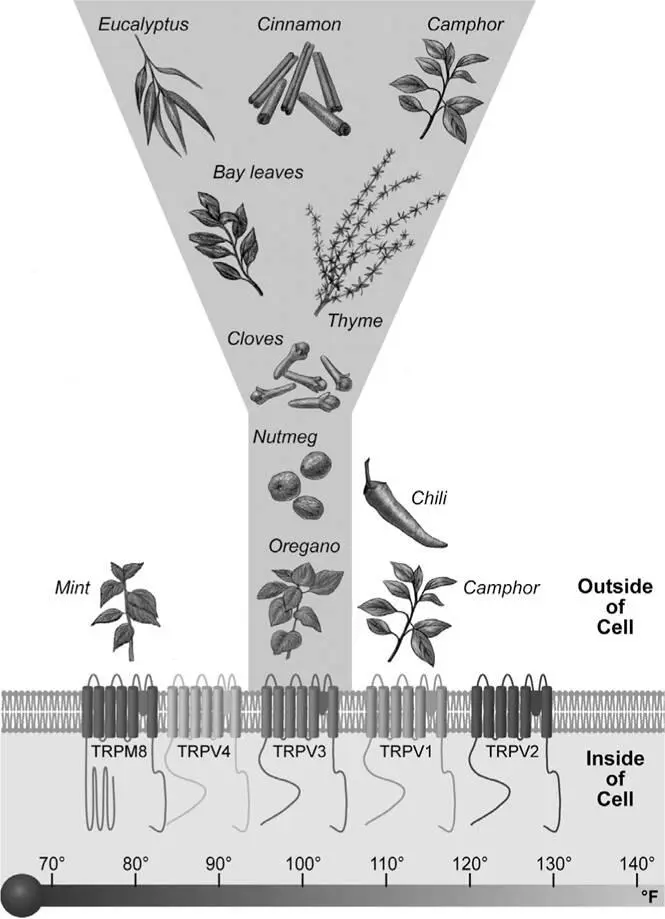
Figure 5.1A family of temperature-sensitive TRP sensors can respond to heating, cooling, and various pungent chemicals found in plants. Here, each TRP sensor is shown at a position along the thermometer where it begins to respond to heating or cooling relative to skin temperature.
Keep in mind that while core body temperature is about 99°F, temperature in the epidermal layer of the skin is about 90°F. While the TRP sensors are not identical, they share certain properties: All of them thread their way across the cell membrane six times and all have a loop structure that dips into the membrane to form an ion channel. Each TRP sensor is drawn to show its overall molecular structure. It is worth noting that the thermal activation points for all the TRP sensors are not sharp thresholds—there is quite a bit of cell-to-cell variation. Adapted from L. Vay, C. Gu, and P. A. McNaughton, “The thermo-TRP ion channel family: properties and therapeutic implications,” British Journal of Pharmacology 165 (2012): 787–801, with permission of the publisher, Wiley.
A similarly murky situation surrounds the sensation of cooling. When genetic engineering was used to create mice that lacked TRPM8, they showed a complete loss of responses to menthol and eucalyptol applied to the skin and an incomplete reduction in responses to mild cooling. In particular, their responses to gentle cooling (below 77°F) were profoundly diminished, but their responses to severe cold (less than 58°F) were normal. 11Similar to the partial effect of TRPV1 deletion of heat sensing, this result indicates that there must be additional molecular sensors for cold, particularly severe cold, that remain undiscovered. 12
When rubbed on the skin, mint feels cool and chili peppers feel hot, but what is the sensation produced by horseradish, or its Japanese cousin wasabi? It’s not exactly hot, but more like a warm pungency. Wasabi, horseradish, and yellow mustard all contain a chemical called AITC (allyl isothiocyanate), which activates a different sensor of the TRP family called TRPA1. 13Another TRPA1-activating group of compounds includes allicin and DADS (diallyl disulfide), which are found in garlic and onions and account for their effects on skin sensation, including the eye-watering response evoked by activation of TRPA1 in the cornea. 14
When I lived in Chicago in the 1980s, there was a great Italian bar on Halsted Street that served steamed garlic that you could smear on crusty bread and wash down with Moretti beer. The dish was prepared by gently removing some of the outer papery skin and then steaming the whole garlic bulb intact. Only after it was completely cooked would the chef cut it in half, around the equator, to allow the diner to scoop out the mild soft flesh of the plant from each clove with a special tiny knife. What chefs have known for years is that the pungent chemicals in garlic and onions—the ones that cause irritation of the skin and eyes—are produced only when the bulb is cut or crushed. When the bulb is intact, the enzyme that produces allicin and related pungent compounds is trapped within special compartments inside the plant cells and cannot act on its substrate. Allicin and DADS are also partially degraded by the high temperatures of cooking. This means that cooking an intact onion or garlic bulb will produce a low concentration of TRPA1-activating pungent compounds, little skin and eye irritation, and a delicious, mild appetizer. 15, 16
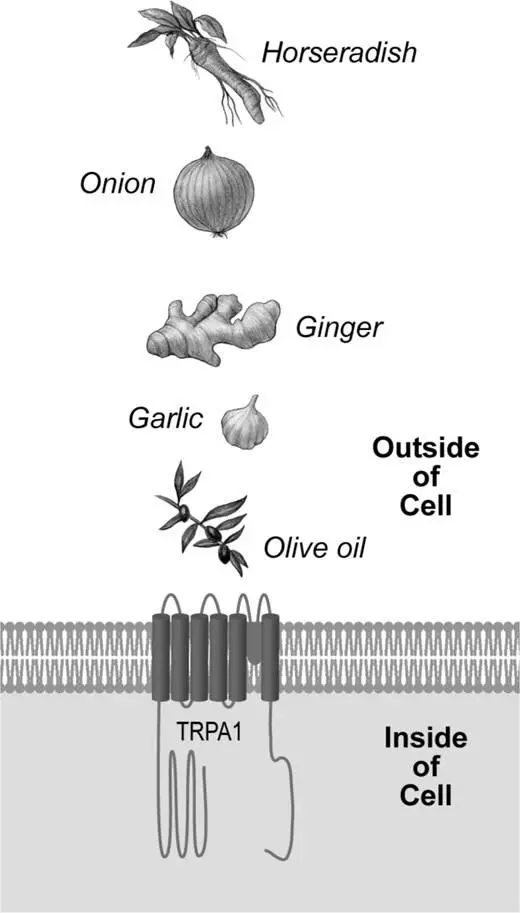
Figure 5.2The TRPA1 sensor, whimsically called the wasabi receptor, is activated by a wide variety of pungent compounds from plants, most notably wasabi, horseradish, and yellow mustard, as well as structurally similar products from onions and garlic and a structurally distinct compound, oleocanthol, found in extra-virgin olive oil. It’s interesting that several different families of plants, most notably the wasabi/horseradish/mustard family (called Brassicaceae ) and the onion/garlic/leek/shallot family (called Allioideae ) have independently evolved chemicals to activate TRPA1, presumably to reduce predation, although these compounds also have antimicrobial properties. Adapted from L. Vay, C. Gu, and P. A. McNaughton, “The thermo-TRP ion channel family: properties and therapeutic implications,” British Journal of Pharmacology 165 (2012): 787–801, with permission of the publisher, Wiley.
The prickly ash tree, Xanthoxylum , is also known as the tickle-tongue tree or the toothache tree because its sap or berries produce a numbing, tingling sensation when ingested. Indeed, the berries of Xanthoxylum , also called Szechuan peppercorns, are prized for the tingling sensation they add to spicy dishes from this region of China. These tingles suggest an interaction with sensory neurons. In both East Asia and North America, preparations of prickly ash are used as folk medicine for their anesthetic or pain-masking properties. The active ingredient of Xanthoxylum is a chemical called hydroxyl-alpha-sanshool. Considering what we have learned about the actions of other plant compounds on sensory neurons that innervate the skin, an obvious guess would be that hydroxyl-alpha-sanshool activates some type of TRP channel in these cells. This, however, is not the case. Hydroxyl-alpha-sanshool excites sensory neurons through a novel mechanism by blocking an ion channel called the two-pore potassium channel. This type of channel normally allows the slow leak of positive ions out of the neuron, so that when it is blocked, positive charge builds up quickly inside the cell, ultimately causing it to fire spikes and thereby send signals to the brain. The neurons that are activated by preparations of Xanthoxylum include C-tactile fibers, which convey light pleasant touch; the caress sensors; and the Meissner fibers, which convey vibration at moderate frequencies. It’s not entirely clear why their activation produces a tingling sensation. 17
Читать дальшеИнтервал:
Закладка:
Похожие книги на «Touch»
Представляем Вашему вниманию похожие книги на «Touch» списком для выбора. Мы отобрали схожую по названию и смыслу литературу в надежде предоставить читателям больше вариантов отыскать новые, интересные, ещё непрочитанные произведения.












Обсуждение, отзывы о книге «Touch» и просто собственные мнения читателей. Оставьте ваши комментарии, напишите, что Вы думаете о произведении, его смысле или главных героях. Укажите что конкретно понравилось, а что нет, и почему Вы так считаете.