David Linden - Touch
Здесь есть возможность читать онлайн «David Linden - Touch» весь текст электронной книги совершенно бесплатно (целиком полную версию без сокращений). В некоторых случаях можно слушать аудио, скачать через торрент в формате fb2 и присутствует краткое содержание. Год выпуска: 2014, ISBN: 2014, Издательство: Penguin Books Ltd, Жанр: Психология, Биология, sci_popular, на английском языке. Описание произведения, (предисловие) а так же отзывы посетителей доступны на портале библиотеки ЛибКат.
- Название:Touch
- Автор:
- Издательство:Penguin Books Ltd
- Жанр:
- Год:2014
- ISBN:9780241184059
- Рейтинг книги:4 / 5. Голосов: 1
-
Избранное:Добавить в избранное
- Отзывы:
-
Ваша оценка:
Touch: краткое содержание, описание и аннотация
Предлагаем к чтению аннотацию, описание, краткое содержание или предисловие (зависит от того, что написал сам автор книги «Touch»). Если вы не нашли необходимую информацию о книге — напишите в комментариях, мы постараемся отыскать её.
Dual-function receptors in our skin make mint feel cool and chili peppers hot. Without the brain’s dedicated centers for emotional touch, an orgasm would feel more like a sneeze—convulsive, but not especially nice. From skin to nerves to brain, the organization of our body’s touch circuits is a complex and often counterintuitive system that affects everything from our social interactions to our general health and development.
In Touch, neuroscientist and bestselling author David J. Linden explores this critical interface between our bodies and the outside world, between ourselves and others. Along the way, he answers such questions as: Why do women have more refined detection with their fingertips than men? Is there a biological basis for the use of acupuncture to relieve pain? How do drugs like Ecstasy heighten and motivate sensual touch? Why can’t we tickle ourselves? Linking biology and behavioral science, Touch offers an entertaining and enlightening answer to how we feel in every sense of the word.
Touch — читать онлайн бесплатно полную книгу (весь текст) целиком
Ниже представлен текст книги, разбитый по страницам. Система сохранения места последней прочитанной страницы, позволяет с удобством читать онлайн бесплатно книгу «Touch», без необходимости каждый раз заново искать на чём Вы остановились. Поставьте закладку, и сможете в любой момент перейти на страницу, на которой закончили чтение.
Интервал:
Закладка:
We experience pain as intrinsically unpleasant. In describing pain, people use emotional words like punishing , cruel , and unbearable (see the McGill Pain Questionnaire, figure 6.3). When pain occurs, we don’t experience it as a series of distinct sensory-discriminative and emotional-affective components: We experience it as a unified, unpleasant sensation. The emotional and the sensory are completely blended. However, when certain types of brain damage occur, the component parts of pain can be distinguished by affected individuals.
Selective damage to the lateral portion of the thalamus and the primary and secondary somatosensory cortices results in a syndrome in which the sensory-discriminative properties of the pain stimulus are lost. Incredibly, people with this type of damage can describe an unpleasant emotional reaction to a painful stimulus but are completely unable to resolve the quality of the pain (burning versus freezing, sharp versus dull) or even specify its location on the body. Conversely, selective damage to the posterior insula or the dorsal anterior cingulate cortex, central nodes of the affective-emotional pain circuit, can result in a condition called pain asymbolia. These patients are able to accurately report the quality, intensity, and bodily location of the painful stimulus, but they lack the negative emotional response to pain that the rest of us take for granted. Because pain asymbolics no longer appreciate the destructive significance of pain, they are slow to withdraw from a painful stimulus. They feel pain, but it just doesn’t seem to bother them:
Pricked on the right palm, the patient smiles joyfully, winces a little, and then says, “Oh, pain, that hurts.” … The patient’s expression is one of complacency. The same reaction is displayed when she is pricked in the face and stomach. Pricked on the soles of the feet, she begins to smile, openly titillated. 14
Pain asymbolics are not masochists; in fact, they are the opposite of masochists, for whom pain has deep emotional meaning. Pain asymbolics do not enjoy pain and do not seek it out. Nor are they merely spacey and inattentive. Pain simply has no emotional resonance for them, either positive or negative.
Pain is intrinsically emotional and negative, in much the same way that orgasms are intrinsically emotional and positive. Both the normal experience of orgasm and the normal experience of pain require the near-simultaneous activation of several brain regions to produce the sensation that we experience as a unified whole. Pain and orgasm require the primary and higher somatosensory cortices for the sensory-discriminative portion and another region for the affective-emotional portion: the posterior insula, anterior cingulate cortex, and associated regions for pain; and the ventral tegmental area and the targets of its dopamine neurons for pleasure. Stripped of their emotional components, pain and orgasm are rather tepid, reflexive experiences.

When I was a child, sunburn seemed like sympathetic magic. I’d spend the day at the beach, roasting in the sunshine and splashing in the waves. Then, that evening, the heat of the sun’s rays would follow me indoors, trapped in my skin, keeping me up at night and making the light touch of the bedsheets and the spray of a hot shower unbearable. Sunburn produces allodynia, a painful sensation in response to touch stimuli that are normally innocuous—like the light stroking of sunburned skin. Allodynia shares many features with another form of persistent pain called spontaneous pain, which occurs when pain is felt in the absence of any specific stimulus to the body. There are two key features of persistent allodynic pain and spontaneous pain arising from tissue damage. The first is that these forms of persistent pain will become generalized. Tissue damage from burning, for example, will make the damaged area more sensitive not only to heat but also to mechanical stimulation: If you burn the distal pad of your thumb while cooking and then try to grasp a pen to write, the innocuous mechanical stimulation will also cause pain. The second is that the inflammation that occurs in response to tissue damage (including the symptoms of swelling, redness, and the sensation of heat) will not be precisely restricted to the damaged tissue but will spread for some distance beyond it. A minor burn to the pad of your thumb, for example, may well cause the entire digit to become inflamed for days; this inflamed area, and even a bit of tissue beyond that area, will experience allodynia and spontaneous pain.
Inflammation and the persistent pain associated with it are produced by a complex brew of chemical signals called the inflammatory soup (figure 6.5). When tissue is injured, its damaged cells release a set of compounds called prostanoids, which can affect receptors like TRPV1 on the endings of C-type pain fibers. Damaged tissue can also activate white blood cells, like mast cells and macrophages, causing them to release a compound called bradykinin, which, like prostanoids, reduces the temperature threshold of TRPV1 activation from a toasty 109°F to an otherwise harmless 85°F (as discussed in chapter 5). Other compounds released from macrophages, like the proteins TNF-alpha and NGF, also act to sensitize C-type pain fibers. Activated mast cells release histamine, which targets blood vessels to dilate them and make them slightly porous to blood plasma, thus resulting in warmth, redness, and swelling of the surrounding tissue.
Initially it was thought that the nerve fibers were merely the recipients of these painful chemical signals. Now it is well established that the terminals of the pain-sensing C-fibers also signal back to the tissue in a positive feedback loop. Nerve terminals release a molecule called CGRP, which promotes blood vessel dilation and plasma leakage. They also release another molecule called substance P, which activates mast cells. The ongoing flow of chemical signals among damaged tissue, white blood cells, blood vessels, and pain-sensing C-fibers is one of the reasons why pain and inflammation can persist for days to weeks following an injury. Because these chemical signals can diffuse to neighboring healthy tissue and trigger the feedback signaling there, swelling and hyperalgesia can spread, but only in a limited fashion: While damage to your thumb may cause your hand to swell and ache, in the absence of infection, it probably won’t cause your whole arm to do so (figure 6.5).
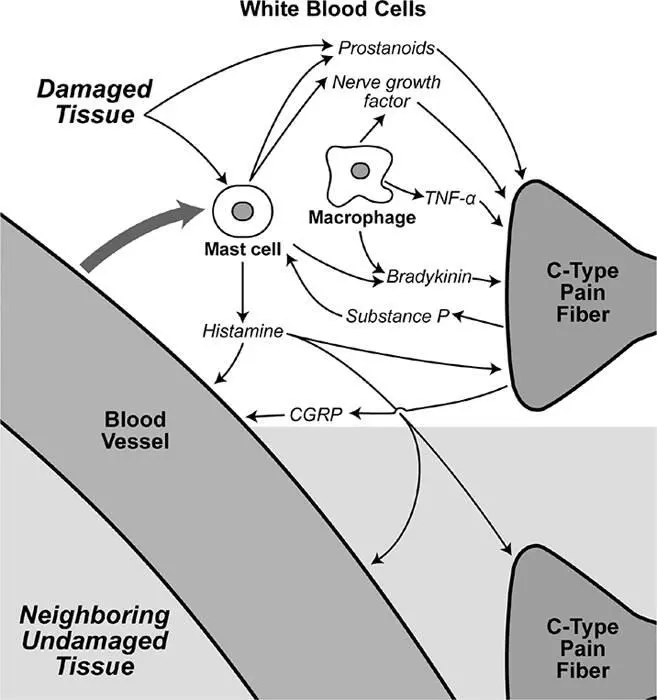
Figure 6.5Tissue damage results in production of an inflammatory soup of chemical signals. Some signals derive from the damaged tissue itself (like keratinocyte cells in skin), while others originate from white blood cells (macrophages and mast cells), and yet others are secreted by the C-type pain-sensing nerve fibers. The end result of all this is a positive feedback loop that causes pain and inflammation to persist and spread, in part through the diffusion of the signaling molecule histamine. Drugs to blunt pain and inflammation often act to block certain parts of this chemical-signaling network. While this diagram may look complex, and it is, there are many additional components of the inflammatory soup that are not shown here.
Many of our most useful drugs for treating pain and inflammation act on chemical signals in the inflammatory soup. Aspirin, acetaminophen (Tylenol), and ibuprofen all inhibit the production of prostanoids. Antihistamines block the action of histamine on its receptors on nerve terminals and blood vessels. In recent years drugs that interfere with TNF-alpha signaling have revolutionized the treatment of rheumatoid arthritis pain. Drugs that disrupt the action of NGF hold great promise of relieving persistent pain and are presently in clinical trials, but they seem to accelerate the degeneration of the joints, so it is unclear whether they will ultimately be effective. 15Compounds extracted from pineapple and aloe can interfere with the action of bradykinin. It’s possible that they may have therapeutic uses or may serve as a template for the design of bradykinin-blocking drugs inspired by the structure of these natural compounds. Developing drugs to interfere with additional compounds in the inflammatory soup will continue to be an important endeavor.
Читать дальшеИнтервал:
Закладка:
Похожие книги на «Touch»
Представляем Вашему вниманию похожие книги на «Touch» списком для выбора. Мы отобрали схожую по названию и смыслу литературу в надежде предоставить читателям больше вариантов отыскать новые, интересные, ещё непрочитанные произведения.












Обсуждение, отзывы о книге «Touch» и просто собственные мнения читателей. Оставьте ваши комментарии, напишите, что Вы думаете о произведении, его смысле или главных героях. Укажите что конкретно понравилось, а что нет, и почему Вы так считаете.