Robert Reed - Marrow
Здесь есть возможность читать онлайн «Robert Reed - Marrow» весь текст электронной книги совершенно бесплатно (целиком полную версию без сокращений). В некоторых случаях можно слушать аудио, скачать через торрент в формате fb2 и присутствует краткое содержание. Год выпуска: 2000, ISBN: 2000, Издательство: Tor Books, Жанр: Фантастика и фэнтези, на английском языке. Описание произведения, (предисловие) а так же отзывы посетителей доступны на портале библиотеки ЛибКат.
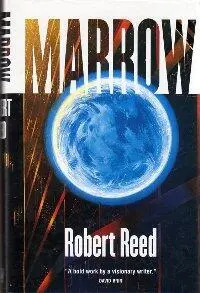
- Название:Marrow
- Автор:
- Издательство:Tor Books
- Жанр:
- Год:2000
- ISBN:0-312-86801-4
- Рейтинг книги:5 / 5. Голосов: 1
-
Избранное:Добавить в избранное
- Отзывы:
-
Ваша оценка:
Marrow: краткое содержание, описание и аннотация
Предлагаем к чтению аннотацию, описание, краткое содержание или предисловие (зависит от того, что написал сам автор книги «Marrow»). Если вы не нашли необходимую информацию о книге — напишите в комментариях, мы постараемся отыскать её.
Marrow — читать онлайн бесплатно полную книгу (весь текст) целиком
Ниже представлен текст книги, разбитый по страницам. Система сохранения места последней прочитанной страницы, позволяет с удобством читать онлайн бесплатно книгу «Marrow», без необходимости каждый раз заново искать на чём Вы остановились. Поставьте закладку, и сможете в любой момент перейти на страницу, на которой закончили чтение.
Интервал:
Закладка:
Washen wouldn’t think of it any other way now.
A few more quiet steps, and she found herself staring at the largest virtue tree that she had ever seen. Age must have killed it, and rot had brought it down, splitting the canopy as it crumbled. Adult children and their little brothers and sisters had assembled in that pool of brilliant blue-white sky-light, standing in clumps and pairs, some wearing hammerwing tails shoved into their hair. Soft quick voices merged into a senseless buzz. Till was there, pacing back and forth on the wide black trunk. He looked fully adult, ageless and unexceptional, wearing a simple breechcloth and two bracelets, one of steel and the other gold. His dark braids resembled a long rope. His young, almost pretty face showed a timid, self-conscious expression that gave Wishen the strangest little moment of hope. Maybe this was nothing but the old game swollen up into some kind of social gathering. Till would perform for the children, telling his elaborate stories that no sensible mind could believe but that everyone, in one fashion or another, would take pleasure from.
Locke didn’t look back or say a word. He simply pressed ahead, through a low wall of lambdas and out into the bright busy clearing.
“Hello, Locke,” said twenty voices.
He said. “Hello,” once, loudly, then joined the oldest children in front.
Obeying their promise, his parents knelt in the jungle, ignoring the hiss and sputter of a thousand little bugs. Nothing happened.
A few more children filtered into view, and there was quiet conversation, and Till, oblivious to it all, continued to pace. Maybe this was all that would happen. It was certainly easy to hope so.
Till stopped.
In an instant, the worshipers fell silent.
With a quiet voice, Till asked, “What do we want?”
“What is best for the ship,” the children answered, each with his own quiet voice. Then together, in one voice, they said, “Always.”
“How long is always?”
“Longer than we can count.”
“How far is always?”
“To the endless ends.”
“Yet we live—”
“For a moment!’ they cried. “If that long!”
The words were absurd, and chilling. What should have sounded ludicrous to Washen wasn’t, the prayer acquiring a muscular credibility when hundreds were speaking in a smooth chorus, every syllable endowed with a practiced surety.
“What is best for the ship,” Till repeated.
But the words were a question. His narrow and very appealing face was filled with a curiosity, a genuine longing.
Quietly, he asked his audience, “Do you know the answer?”
In a muddled shout, the children said, “No.”
“Do I know the answer?”
Quiedy, respectfully, they told him, “No.”
“True, and true,” their leader professed. “But when I’m awake, I am searching for what is best. Best for our great ship, and for always. And when I sleep, my dream self does the same.”
“And so do we,” his followers chanted.
Then Washen thought, No, it wasn’t a chant. It was too disheveled and honest-sounding, each one of them making the solemn vow to himself.
There was a brief, unnerving pause.
Then Till asked, “Do we have business today?”
“We have newcomers!’ someone cried out.
For a slippery instant, Washen thought they meant her and Diu. She glanced over her shoulder, looking at Diu for the first time: he appeared calm in that electric, perpetually busy way of his, and he seemed thankful for the look. One hand took her by the arm as Till’s voice shouted, “Bring them up here.”
The newcomers were genuine children. Seven-year-old twins, as it happened. Brother and sister climbed the rotting trunk slowly, as if terrified, trembling hands clinging to the fluted velvet-black bark. But Till offered his hands, and with a crisp surety, he suggested deep breaths. “We’re your brothers and sisters,” he reminded them, more than once. Then when they finally smiled, he asked, “Do you know about the ship?”
The little boy glanced at the sky, saying, “It’s very old.”
“Nothing is older,” Till confided.
“And it’s huge.”
“Nothing can be larger. Yes.”
His sister fingered her navel, waiting to feel brave. When Till looked at her, she lifted her gaze and told everyone, “It’s where we came from. The ship is.”
The audience laughed at her.
Till lifted a hand, bringing silence.
Her brother corrected her. Quietly and fiercely, he said, “The captains came from there. Not us.”
Till nodded, waiting.
“But we’re going to help them,” the boy added, infinitely pleased with that destiny. “We’ll help them get back up to the ship. Soon.”
There was a prolonged and very cold silence.
Till allowed himself a patient smile, patting both of their heads. Then he looked out at his followers, asking, “Is he right?”
“No,” they roared.
The siblings winced and tried to vanish.
Till knelt between them, and with a steady, untroubled voice said, “The captains are just the captains. But you and I and all of us here… we are built from the stuff of this world, from its flesh and water and air… and from the old souls of the Builders, too…”
Washen hadn’t heard that nonsense in a quarter of a century, and hearing it now, she couldn’t decide whether to laugh or explode.
“We are the Builders reborn,” Till assured everyone. Then he stood, and with his hands fondly draped over the children’s slumping shoulders, he hinted at the true scope of this rebellion. “Whatever our purpose is, it is not to help the captains. That is the one truth about which I am certain.”
Staring off into the shadowy jungle, he exclaimed, “The captains only think they have a tight hold on the ship. But friends, if you will… think of all the wonders that can happen in a single day…!”
Miocene refused to believe any of it.
“First of all,” she told Washen, and herself, “I know my own son. What you’ve described is ridiculous. Ludicrous. And frankly, stupid. Second of all, according to your count, this rally involved more than half of our children—”
Diu interrupted. “Most of them are adults. With their own homes.” Then he added, “Madam,” and framed the word with quick nods.
An angry silence descended.
Then Washen admitted, “I checked. Several dozen children slipped out of the nurseries last night—”
“And I’m not claiming they didn’t. And I’m very sure they slipped off somewhere.” Then with a haughty expression, Miocene asked, “Will the two of you listen to me? Will you give me that much consideration, please?”
“Of course, madam,” said Diu.
“I know what’s possible. I know exactly how my child was raised, and I know his character, and unless you can offer me some credible motivation for this fable… this shit… then I think we’ll just pretend that nothing has been said here…”
“What about my motivation?” asked Washen. “Why would I tell such a story?”
With a chill delight, Miocene said, “Greed.”
“Toward who?”
“Believe me, I understand.” The sullen eyes narrowed, silver glints in their corners. “If Till is insane, your son stands to gain. Status among his peers, at the very least. And eventually, genuine power.”
Washen glanced at Diu.
They hadn’t mentioned Locke’s role as informant, and they’d keep it secret as long as possible—for a tangle of reasons, most of them selfish.
They were inside the Submaster’s one-room house. The place felt small and crowded, its nervous air nearly too hot to breathe. There was a shabbiness here, despite the fact that Miocene kept every surface as clean as possible. A shabbiness, and a deep weariness, and in the darkest corners, there was a cold, living fear. Washen could almost see the fear staring out at her with its dim red eyes.
Читать дальшеИнтервал:
Закладка:
Похожие книги на «Marrow»
Представляем Вашему вниманию похожие книги на «Marrow» списком для выбора. Мы отобрали схожую по названию и смыслу литературу в надежде предоставить читателям больше вариантов отыскать новые, интересные, ещё непрочитанные произведения.





Обсуждение, отзывы о книге «Marrow» и просто собственные мнения читателей. Оставьте ваши комментарии, напишите, что Вы думаете о произведении, его смысле или главных героях. Укажите что конкретно понравилось, а что нет, и почему Вы так считаете.