Robert Reed - Marrow
Здесь есть возможность читать онлайн «Robert Reed - Marrow» весь текст электронной книги совершенно бесплатно (целиком полную версию без сокращений). В некоторых случаях можно слушать аудио, скачать через торрент в формате fb2 и присутствует краткое содержание. Год выпуска: 2000, ISBN: 2000, Издательство: Tor Books, Жанр: Фантастика и фэнтези, на английском языке. Описание произведения, (предисловие) а так же отзывы посетителей доступны на портале библиотеки ЛибКат.
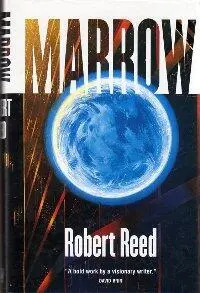
- Название:Marrow
- Автор:
- Издательство:Tor Books
- Жанр:
- Год:2000
- ISBN:0-312-86801-4
- Рейтинг книги:5 / 5. Голосов: 1
-
Избранное:Добавить в избранное
- Отзывы:
-
Ваша оценка:
Marrow: краткое содержание, описание и аннотация
Предлагаем к чтению аннотацию, описание, краткое содержание или предисловие (зависит от того, что написал сам автор книги «Marrow»). Если вы не нашли необходимую информацию о книге — напишите в комментариях, мы постараемся отыскать её.
Marrow — читать онлайн бесплатно полную книгу (весь текст) целиком
Ниже представлен текст книги, разбитый по страницам. Система сохранения места последней прочитанной страницы, позволяет с удобством читать онлайн бесплатно книгу «Marrow», без необходимости каждый раз заново искать на чём Вы остановились. Поставьте закладку, и сможете в любой момент перейти на страницу, на которой закончили чтение.
Интервал:
Закладка:
She lifted her head.
The motion was so abrupt that the room suddenly fell silent. A flock of jade-crickets broke into song, then, as if sensing a breach in etiquette, stopped.
“Assuming some kind of expansion,” Miocene told her captains, “this world of ours has grown a little less than a kilometer since the Event. And at this rate, assuming that Marrow can maintain this modest pace for another five thousand years… in another five millenia, the world will fill this entire chamber, and we’ll be able to walk back to our base camp.”
In her own grim, determined way, Miocene laughed.
“And after that,” she whispered, “if need be… we’ll be able to walk all the way home…”
Fourteen
It was sleeptime for the children.
Washen intended to visit the nursery. But as she approached she heard the gentle murmurs of a voice, and she hesitated, then eased closer, an adult caution and her own curiosity making a game out of this routine chore.
The community nursery was built from iron blocks and iron bricks, black umbra wood making the steeply pitched roof. Next to the cafeteria, this was the largest structure in the world, and easily the most durable. Washen leaned against the wall, an ear to one of the little shuttered windows, listening carefully, realizing that it was the oldest boy who was speaking, telling everyone a story.
“We call them the Builders,” he was explaining. “That’s our name for them because they built the ship and everything within it.”
“The ship,” whispered the other children, in one voice.
“The ship is too large to measure,” he assured them, “and it is nothing but beautiful. Yet when it was new, there was no one to share it with. There were only the Builders, and they were proud, and that’s why they called out into the darkness, inviting others to come fill its vastness. To come see what they had done and sing about their lovely creation.”
Washen leaned against the wall, smelling the shutter’s sweet wood.
“Who came from the darkness?” asked that oldest boy. “The Bleak,” dozens of voices answered instantly. “Was there anyone else?”
“No one.”
“Because the universe was so young,” the boy explained. With utter confidence, he picked his own odd course through what the captains had taught him. “Everything was new, and there were only the Bleak and the Builders.”
“The Bleak,” one little girl repeated, with feeling.
“They were a cruel, selfish species,” the boy maintained. “But they always wore smiles and said careful words. They came and sang praises to our lovely ship. But what did they want? Even from the earliest moment?”
“To steal our ship,” the others answered.
“In the night, as the Builders slept unaware,” he said with a practiced foreboding, “the Bleak attacked, slaughtering most of them while they lay helpless in their beds.”
Every child whispered, “Slaughtered.”
Washen eased her way closer to the nursery door. Each child had his own little bed positioned according to some personal logic. Some of the beds were close together, in twos and threes and fives, while others preferred distance and a comparative solitude. Peering through the shuttered door, she found the storyteller. He was apart from the others, sitting up in his little bed, his face catching one of the bright slivers of light that managed to slip through the heavy ceiling. His name was Till. He looked very much like his mother, tall with a tall, thin face. Then he moved his head slightly, and he resembled no one but himself.
“Where did the surviving Builders go?” he asked.
“Here.”
“And from here, what did they do?”
“They purified the ship.”
“They purified the ship,” he repeated, with emphasis. “Everything above us had to be killed. The Builders had no choice whatsoever.”
There was a long, reflective pause.
“What happened to the Builders?” he asked.
“They were trapped here,” said the others, on cue.
“And?”
“They died here. One after another.”
“What died?”
“Their flesh.”
“But is flesh all that there is?”
“No!”
“What else is there?”
“Their spirits.”
“What isn’t flesh cannot die,” said that very peculiar boy.
Hands against the warm iron frame of the door, Washen waited, trying to recall when she had last taken a meaningful breath.
In a songful whisper, Till asked, “Do you know where the Builders’ spirits live?”
“Inside us,” the children replied with a palpable delight.
“We are the Builders now,” Tills voice assured them. “After the long, lonely wait, we have finally been reborn…!”
After, eight decades, life on Marrow had become glancingly comfortable and halfway predictable. Twist’s tectonics team had mapped the local plumes and vents and every major fault, and as a consequence, they knew where the iron crust was thickest and where to build homes that would linger. Food was abundant and was only going to be more so. Washen’s biologists were cultivating wild plants, and in the last few years, they had begun raising the most palatable bugs in cages and special huts. Various attempts at science, no matter how clumsy, were making gains. Miocene had been right: Marrow was expanding at a steady, almost stately pace as the buttressing fields grew weaker, and the sky’s brilliant light had already faded by more than a percentage point. Aasleen’s people, fueled by genius and sanguinity, had invented at least ten difficult schemes that would allow everyone to escape from Marrow.
It would only require another forty-nine centuries, give or take.
Children were inevitable, and essential. They brought new hands and new possibilities, and they would replace the losses inflicted by this awful place. Then once they had their own children, a slow-motion demographic onslaught would have begun.
Every female captain owed the world at least one healthy boy or girl; that was Miocene’s pronouncement.
But her words slammed up against modern physiologies. There wasn’t one viable egg or a motile sperm inside any captain. In modern society, complex medicines and delicate autodocs were used to tease long-lived people into fertility. They had neither. That’s why it took twenty years of determined research before Promise and Dream, working in their own laboratory, discovered that the black spit of a hammerwing, poisonous to most native life-forms, could induce a temporary fecundity in human beings.
There were dangers, however. A woman required very high, even toxic dosages, and the effects on a developing embryo were far from clear.
Miocene volunteered to be first.
It was an heroic act, and if successful, it would be a selfish act, her child destined to be the oldest. She ordered the two captains to collect sperm from every donor, and alone, the Submaster impregnated herself. As far as Washen could tell, no one but Miocene could be certain who Tills father was.
Miocene carried the boy for the full eleven-month term. The birth itself was uneventful, and for those first few months, Till seemed perfectly normal. He was happy and engaged, ready to smile up at any face that smiled at him. Later, as they tried to piece together events, it wasn’t apparent when the baby had changed. It must have happened slowly, and only later were the effects obvious. Till was a happy, giggling boy riding gracefully on his mother’s hard hip, and then it was a different day, and people began to notice that he was much more quiet, still riding that hip without complaint, but his gaze distant, and always, in some odd, undefinable fashion, distracted.
Hammerwing spit wasn’t to blame.
Maybe the boy would have grown up the same way on the ship. Or Earth. Or anywhere else, too. Children are never predictable, and they are never easy. In the following years, the encampment began to fill up with strangers. They were small and fierce, and they were endlessly entertaining. And more than anyone anticipated, the children were challenges to the captains’ seamless authority.
Читать дальшеИнтервал:
Закладка:
Похожие книги на «Marrow»
Представляем Вашему вниманию похожие книги на «Marrow» списком для выбора. Мы отобрали схожую по названию и смыслу литературу в надежде предоставить читателям больше вариантов отыскать новые, интересные, ещё непрочитанные произведения.







Обсуждение, отзывы о книге «Marrow» и просто собственные мнения читателей. Оставьте ваши комментарии, напишите, что Вы думаете о произведении, его смысле или главных героях. Укажите что конкретно понравилось, а что нет, и почему Вы так считаете.