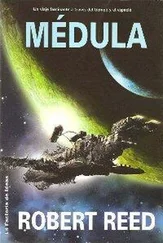
Robert Reed - Marrow
Здесь есть возможность читать онлайн «Robert Reed - Marrow» весь текст электронной книги совершенно бесплатно (целиком полную версию без сокращений). В некоторых случаях можно слушать аудио, скачать через торрент в формате fb2 и присутствует краткое содержание. Год выпуска: 2000, ISBN: 2000, Издательство: Tor Books, Жанр: Фантастика и фэнтези, на английском языке. Описание произведения, (предисловие) а так же отзывы посетителей доступны на портале библиотеки ЛибКат.
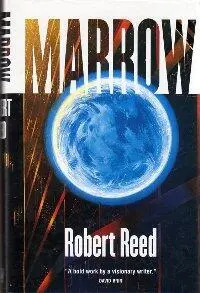
- Название:Marrow
- Автор:
- Издательство:Tor Books
- Жанр:
- Год:2000
- ISBN:0-312-86801-4
- Рейтинг книги:5 / 5. Голосов: 1
-
Избранное:Добавить в избранное
- Отзывы:
-
Ваша оценка:
Marrow: краткое содержание, описание и аннотация
Предлагаем к чтению аннотацию, описание, краткое содержание или предисловие (зависит от того, что написал сам автор книги «Marrow»). Если вы не нашли необходимую информацию о книге — напишите в комментариях, мы постараемся отыскать её.
Marrow — читать онлайн бесплатно полную книгу (весь текст) целиком
Ниже представлен текст книги, разбитый по страницам. Система сохранения места последней прочитанной страницы, позволяет с удобством читать онлайн бесплатно книгу «Marrow», без необходимости каждый раз заново искать на чём Вы остановились. Поставьте закладку, и сможете в любой момент перейти на страницу, на которой закончили чтение.
Интервал:
Закладка:
At the first sign of trouble, crab-sized, highly social beetles launched themselves in fantastic migrations, thousands and millions scrambling overland. Though, as Dream noted, the herds often went charging off in the very worst direction.
At least three predatory species, hammer-wings included, would suddenly arrive in areas soon to be abandoned. Perhaps it was an adaption to the good hunting that would come when locals rushed out of their burrows and nests.
In dangerous times, certain caterpillars sprouted wings and took up the predatory life.
And slight changes in water temperature and chemistry caused aquatic communities to panic or grow complacent. Just what those changes were, no one was certain. It would take delicate instruments and years more experience to read the signs as easily as the simplest black scum seemed to manage it.
Everything said was duly recorded. A low-grade captain sat at the far end of the table, taking copious notes on the huge bleached wings of copperflies.
Once finished, it was Miocene’s place to invite questions.
“How about our virtue trees?” asked Aasleen. “Are they behaving themselves?”
“As if they’ll live forever,” Washen replied. “They’re still early in their growth cycles, which means nothing. Eruptions can come anytime. But they’re putting their energies into wood and fat, not into gold balloons. And since their roots are deep and sensitive, they know what we can’t. I can guarantee that we can remain here for another two or three, or perhaps even four whole days.” Again, the grim laughter.
Washen’s confidence was contagious, and useful. Losing her would have been a small disaster. Yet years ago, the Master had sent this talented woman to the far side of Marrow, doing her accidental best to get rid of her.
Miocene nodded, then lifted a hand.
Quietly, almost too quietly to be heard, she said, “Cycles.”
The closest captains turned, watching her.
“Thank you, Washen.” The Submaster looked past her, and shivered. Without warning, she felt her own private eruption. Thoughts, fractal as any quake, made her tremble. Just for the briefest moment, she was happy.
Diu asked, “What was that, madam?”
Again, louder this time, Miocene said, “Cycles.”
Everyone blinked, and waited.
Then she turned to the leader of the geologic team, and with a barely hidden delight, she asked, “What about Marrow’s tectonics? Are they more active, or less?”
The leader was named Twist. He was a Second Chair Submaster, and if anything, he was more serious-minded than Miocene. With a circumspect nod, Twist announced, “Our local faults are more active. We have nothing but crude seismographs, of course. But the quakes are twice as busy as when we arrived on Marrow.”
“How about worldwide?”
“Really, madam… at this point, there’s no competent, comprehensive way for me to address that question…”
“What is it, madam?” asked Diu.
Honestly, she wasn’t absolutely certain.
But Miocene looked at each of the faces, wondering what it was about her face that was causing so much puzzlement and concern. Then quietly, in the tone of an apology, she said, “This may be premature. Rash. Perhaps even insane.” She swallowed and nodded, and more to herself than to them, she said, “There is another cycle at work here. A much larger, much more important cycle.”
There came the distant droning of a lone hammerwing, then silence.
“My self-appointed task,” Miocene continued, ‘is to keep watch on our former base camp. It’s a hopeless chore, frankly, and that’s why I don’t ask for anyone’s help. The camp is still empty. And until we can find the means, I think it will remain abandoned.”
A few of the captains nodded agreeably. One or two sipped at their pungent tea.
“We have only one small telescope, and a crude tripod.” Miocene was unfolding a copperfly wing, her long hands gently trembling as she told everyone, “I leave the telescope set on the east ridge, on flat ground inside a sheltered bowl, and all I use it for is to watch the camp. Five times every day, without exception.”
Someone said, “Yes, madam.”
Patiently, but not too patiently.
Miocene rose to her feet, spreading out the reddish wings covered with numbers and small neat words. “When we lived beneath the camp, we rarely adjusted our telescopes. Usually after a tremor or a big wind. But now that we’ve moved here, fifty-three kilometers east of original position… well, I’ll tell you… in these last weeks, I’ve twice had to adjust my telescope’s alignment. I did it again just this morning. Always nudging it down toward the horizon.”
Silence.
Miocene looked up from the numbers, seeing no one.
She asked herself, “How can that be?”
With a quiet, respectful voice, Aasleen suggested, “Tremors are throwing the telescope out of alignment. As you said.”
“No,” the Submaster replied. “The ground is flat. It’s always been flat. I’ve tested for that exact error.”
It was a steadily growing error; she saw it in the careful numbers.
Quietly, Miocene read her data. When she felt absolutely sure that she understood the answer, she asked, “What does this mean?”
Someone offered, “Marrow has started to rotate again.” The flywheel hypothesis, again.
Aasleen said,’It could be the buttresses. With a fraction of their apparent energies, they could act on the iron, causing it, and us, to move a few kilometers…”
A few kilometers. Yes.
One of Miocene’s long hands lifted high, silencing the others. “Perhaps,” she said with a little smile. “But there’s still another option. Involving the buttresses, but in a rather different fashion.”
No one spoke, or blinked.
“Imagine that the Event, whatever it was… imagine it was part of some grand cycle. And after it happened, the buttresses under our feet started to weaken. To loosen their grip on Marrow, if only just a little bit.”
“The planet expands,” said someone.
Said Washen.
“Of course,” Aasleen trumpeted. “The interior iron is under fantastic pressures, and if you took off the lid, even a little bit—”
Perhaps unconsciously, half a dozen captains inflated their cheeks.
Miocene grinned, if only for a moment. This very strange idea had taken hold of her gradually, and in the excitement of the moment, she summoned up old instincts, telling everyone. “This is premature. We’ll need measurements and many different studies, and even then we won’t be certain about anything. Not for a very long while.”
Washen glanced at the ceiling, perhaps imagining the faraway base camp.
Diu, that low-grade charmer, laughed softly. Happily. And he took his lover’s hand and squeezed until she noticed and smiled back at him.
“If the buttresses below us are weakening,” Aasleen pointed out, “then maybe the ones in the sky are getting dimmer, too.”
Twist said, “We can test that. Easily.”
Nothing was easy here, Miocene nearly warned them.
But instead of discouraging anyone, she took back those copperfly wings and her precious numbers, and with the simplest trigonometry, she interpolated a rugged Little estimate. Only in the dimmest back reaches of her mind did she hear Washen and the engineers spinning new hypotheses. If the expansion was real, perhaps it would give away clues about how the buttresses worked. Clues about what powered them, and why. Aasleen suggested that a cycle of expansion and compression was the obvious means through which excess heat, from nuclear decay or other sources, was bled away from Marrow. It might even explain how the bright buttresses overhead were refueled. The whole ad hoc hypothesis sounded perfectly reasonable. And perhaps it was even a little bit true. But its truth was inconsequential. All that mattered were the dry little answers appearing beneath Miocene’s stylus.
Читать дальшеИнтервал:
Закладка:
Похожие книги на «Marrow»
Представляем Вашему вниманию похожие книги на «Marrow» списком для выбора. Мы отобрали схожую по названию и смыслу литературу в надежде предоставить читателям больше вариантов отыскать новые, интересные, ещё непрочитанные произведения.







Обсуждение, отзывы о книге «Marrow» и просто собственные мнения читателей. Оставьте ваши комментарии, напишите, что Вы думаете о произведении, его смысле или главных героях. Укажите что конкретно понравилось, а что нет, и почему Вы так считаете.