Robert Reed - Marrow
Здесь есть возможность читать онлайн «Robert Reed - Marrow» весь текст электронной книги совершенно бесплатно (целиком полную версию без сокращений). В некоторых случаях можно слушать аудио, скачать через торрент в формате fb2 и присутствует краткое содержание. Год выпуска: 2000, ISBN: 2000, Издательство: Tor Books, Жанр: Фантастика и фэнтези, на английском языке. Описание произведения, (предисловие) а так же отзывы посетителей доступны на портале библиотеки ЛибКат.
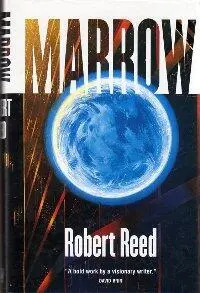
- Название:Marrow
- Автор:
- Издательство:Tor Books
- Жанр:
- Год:2000
- ISBN:0-312-86801-4
- Рейтинг книги:5 / 5. Голосов: 1
-
Избранное:Добавить в избранное
- Отзывы:
-
Ваша оценка:
Marrow: краткое содержание, описание и аннотация
Предлагаем к чтению аннотацию, описание, краткое содержание или предисловие (зависит от того, что написал сам автор книги «Marrow»). Если вы не нашли необходимую информацию о книге — напишите в комментариях, мы постараемся отыскать её.
Marrow — читать онлайн бесплатно полную книгу (весь текст) целиком
Ниже представлен текст книги, разбитый по страницам. Система сохранения места последней прочитанной страницы, позволяет с удобством читать онлайн бесплатно книгу «Marrow», без необходимости каждый раз заново искать на чём Вы остановились. Поставьте закладку, и сможете в любой момент перейти на страницу, на которой закончили чтение.
Интервал:
Закладка:
Till shrugged again, his eyes looking past her.
On the far side of the round, in front of their machine shop, a team of sweating captains fired up their latest turbine—a primitive wonder built from rough steel and vague memories, plus considerable trial and error. Homebrewed alcohols combined with oxygen, creating a delicious roar. While it was working, the engine was powerful enough to do any job they could offer it, at least for today. But it was dirty and noisy, and it was inefficient, and the sound of it almost obscured the boy’s strong voice.
“I’m not speculating,” he announced. “Not about anything.”
Washen said, “Excuse me?” as if she hadn’t heard him.
“I won’t tell you that. That I’m making it up.”
The turbine sputtered, then fell silent.
Washen nodded, smiling in a defeated way. Then she noticed an approaching figure. From the shop, wearing her old epaulets on a simple robe of handwoven fabric, Miocene looked weary as always, and angry in a thousand ways.
“I don’t make up anything,” the boy protested. His mother asked, “What don’t you do?” Till didn’t say.
For a moment, he and Washen exchanged looks, as if making a pact. Then he turned to Miocene, complaining, “That machine… it sounds awful.”
“It does. You’re right.”
“Is that how the ship is? Big engines screaming all the time?”
“No, we use fusion reactors. Very efficient and quiet, and extremely safe, too.” She glanced at Washen, asking, “Don’t we, darling?”
“Fusion, yes,” Washen offered, her hands trying to straighten the stiff fabric of her own handmade uniform. “The best reactors in the galaxy, I would think.”
Then like a trillion mothers, Miocene said, “I haven’t seen you for too long. Where have you been, Till?”
“Out there,” said Till. He waved in a distant, imprecise fashion, three of his fingers smaller than the rest. And paler. Regenerating after a little accident, no doubt.
“Were you exploring again?”
“But not far from here,” he told her. “Always in the valley’ He was lying, thought Washen. She heard the lie between the words.
Yet Miocene nodded with conviction, saying, “I know you were. I know.” It was a self-imposed delusion, or it was an act meant for public eyes.
There was an uncomfortable moment of silence. Then, the turbine fired up again and rattled along with a healthy vigor. The sound of it drew Miocene’s attention, leading her back toward the machine shop.
Washen smiled at the boy, then knelt beside him.
“You like to make up things,” she observed. “Don’t you?”
“No, madam.”
“Don’t be modest,” she warned.
But Till shook his head stubbornly, staring down at his toes and the black iron. “Madam Washen,” he said with a boy’s fragile patience. “What is, is. It’s the only thing that can never be made up.”
Fifteen
Locke waited in the shadows—a grown man with a boy’s guilty expression and the wide, resdess eyes of someone expecting disaster to lash out from every direction.
His first words were, “I shouldn’t be doing this.”
But a moment later, responding to the anticipated response, he said,’I know, Mother. Promises given are promises always.”
Washen hadn’t made a sound.
It was his father who offered second thoughts. “If this is going to create troubles,” Diu muttered, “maybe we should slip back home again.”
“Maybe you should,” their son allowed. Then he turned and abruptly walked off, never inviting them to follow, knowing they wouldn’t be able to help themselves.
Washen hurried up the path, feeling Diu in her footsteps. A young jungle of black umbra trees and elegant lambda bushes dissolved into a sudden landscape of bare iron: black pillars and arches created an indiscriminate, infuriating maze. Every step was a challenge, an act of conscious grace. Razored edges sliced exposed flesh, crisscrossing lingers and calves with thin pink wounds. Bottomless crevices beckoned to passersby, wind and dripping rainwater echoing out of the metal ground. Worst of all, Washen s body was accustomed to sleep at this hour. Fatigue slowed her senses and her common sense. When she saw Locke standing on the rusty lip of a cliff, waiting for them, she noticed nothing but his wide back and the long golden hair tied into an elaborate set of braids. She stared at the simple black shirt woven in the village loom, from mock cotton, the shirt that his mother had patched more than once, and always badly.
Until she stood beside him, Washen was oblivious to the deep valley spread out below them, long and rather narrow, its flat floor covered with a mature stand of black-as-night virtue trees.
“Black as night,” Washen whispered.
Her son rose to the bait. Shaking his head, he said, “Mother. There s no such thing.”
As night, he meant.
In his world, he meant.
This was lucky ground. When the world’s fiery guts began to pour out on all sides, this thick and durable slab of crust had fallen into the great fissure. The virtue jungle had burned but it hadn’t died. Its roots could be a century old, or older. As old as the human tenure on Marrow, perhaps. There was a rich, eternal feel to the ground, and perhaps that’s why the children had chosen it.
The children.
Washen knew better, but despite her careful intentions, she couldn’t think of them as anything but young, and in some profound sense, vulnerable.
“Quiet,” Locke whispered, not bothering to look back at them.
Who was talking here? she wondered. But she didn’t ask.
Then with nothing but his own deeply callused flesh between himself and the iron, Locke jumped from perch to perch, grunting softly with each impact, then pausing just long enough to glance up from below, blinking against the bright skylight as he added with an almost parental concern, “And keep close to me. Please.”
His parents’ field boots had fallen apart decades ago. They wore clumsy sandals made from mock cork and rubber, and they had to work to stay with him. On the valley floor, in the living shadows, the air turned slightly cooler and uncomfortably damp. Blankets of rotting vegetation had fallen from the canopy, leaving the ground watery-soft, a rotting organic stink still smelling utterly alien to Washen. A giant daggerwing roared past, intent on some vital business. Washen watched the animal vanish into the gloom, then reappear, tiny with the distance, its cobalt-blue carapace shining in a patch of sudden skylight.
Locke turned abruptly, silently.
A single finger lay against his lips. Just for a moment, in that light, he looked like his father. But what Washen noticed most was his expression, his gray eyes showing a pain and worry so intense that she had to try and reassure him with a touch.
Diu had wormed the secret out of their son. The children were meeting in the jungle, and these meetings had been going on for more than twenty years. At irregular intervals, Till would call them to a secluded location, and it was Till who controlled everything that was said and done.
“What’s said?” Washen had asked. “What’s done?”
Locke wouldn’t explain. First he shook his head with defiance and shame. Then with a quiet disappointment, he admitted to them, “I’m breaking my oldest promise by repeating any of this.”
“Then why tell?” she had pressed.
“Because.” Locke’s expression was complicated, his soft gray eyes changing with each blink. Finally a compassionate, halfway fearful look settled on him, and he explained, “You have every right to hear. So you can decide for yourselves.”
He cared for his parents. That’s why he broke his promise, and that’s why he had no choice but to bring them here.
Читать дальшеИнтервал:
Закладка:
Похожие книги на «Marrow»
Представляем Вашему вниманию похожие книги на «Marrow» списком для выбора. Мы отобрали схожую по названию и смыслу литературу в надежде предоставить читателям больше вариантов отыскать новые, интересные, ещё непрочитанные произведения.




Обсуждение, отзывы о книге «Marrow» и просто собственные мнения читателей. Оставьте ваши комментарии, напишите, что Вы думаете о произведении, его смысле или главных героях. Укажите что конкретно понравилось, а что нет, и почему Вы так считаете.