Robert Reed - Marrow
Здесь есть возможность читать онлайн «Robert Reed - Marrow» весь текст электронной книги совершенно бесплатно (целиком полную версию без сокращений). В некоторых случаях можно слушать аудио, скачать через торрент в формате fb2 и присутствует краткое содержание. Год выпуска: 2000, ISBN: 2000, Издательство: Tor Books, Жанр: Фантастика и фэнтези, на английском языке. Описание произведения, (предисловие) а так же отзывы посетителей доступны на портале библиотеки ЛибКат.
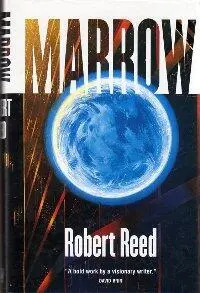
- Название:Marrow
- Автор:
- Издательство:Tor Books
- Жанр:
- Год:2000
- ISBN:0-312-86801-4
- Рейтинг книги:5 / 5. Голосов: 1
-
Избранное:Добавить в избранное
- Отзывы:
-
Ваша оценка:
Marrow: краткое содержание, описание и аннотация
Предлагаем к чтению аннотацию, описание, краткое содержание или предисловие (зависит от того, что написал сам автор книги «Marrow»). Если вы не нашли необходимую информацию о книге — напишите в комментариях, мы постараемся отыскать её.
Marrow — читать онлайн бесплатно полную книгу (весь текст) целиком
Ниже представлен текст книги, разбитый по страницам. Система сохранения места последней прочитанной страницы, позволяет с удобством читать онлайн бесплатно книгу «Marrow», без необходимости каждый раз заново искать на чём Вы остановились. Поставьте закладку, и сможете в любой момент перейти на страницу, на которой закончили чтение.
Интервал:
Закладка:
Miocene stood alone, almost forgotten.
While the captains and the loyal children hurried south together, making for the nearest safe ground, the Submaster remained rooted in the center of the round, speaking with a thin, dry, weepy voice.
“We’re getting closer,” she declared.
“What do you mean?” Washen asked.
“Closer,” she said again. Then she looked up into the brilliant sky, arms lifting high and the hands reaching for nothing.
With a gentle touch, Washen tried to coax her.
“We have to hurry,” she cautioned. “We should already be gone, madam.”
But Miocene picked herself up on her toes, reaching even higher, fingers straightening, eyes squinting, as she leaked a low, pained laugh.
“But not close enough,” she whimpered. “No, not quite. Not yet. Not yet.”
Sixteen
One of the sweet problems about an exceedingly long life was what to do with your head. How do you manage, after many thousands of years, that chaotic mass of remembered facts and superfluous memories?
Just among human animals, different cultures settled on a wide range of solutions. Some believed in carefully removing the redundant and the embarrassing—a medical procedure often dressed up in considerable ceremony. Others believed in sweeping purges, more radical in nature, embracing the notion that a good pruning can free any soul. And there were even a few harsh societies where the mind was damaged intentionally and profoundly, and when it would heal again, a subtly new person would be born.
Captains believed in none of those solutions.
What was best, for their careers and for the well-being of their passengers, was a skilled, consistent mind filled with minute details. “Forget nothing,” was their impossible ideal. Ruling any ship required mastery over detail and circumstance, and nobody could predict when her trusted mind would have to yank some vital but obscure fact out of its recesses, the captain—if she was any sort of captain—accomplishing her job with the predictable competence that everyone righdy demanded of her.
Miocene was forgetting how to be a captain.
Not in a serious or unexpected way. Time and the intensity of her new life naturally shoved aside old memories. But after more than a century on Marrow, she could feel the erosions of small, cherished talents, and she found herself worrying about her eventual return to duty, wondering if she could easily fill her old seat.
Which captains last earned the Master’s award, and for what?
Past the most recent fifty winners, she wasn’t certain.
What was that jellyfish species that lived in the cold ammonia-water Alpha Sea? And that robotic species that lived in special furnaces, and that at room temperature would freeze rigid? And that software species, dubbed Poltergeists for its juvenile sense of humor… where did it come from originally?
Little details, but to millions of souls, utterly vital.
There was a human population in the Smoke Canyons… antitechnologest who went by the name of… what…? And they were founded by whom…? And how did they accept living entirely dependent upon the greatest machine ever built…?
Five course adjustments should have been made in the last hundred-plus years—all previously scheduled, all minor. But even though the ship’s course was laid out with a delicate precision, stretching ahead for twenty millennia, Miocene could bring to mind only the largest of the burns.
Little more than an informed passenger, she was.
Of course plenty will have changed before she returned. Ranks and faces, and honors, and perhaps even the ship’s exact course… all were subject to contingencies and hard practicalities, and every important decision, as well as the trivial ones, were being made without Miocene’s smallest touch…
Or perhaps, no decisions were being made.
She had heard the whispered speculations. The Event had purged the ship of all life, leaving it as a derelict again. That explained the lack of any rescue mission. The Master and crew and that myriad of ill-matched passengers had evaporated in a terrible instant, every apartment and great hallway left sterile and pure. And if there was a local species that was brave enough or foolish enough to board the ship today, it would probably take aeons for them to find their way down to this horrible wasteland.
Why was that such an appealing image?
Because it did appeal to Miocene, particularly in her blackest moments.
After Till and the other Waywards abandoned her, she found the possibility comforting: total carnage. Billions dead. And what was her own tragedy but a small thing? A sad detail in the ship’s great history. And since it was only a detail, there was the credible, intoxicating hope that she could forget the horrible things that her son had said to her, and how he had forced her to banish him, and she would eventually stop having these poisonous moments when her busy, cluttered mind was suddenly thinking of him.
Miocene’s diary began as an experiment, an exercise that she gave little hope. At the arbitrary end of each day, sitting alone in the shuttered darkness of her present house, she would fill the long stiff tail of a tasserbug with fresh ink, then using her smallest legible print, she would record the day’s important events.
It was an ancient, largely discredited trick.
As a means of enhancing memory and recording history, the written word had been supplanted by digitals and memochips. But like everything else in her immediate life, this technology had been resurrected, if only for this little while.
“I hate this place.”
Those were her first words and among her most honest.
Then to underscore her consuming hatred, she had listed the captains who were killed by Marrow, and the horrible causes of death, filling the rough bone-colored paper with livid details, then folding each sheet and slipping it inside an asbestos pouch that she would carry with her when this house and setdement were abandoned.
The experiment gradually became a discipline.
Discipline bled into a sense of duty, and after ten years of fulfilling her duty, without fail, Miocene realized that she truly enjoyed this writing business. She could tell the page whatever she wished, and the page never complained or showed doubt. Even the slow, meticulous chore of drawing each letter had a charm and a certain pleasure. Each evening, she began with the day’s births and deaths. The former outnumbered the latter by a fat margin. Many of her captains were having new children, and their oldest offspring—the rare ones who had proved loving and loyal—were throwing themselves into their own brave spawning. Marrow was a hard world, but productive, and its humans had become determined and prolific. Births outnumbered deaths by twentyfold, and the gap was only growing. It was the rare captain who didn’t offer eggs or sperm to the effort. Of course if there was a shortfall, Miocene would have commanded total compliance. Even quotas. But that wasn’t a necessary sacrifice, thankfully. And more to the point, that freedom allowed Miocene to be one of the captains who chose not to offer up another son or daughter to this demographic tidal wave.
Once was ample; more than ample, frankly.
Another captain scarred by her experience was Washen. At least that was Miocene’s assumption. Both had sons running with the Waywards. Both knew the dangers inherent in giving birth to another soul. This was why humans so often embraced immortality, Miocene had decided. They wanted to keep responsibility for the future where it belonged, with finished souls who were proven and trustworthy.
“That’s not my excuse,” Washen had replied, anger framed with a careful half-smile.
Quiedy, firmly, Miocene had repeated that inappropriate word. “Excuse?” she said. “Excuse?” Then she shook her head and took a sip of scalding tea, asking, “What exactly do you mean by ‘excuse’?”
Читать дальшеИнтервал:
Закладка:
Похожие книги на «Marrow»
Представляем Вашему вниманию похожие книги на «Marrow» списком для выбора. Мы отобрали схожую по названию и смыслу литературу в надежде предоставить читателям больше вариантов отыскать новые, интересные, ещё непрочитанные произведения.







Обсуждение, отзывы о книге «Marrow» и просто собственные мнения читателей. Оставьте ваши комментарии, напишите, что Вы думаете о произведении, его смысле или главных героях. Укажите что конкретно понравилось, а что нет, и почему Вы так считаете.