Robert Reed - Marrow
Здесь есть возможность читать онлайн «Robert Reed - Marrow» весь текст электронной книги совершенно бесплатно (целиком полную версию без сокращений). В некоторых случаях можно слушать аудио, скачать через торрент в формате fb2 и присутствует краткое содержание. Год выпуска: 2000, ISBN: 2000, Издательство: Tor Books, Жанр: Фантастика и фэнтези, на английском языке. Описание произведения, (предисловие) а так же отзывы посетителей доступны на портале библиотеки ЛибКат.
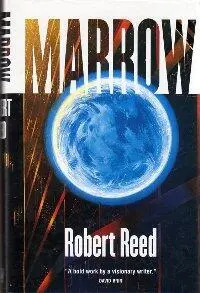
- Название:Marrow
- Автор:
- Издательство:Tor Books
- Жанр:
- Год:2000
- ISBN:0-312-86801-4
- Рейтинг книги:5 / 5. Голосов: 1
-
Избранное:Добавить в избранное
- Отзывы:
-
Ваша оценка:
Marrow: краткое содержание, описание и аннотация
Предлагаем к чтению аннотацию, описание, краткое содержание или предисловие (зависит от того, что написал сам автор книги «Marrow»). Если вы не нашли необходимую информацию о книге — напишите в комментариях, мы постараемся отыскать её.
Marrow — читать онлайн бесплатно полную книгу (весь текст) целиком
Ниже представлен текст книги, разбитый по страницам. Система сохранения места последней прочитанной страницы, позволяет с удобством читать онлайн бесплатно книгу «Marrow», без необходимости каждый раз заново искать на чём Вы остановились. Поставьте закладку, и сможете в любой момент перейти на страницу, на которой закончили чтение.
Интервал:
Закладка:
In secret, it occurred to each of them that they would die today. But none could find the simple courage to admit what they were thinking, and each heard herself or himself coaxing the others to hurry, squinting into the black clouds, lying when they claimed, “I can see the mountains.”
Saying, “It isn’t far now, I think.”
I hope.
Using a homing beacon, they found their firesuits and air tanks. Without that simple precaution, they would have stumbled past the cache, the landscape already transformed by the wildfires.
Everyone dressed, not one of the suits fitting properly.
But who cared if there were gaps in the seams, and the brutal heat was leaking inside too quickly? They were brave, and they were hopelessly together in this undertaking, and as if Marrow were trying to entertain them, a sudden vent opened up nearby, letting a deep plume of molten red-hot metal slip a finger out into the open air, under pressure, hot enough to make unshielded eyes blink, running like a river down the floor of the doomed valley.
“Closer,” the children screamed at each other. “Get closer.”
They didn’t bother with safety lines or lifeguards. What mattered was to get near the shoreline, watching the blazing iron push downhill, feeling its enormous, irresistible weight through your sweating toes.
Like a living monster, it was.
And like all good monsters, it possessed a surprising, intriguing beauty.
With a massive grace, the river melted the ground beneath it. Ancient tree trunks evaporated in its presence. Chunks of cold iron were tossed into the river, sinking where it was deep. Larger knobs and boulders of iron resisted the flow for an instant or two, then were shoved downstream with a plaintive screeching scream.
One boy crept up behind a spellbound girl—the subject of a little crush—and with both hands, he gave her a hard little shove.
Then he grabbed her.
She howled and jabbed him with both elbows, then tried to turn around. But she was clumsy in that heavy misfitting suit, one boot slipping and her body yanked free of the fond grip, tumbling back toward the molten metal until she grabbed the boy’s belt, yanking him hard toward her.
For an instant, they hung in the incandescent air. Then they fell slowly and clumsily onto the cooler ground, laughing in each other’s arms, the simple raw danger of the moment leaving them in love.
While the other children played by the river, they slipped away.
On a burnt hillside, wearing nothing but the thick-soled boots, they made love. He was behind her, holding her against him by her hips, then her hard little breasts. They didn’t dare sit; the ground was far too hot. There were moments when the fumes rose and found them, and they would suck at the bottled air, or they would hold their breath, feeling a quick dizzyness that became a warm electric buzz as their physiologies coped with the lack of oxygen.
Eventually, the game lost its intoxicating charm.
The urgency had left them. Little regrets started to nag. To obscure their feelings, they talked about the grandest imaginable things. The girl pulled up her insulated trousers, asking, “Where are you going to live afterward?”
When we reach the ship, she meant.
“By that big sea,” the boy replied. “The one where the captains first lived.”
It was a common response. Everyone knew about the great bodies of water, the illusion of an endless blue sky suspended overhead. The most artistic captains had done paintings, and without exception, the grandchildren were in awe of the idea that there could be so much water, and it would be so clean, and that living inside it would be great creatures like those mythical whales and squid and tuna.
Running a hand across her lover’s Gordian bun, the girl confessed, “I’m going to live outside the ship.”
“On another world?”
She shook her head. “No. I mean on the ship’s hull.”
“But why?”
She wasn’t entirely serious. These were words, and fun. Yet she felt a surprising conviction in her voice, explaining, “There are people who live out there. Remoras, I think they’re called.”
“I’ve never heard of them,” the boy admitted.
So she explained the culture. She told how the Remoras lived inside elaborate suits, eating and drinking nothing but what their suits and bodies produced. Worlds unto themselves, they were. And wherever they were on the ship’s hull, half of the universe was overhead. Near enough to reach, beautiful beyond words.
She was a strange girl, the boy concluded. In important little ways, he suddenly didn’t like her very much. He heard himself say, “I see,” without a shred of comprehension. Then with a forced sincerity, he promised, “I’ll come visit you there. Sometime. Okay?”
She knew that he was lying, and somehow that was a relief.
They stared off into the distance, in different directions, struggling with the shared problem of extracting themselves from this awkward place.
After a few moments, the boy gave a little cough and said, “I see something.”
“What?”
“In the iron river. There.”
In horror, she asked, “Is it one of us?”
“No,” he remarked. “At least, I don’t think so.”
The girl started to dress again, forgetting two seams as she struggled to get ready for a rescue attempt. When had she ever been a bigger fool, coming here like this? Unprepared, and doing this with this extremely ordinary boy?
“Where is it?” she called out.
With a marksman’s care, he pointed upstream, and she laid her head against his long arm, squinting now, peering through the clouds of rising fumes to find herself watching a round silvery lump, something that looked odd as can be, immune to the heat and calmly bobbing its way down the iron river.
“That’s not one of us,” she said.
“I told you it wasn’t,” he snapped.
Then he said something else, but she didn’t hear him. She had pushed her helmet over her head and scrambled out of their hiding place, and in her heavy, ill-fitting fire-suit, she was racing down the hillside, shouting and waving, begging for anyone’s attention.
They had just enough time to unwrap a pair of new safety lines, making loops at the ends and running down to where the iron river was narrowest, flinging the loops out at the strange silvery object.
One line fell short, tangled in newborn slag and melted. But the second line fell on the silvery surface, its loop tightening around some kind of thumb-like projection. Eleven grandchildren grabbed the line, and tugged, and screamed hard in one voice, and tugged. The second line was melting in that open blast furnace, but the object was close to shore, its invisible belly rubbing against half-molten ground. Three more expensive, nearly irreplaceable lines were destroyed before they could drag their prize out of the river, and if not for a favorable eddy and the river’s cutting a new channel on its north, they wouldn’t have retrieved the object at all.
But they had it now, and that was something.
The prize proved to be a little larger than a big person tucked into a tight ball, and it was stubbornly massive. Moving that much mass proved to be hard work, particularly while it was still radiating the iron’s heat. But later, after several kilometers of practice and the crushing of two makeshift sleds, the grandchildren learned that simply rolling their prize was easiest. Whatever the object was—and it could have been just about anything—the cold metal ground didn’t seem to dent it or even smudge its mirrored face.
They were halfway home when they were discovered. A lone figure appeared on the main trail, jogging up into the shadow of a virtue tree, then standing motionless, watching as they worked their way closer.
Читать дальшеИнтервал:
Закладка:
Похожие книги на «Marrow»
Представляем Вашему вниманию похожие книги на «Marrow» списком для выбора. Мы отобрали схожую по названию и смыслу литературу в надежде предоставить читателям больше вариантов отыскать новые, интересные, ещё непрочитанные произведения.





Обсуждение, отзывы о книге «Marrow» и просто собственные мнения читателей. Оставьте ваши комментарии, напишите, что Вы думаете о произведении, его смысле или главных героях. Укажите что конкретно понравилось, а что нет, и почему Вы так считаете.