Robert Reed - Marrow
Здесь есть возможность читать онлайн «Robert Reed - Marrow» весь текст электронной книги совершенно бесплатно (целиком полную версию без сокращений). В некоторых случаях можно слушать аудио, скачать через торрент в формате fb2 и присутствует краткое содержание. Год выпуска: 2000, ISBN: 2000, Издательство: Tor Books, Жанр: Фантастика и фэнтези, на английском языке. Описание произведения, (предисловие) а так же отзывы посетителей доступны на портале библиотеки ЛибКат.
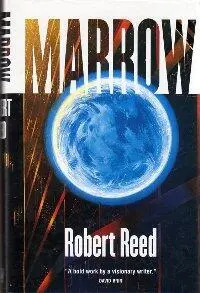
- Название:Marrow
- Автор:
- Издательство:Tor Books
- Жанр:
- Год:2000
- ISBN:0-312-86801-4
- Рейтинг книги:5 / 5. Голосов: 1
-
Избранное:Добавить в избранное
- Отзывы:
-
Ваша оценка:
Marrow: краткое содержание, описание и аннотация
Предлагаем к чтению аннотацию, описание, краткое содержание или предисловие (зависит от того, что написал сам автор книги «Marrow»). Если вы не нашли необходимую информацию о книге — напишите в комментариях, мы постараемся отыскать её.
Marrow — читать онлайн бесплатно полную книгу (весь текст) целиком
Ниже представлен текст книги, разбитый по страницам. Система сохранения места последней прочитанной страницы, позволяет с удобством читать онлайн бесплатно книгу «Marrow», без необходимости каждый раз заново искать на чём Вы остановились. Поставьте закладку, и сможете в любой момент перейти на страницу, на которой закончили чтение.
Интервал:
Закладка:
“But does this vault still work?” Miocene growled.
“Too soon to tell,” Aasleen replied. “I’ve got to peel back the shell and feed power to the systems… which will mean… hey, what’s the date…?”
Twenty voices told her. Counting from the first day of the mission, up in the leech habitat, the date was 619.23.
“Working at night, making one cut at a time… and of course I’ll have to refurbish the laser once every week or so… so maybe by 621 or 621.5. Maybe…?”
The Submasters were openly disappointed.
Miocene spoke for them, asking, “Is there any way to speed up this process?”
“Absolutely,” Aasleen responded. “Take me back upstairs, and I can do everything in three minutes. At the most.”
“Upstairs’ was the latest term for the ship. Informal, and by implication, a place that was relatively close by.
Miocene was disgusted, and happy to show her feelings. She shook her head and rose to her feet. Half a hundred of the captains’ children and grandchildren were in attendance. After all, this was their mystery, too. Facing them, she asked the engineer, “What are the odds that this memory vault remembers anything at all?”
“After being immersed in liquid iron for several billion years…?”
“Yes.”
Aasleen chewed on her lower lip for a thoughtful moment, then said, “Next to none. Madam.”
Disappointment hung in the air, thick and bitter.
“But that’s assuming that the bioceramics are the same as the grades seen before, of course. Which might be unlikely, since the Builders always seemed to know just how good their machines needed to be.”
Disappointment wrestled with a sudden hope.
“Whoever they were,” Aasleen reported, “the Builders were great engineers.”
“Undoubtedly,” Miocene purred.
“Begging to differ,” someone muttered. Who? Washen? Miocene gave her a quick glance and a crisp, “And why not, darling?”
“I’ve never known an engineer, great or lousy, who didn’t leave behind at least one plaque with her name on it.”
When Aasleen laughed, almost everyone began to laugh with her.
Giggling, nodding her happy face, the engineer admitted, “That’s the truth. That’s exactly how we are!”
Maybe the Builders were clever and rich with foresight, but the artifact—the ancient memory vault—was found empty of anything other than a few shredded, incoherent images. Shades of gray laid over a wealth of blackness.
The sorry news was delivered by one of Aasleen s genuine grandsons.
It was five days before the year 621 began. The speaker, named Pepsin, was a stocky, vivacious man with an easy smile and blue-black skin and a habit of talking too quickly to be understood. As evidence mounted that nothing of consequence waited in the vault, Pepsin had inherited the project from his famous grandmother. And like the good descendant of any good captain, he had taken this dead-end project and made it his own, carefully and thoroughly wringing from it everything that was important.
A small group of disappointed captains and Submasters were in attendance. No one else. Miocene herself sat in the back, reviewing administrative papers, barely noticing when that fast, fast voice announced, “But information comes in many delicate flavors.” What was that?
Pepsin grinned and said, “The hyperfiber shell degraded over time. Which gives us clues about its entombment.”
Washen was sitting in the front. She noticed that Miocene wasn’t paying attention, which was why she took it upon herself to ask, “What do you mean?”
“Madam,” he replied, “I mean what I say.”
Sarcasm caused the Submaster to lift her head. “But I didn’t hear you,” she growled. “And this time, darling, talk slowly and look only at me.”
The young engineer blinked and licked his lips, then explained. “Even the best hyperfiber ages, if stressed. As I’m sure you know, madam. By examining cross sections of the vault’s shell, at the microscopic level, we can read a crude history not only of the vault, but of the world that embraced it, too.”
“Marrow,” the old woman growled.
Again, he blinked. Then with a graceless cleverness, added, “Presumably, madam. Presumably”
With her quietest voice, Miocene advised, “Maybe you should proceed.”
Pepsin nodded, obeyed.
“The hyperfiber has spent the last several billion years bobbing inside liquid iron. As expected. But if there were no breaks in that routine, the degradation should be worse than observed. Fifty to ninety percent worse, according to my honorable grandmother.” A glance at Aasleen; no more. “Hyperfiber has a great capacity to heal itself. But the bonds don’t knit themselves quite as effectively at several thousand degrees Kelvin. No, what’s best is chilly weather under a thousand degrees. Deep space is the very best. Otherwise, the hyperfiber scars, and it scars in distinct patterns. And what I see in the microscope, and what everyone else here sees… measuring the scan, we have evidence of approximately five to fifteen hundred thousand distinct periods of high heat. Presumably, each of those periods marks time spent in Marrows deep interior—”
“Five to fifteen billion years,” Miocene interrupted. “Is that your estimate?”
“Basically. Yes, madam.” He licked his lips, and blinked, and conjured up a wide contented smile. “Of course we can’t assume that the vault was always thrown to the surface, and there surely have been periods when it was submerged several times during a single cycle.” Again, the lips needed moisture. “In different words, this is a lousy clock. But being a clock whose hands have moved, it points to what we have always assumed. For my entire little life, and this last brief chapter in your great lives…”
“Just say it,” Aasleen snarled at her grandson.
“Marrow expands and contracts. Again, we have evidence.” He grinned at everyone, at no one. Then he added, “Why this should be, I don’t know. And how it does this trick is difficult for me to conceive.”
Miocene couldn’t leave those mysterious words floating free.
With a quiet certainty, she said, “Our standard model is that the buttressing fields squeeze Marrow down, then relax. And when they relax, the world expands.”
“Until when?” asked Pepsin. “Until it fills the chamber?”
“We shall see,” the Submaster conceded.
“And what about the buttresses?” he persisted. Foolish, or brave, or simply intrigued, he had to ask the great woman, “What powers them?”
It was an old, always baffling question. But Miocene employed the oldest, easiest answer. “Hidden reactors of some unknown type. In the chamber walls, or beneath our feet. Or perhaps in both places.”
“And why go through these elaborate cycles, madam? I mean, if I was the chief engineer, and I needed to keep Marrow firmly in place, I don’t think I’d ever allow my fancy buttresses to fall halfway asleep. Would you, madam? Would you let them fall partway asleep every ten thousand years?”
“You don’t understand the buttresses,” Miocene replied. “You admitted it just a few breaths ago. Nobody knows how they refuel themselves, or regenerate, or whatever is happening. These mysteries have worked hard to remain mysteries, and we should give them our well-deserved respect.”
Pepsin hugged himself, nodding as if the words carried a genuine weight. But the eyes betrayed distance, then a revelation. Suddenly they grew wide, and darker somehow, and with an embarrassed grin, he said, “You’ve already had this debate with my grandmother. Haven’t you?”
“A few times,” the Submaster conceded.
“And does Aasleen ever win?” the young man inquired.
Miocene waited an instant, then told Pepsin, and everyone, “She always wins. In the end, I always admit that we haven’t any answers, and her questions are smart and valid and vast. And sadly, they are also quite useless to us here.
Читать дальшеИнтервал:
Закладка:
Похожие книги на «Marrow»
Представляем Вашему вниманию похожие книги на «Marrow» списком для выбора. Мы отобрали схожую по названию и смыслу литературу в надежде предоставить читателям больше вариантов отыскать новые, интересные, ещё непрочитанные произведения.









Обсуждение, отзывы о книге «Marrow» и просто собственные мнения читателей. Оставьте ваши комментарии, напишите, что Вы думаете о произведении, его смысле или главных героях. Укажите что конкретно понравилось, а что нет, и почему Вы так считаете.