Robert Reed - Marrow
Здесь есть возможность читать онлайн «Robert Reed - Marrow» весь текст электронной книги совершенно бесплатно (целиком полную версию без сокращений). В некоторых случаях можно слушать аудио, скачать через торрент в формате fb2 и присутствует краткое содержание. Год выпуска: 2000, ISBN: 2000, Издательство: Tor Books, Жанр: Фантастика и фэнтези, на английском языке. Описание произведения, (предисловие) а так же отзывы посетителей доступны на портале библиотеки ЛибКат.
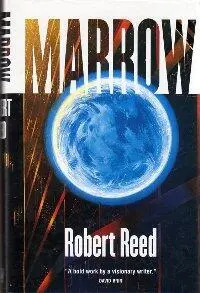
- Название:Marrow
- Автор:
- Издательство:Tor Books
- Жанр:
- Год:2000
- ISBN:0-312-86801-4
- Рейтинг книги:5 / 5. Голосов: 1
-
Избранное:Добавить в избранное
- Отзывы:
-
Ваша оценка:
Marrow: краткое содержание, описание и аннотация
Предлагаем к чтению аннотацию, описание, краткое содержание или предисловие (зависит от того, что написал сам автор книги «Marrow»). Если вы не нашли необходимую информацию о книге — напишите в комментариях, мы постараемся отыскать её.
Marrow — читать онлайн бесплатно полную книгу (весь текст) целиком
Ниже представлен текст книги, разбитый по страницам. Система сохранения места последней прочитанной страницы, позволяет с удобством читать онлайн бесплатно книгу «Marrow», без необходимости каждый раз заново искать на чём Вы остановились. Поставьте закладку, и сможете в любой момент перейти на страницу, на которой закончили чтение.
Интервал:
Закладка:
Perhaps Diu guessed her thoughts.
Whatever the reason, he suddenly asked, “How are those people, by the way? The poor souls that we brought back to you?”
“They healed,” she allowed. “In most ways.”
He shook his head sadly, then said, “Good. Good.”
Together, they watched a pair of children—probably brothers—running hard on the blue-bricked walkway. There was no railing or wall between them and the river. So when the older brother decided to shove the younger, the smaller boy stumbled and fell over the brink, his screaming face leading the way into the toxic waters.
Washen rose immediately.
But then their parents appeared, and while the mother reprimanded, the father scrambled down the face of the steel retaining wall, balancing on rocks as he fished his battered son out of a rancid goo, both of them filthy and angry, the father handing him up to his brother’s hands.
then shouting, “Showers cost! Good water’s never cheap!”
Emotional equations suddenly changed. A potential disaster had turned petty. Washen made herself sit again, telling her companion, “I used to drown.”
“Did you?”
“A few times,” she allowed. “I was little. I had a pet whale. I would ride him across the Alpha Sea—”
“I remember the story, Washen.”
“Did I tell you? How I used to make him dive deep, down where the great squids lived, and the pressure would crush mc until I was unconscious and in a coma that lasted for hours. Sometimes for a full day.”
He stared as if seeing a stranger. A worrisome, possibly insane stranger.
“My parents were pissed. As you can imagine.” She narrowed her eyes, wondering where to take this story. “My argument was that I couldn’t die, really die, just from being underwater. But carelessness bred carelessness, they said, and what if I was swept off my whale, too? What if nobody found my body?”
Something in those words made Diu laugh quietly, privately.
Washen shook her head, adding, “I just had this other memory. All of a sudden. And it’s a strange one.”
“Oh,” he said. “A strange one.”
She ignored the tone, looking off toward the new buildings across the river and seeing none of them. Instead, she saw the city where she was born, and the Master Captain was sitting with the original Submasters. For some reason, Washen was brought to them. But she was just a tiny girl. For some unimaginable reason, the Master spoke to her, asking some question. Washen couldn’t recall the question, much less her reply. But she clearly remembered sitting in the Master’s chair. And when she climbed out of it, a gust of wind had come out of nowhere, knocking the chair off its feet.
She reported that recollection, then asked, “What does it mean?”
“It didn’t happen,” Diu replied. Instantly, without doubts. “No?”
“And even if it happened,” he added, “it means nothing.”
For a moment, she heard something in his voice. Then Washen blinked and looked back at the rugged face, hairless save for the thick dark eyebrows, and she found a smile waiting—a broad smile in the mouth if not in those bright steel-gray eyes.
Within each of the ancient vaults, buried inside its uranium ballast, was an elegant little device, apparently useless and mostly ignored. One day, an empty vault was being fed test data while a piece of nearby machinery, purely by coincidence, emitted a low-frequency sound. The sound triggered an echo, a powerful and instantaneous throb noticeable for kilometers in every direction. A homing signal, perhaps? If so, it would only work with an operational vault, and there was no such creature. But to be thorough, the Loyalists sent the appropriate pulses into the crust, then listened for the hypothetical “Here I am” returns.
Because their equipment was crude, the first positive returns went unnoticed. But then a soft, imprecise echo was identified, and debated, and most observers denied the data, arguing on technical grounds while emotional reasons went unmentioned.
Newer, more sensitive microphones were designed, and built, and found wanting.
But the third generation of sensors produced not only a definite return, they also confidently supplied a location.
The echo came from a point a little more than nine kilometers deep, from inside a quiet eddy of molten iron.
A small, hopefully secret project was born. Under the camouflage of a new mantle-based geothermal works, lasers began boring a series of deep holes. The local crust was a fat three kilometers thick. Beneath the crust, ceramic pipes and pumps were employed. The red-hot iron had to be lifted to the surface, and cooled, and set out of the way. Since the mande was far from rigid, their target had a nagging habit of wandering. The grandchildren likened the adventure to putting an arm into lake muck, trying to grab one of those hot black winklewarts that just had to be down there.
A full eight years were invested in the drilling.
When success was imminent, a coded message was sent to Miocene. But before she arrived, something solid was ingested, and the pumps mindlessly pulled and pulled, bringing the vault to the surface. It looked the same as the other vaults—a simple replica of the Great Ship. Yet it was nothing like the others. Everyone sensed it. Even the captain in attendance—an unimaginative, hardworking man named Koll—felt a surge of anticipation, watching as his crew and a squad of robots yanked the treasure out of that wet iron, then immersed it in a deep basin of ice water.
Blinking against the steam, Koll ordered the treasure moved indoors.
Who knew who was watching?
The pump station was a suitable hiding place. A large, rambling building without the tiniest window, it held the rarest thing on Marrow. Darkness. Koll walked beside the mechanical walker that was carrying the vault, the false rocket nozzles pointed upward. A young granddaughter was at the helm. As soon as they were inside, Koll ordered the door closed behind them, and locked. He intended to call for the lights. “A soft setting,” he would have told the main computer. But after sixteen hundred years in endless daylight, Koll had learned to cherish anything that resembled night. Standing with his eyes open and blind, he noticed that glow. Soft, and colored. Not coming from the vault, no. The light seemed to be spilling from everywhere else.
Ancient systems had been triggered.
The uranium ballast served as a kind of battery. There was just enough power remaining to make a weak, ghostly projection. And Koll, a stolid, hard-to-impress man, stared at the images, a frill minute passing before he remembered to breathe again.
“Do you see this?” he asked the woman.
“I do,” she replied weakly. “Yes.”
She was sitting on the walker, silhouetted against flashes of light, her face wearing a look of stunned awe.
After another minute, she asked Koll, “What does this mean?”
There was no point in lying. He told her simply, “I don’t know what it means.” In circumstances like this, who could know?
The woman said, “Goodness.”
She laughed nervously, then said, “You don’t suppose-?”
“Maybe it’s nothing,” the captain interrupted. Then he said, “Nothing,” once again, with a genuine hopefulness. But because he was a rigorously honest man, he added, “Yet it could be very important. Which, I suppose, makes this a very important day.”
Twenty
Stripped of its hyperfiber shell, the device seemed elegant but not particularly impressive. Various ceramics were knitted into a white buckeyball sphere, rather like an oversized child’s kick ball. The vault rode on the floor in front of Miocene, and she touched it lighdy, and with a flat, matter-of-fact voice, she reported, “I feel confident. About how things will go from here, I mean. Basically, essentially confident.”
Читать дальшеИнтервал:
Закладка:
Похожие книги на «Marrow»
Представляем Вашему вниманию похожие книги на «Marrow» списком для выбора. Мы отобрали схожую по названию и смыслу литературу в надежде предоставить читателям больше вариантов отыскать новые, интересные, ещё непрочитанные произведения.








Обсуждение, отзывы о книге «Marrow» и просто собственные мнения читателей. Оставьте ваши комментарии, напишите, что Вы думаете о произведении, его смысле или главных героях. Укажите что конкретно понравилось, а что нет, и почему Вы так считаете.