Robert Reed - Marrow
Здесь есть возможность читать онлайн «Robert Reed - Marrow» весь текст электронной книги совершенно бесплатно (целиком полную версию без сокращений). В некоторых случаях можно слушать аудио, скачать через торрент в формате fb2 и присутствует краткое содержание. Год выпуска: 2000, ISBN: 2000, Издательство: Tor Books, Жанр: Фантастика и фэнтези, на английском языке. Описание произведения, (предисловие) а так же отзывы посетителей доступны на портале библиотеки ЛибКат.
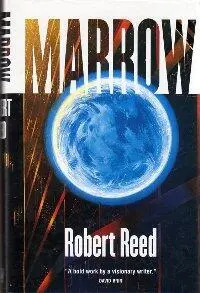
- Название:Marrow
- Автор:
- Издательство:Tor Books
- Жанр:
- Год:2000
- ISBN:0-312-86801-4
- Рейтинг книги:5 / 5. Голосов: 1
-
Избранное:Добавить в избранное
- Отзывы:
-
Ваша оценка:
Marrow: краткое содержание, описание и аннотация
Предлагаем к чтению аннотацию, описание, краткое содержание или предисловие (зависит от того, что написал сам автор книги «Marrow»). Если вы не нашли необходимую информацию о книге — напишите в комментариях, мы постараемся отыскать её.
Marrow — читать онлайн бесплатно полную книгу (весь текст) целиком
Ниже представлен текст книги, разбитый по страницам. Система сохранения места последней прочитанной страницы, позволяет с удобством читать онлайн бесплатно книгу «Marrow», без необходимости каждый раз заново искать на чём Вы остановились. Поставьте закладку, и сможете в любой момент перейти на страницу, на которой закончили чтение.
Интервал:
Закладка:
Washen nodded, then faced forward again. With both hands on the controls, she repeated the word, “Confident.”
“I am,” the Submaster promised. “With luck and some care, this should help heal the old rifts.”
“With luck,” Washen echoed, knowing it would take a lot of that mecurial substance.
She was steering a large walker. Behind them, the latest incarnation of Happens River was dropping over the horizon. What passed for a road would soon become a starved trail, then nothing but jungle and raw mountains. They were already approaching Wayward lands, yet it would be another two hundred kilometers before the rendezvous. Nobody with an official invitation had ever moved this deep into their territory, and it had been at least three centuries since the uninvited had last passed here.
As the day progressed, Washen kept tabs on the walker’s progress. The latest AI pilots still weren’t particularly smart or adaptable, and it wouldn’t impress anyone to have their machine—the culmination of sixteen centuries of technical wizardry—trip over a piece of mountain, ending up on its back like a clumsy crap bug.
The jungle path lifted up onto a wide, newborn plateau, then vanished. A hard hot rain was falling on the open ground, collecting in little basins and pools where black algae grew in silky blankets. In another year, all of this would be a vigorous young jungle. But which species would dominate? Sixteen hundred years of research gave Washen the expertise to admit that she didn’t know how the succession would progress. Not on this ground, or any other. Chemical makeups varied from vent to vent, and even within a single flow. Rains were common but no longer reliable. Little droughts and hard floods could change initial conditions. Plus there was the pure creative randomness of the spores and seeds and eggs that would come here. A chance wind could bring a flotilla of gold balloons that might, or might not, lead to a lofty forest of pure virtue trees. Or the fickle wind would steer the balloons somewhere else. To an established jungle and their deaths, most likely, where hungry mouths waited in abundance. At least a hundred native species loved to chew on the gold foil, incorporating the metal into their own elaborate carapaces, showing the world and their prospective mates both a beauty and a gaudy strength.
Initial conditions were critical. That was essential in jungle ecologies, and in human ecologies, too.
What if Miocene were a better parent? More patient, and nurturing, and just a little more forgiving? If she and Till had been closer, resolving their differences in private, civilized ways, the history of Marrow would certainly have been much quieter. And if she had been a worse mother, she would have murdered her son. Then driven by the other captains’ outrage, Miocene would have been ousted, another Submaster named their leader. Daen, perhaps. Or more likely Twist. Which would have radically changed the evolution of their ad hoc civilization…
The burden of intelligence: you can always imagine all those wonderful places where you can never belong.
The young plateau gave way to a younger volcanic cone, now sleeping. Dirty iron and nickel had frozen into a rough-faced slag. As the machine scrambled up the naked slope, the rains slackened, and the clouds were shoved far ahead, allowing Washen to glance over her shoulder, looking back across the swollen face of the world.
The sky was dimmer than ever.
As the buttresses weakened, the ambient light fell away proportionally. Still brilliant, but not the same cutting-to-the-bone brilliance. Temperatures were following the same smooth curve downward. Gravity weakened as the world expanded, subtly changing the architecture of plants and mountains and the largest, most important buildings. The atmosphere was growing cooler and quieter but not deeper, since it was spreading across more and more surface area. Likewise, there was only a finite amount of water. The metallic lavas were parched, bringing up nothing but rare earths and heavy metals. Less rain was falling and rivers were smaller, and if these various trends continued apace, there was the promise of long, hard droughts.
Near the horizon, far too small to be seen by the naked eye, was the sky’s only flaw. The original base camp still clung to the silvery hyperfiber, its modern buildings and diamond walkways still empty and alone. And in another thirty-four centuries, the camp would remain just as empty, but it would gaze down on a radically different world. The buttresses’ light would have fallen away to nothing, revealing a lovely starlike sparkle marking cities and well-lighted lanes.
That was the instant when a person could escape. And thinking that, Washen glanced at the vault again, feeling a cold, unnerving pain.
“We don’t know if it’s true,” she muttered to herself.
Miocene glanced at her, nearly asking, “What did you say?”
But the Submaster thought better of it, placing both hands on that ball of smooth gray-white ceramics, the gesture protective, hands and her tilting body conveying a strange fondness for the terrible artifact.
An unmapped river of iron meant a prolonged detour.
They were an hour behind schedule when they arrived at the appointed clearing. Three in the morning, ship time, according to Washen’s silver clock.
The clearing began as a lava plain, but when its molten heart retreated underground, the flat countryside collapsed into a natural amphitheatre. A great flat slab was the stage, and the black iron rose up on all sides, in oversized stairsteps. The shadowless play of the light and the angle of the slopes made everything appear closer than it was. As instructed, Washen parked in the middle of the stage, both captains climbing into plain view, and with two of its jointed limbs, the walker carefully lowered the vault to the iron. Then the first Waywards appeared, mere dots against the blackness. Even trotting at a respectable pace, it took them forever to work their way down the long slope. Besides breechcloths, each wore an ornamental mask made from soft leather stretched over a framework of carved bone. Leather made from their flesh; bone torn from their own enduring bodies. Every mask was painted with blood and with urine. Each showed the same wild, almost fluid face. Like electricity with eyes but no mouth. A Builder’s face, Washen recalled. How they had arrived at that imagery, she didn’t know. Diu claimed that Till was preyed upon by visions. The Wayward’s leader was convinced that the Builders were visiting him, and in some ways, they were his only true friends.
As the first Waywards approached, they slowed to a dignified walk and lifted their masks back up on top of their heads.
Nearly fifteen centuries had passed since Washen last saw Till. Yet she knew him immediately. She knew him from the drawings and from a captain’s crisp memories. But she also recognized his mother in his face and in his measured, imperious stride.
He was a smaller, prettier version of Miocene.
The rest of the party—the finest priests and diplomats and cabinet members—followed at a respectful distance. They were staring at the prize. Washen had plugged an umbilical into the vault, and the walker’s generator was feeding it. A smooth living hum came from within, infusing the air with a palpable hint of possibilities.
Only Till wasn’t staring at the prize. He watched Miocene. Wariness was mixed with other, less legible emotions. For an instant, his mouth opened. Then he took a quick breath and turned to Wishen, asking, “May I examine the device?”
“Please,” she told him; she told all of them.
Locke was standing closest to Till. It was a sign of rank, perhaps, and as always, that brought Washen an unexpected pride.
“How have you been, Mother?” he inquired. Always polite; never warm.
Читать дальшеИнтервал:
Закладка:
Похожие книги на «Marrow»
Представляем Вашему вниманию похожие книги на «Marrow» списком для выбора. Мы отобрали схожую по названию и смыслу литературу в надежде предоставить читателям больше вариантов отыскать новые, интересные, ещё непрочитанные произведения.






Обсуждение, отзывы о книге «Marrow» и просто собственные мнения читателей. Оставьте ваши комментарии, напишите, что Вы думаете о произведении, его смысле или главных героях. Укажите что конкретно понравилось, а что нет, и почему Вы так считаете.