Robert Reed - Marrow
Здесь есть возможность читать онлайн «Robert Reed - Marrow» весь текст электронной книги совершенно бесплатно (целиком полную версию без сокращений). В некоторых случаях можно слушать аудио, скачать через торрент в формате fb2 и присутствует краткое содержание. Год выпуска: 2000, ISBN: 2000, Издательство: Tor Books, Жанр: Фантастика и фэнтези, на английском языке. Описание произведения, (предисловие) а так же отзывы посетителей доступны на портале библиотеки ЛибКат.
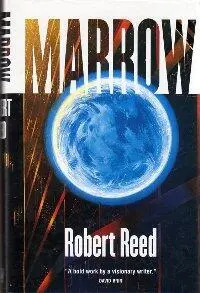
- Название:Marrow
- Автор:
- Издательство:Tor Books
- Жанр:
- Год:2000
- ISBN:0-312-86801-4
- Рейтинг книги:5 / 5. Голосов: 1
-
Избранное:Добавить в избранное
- Отзывы:
-
Ваша оценка:
Marrow: краткое содержание, описание и аннотация
Предлагаем к чтению аннотацию, описание, краткое содержание или предисловие (зависит от того, что написал сам автор книги «Marrow»). Если вы не нашли необходимую информацию о книге — напишите в комментариях, мы постараемся отыскать её.
Marrow — читать онлайн бесплатно полную книгу (весь текст) целиком
Ниже представлен текст книги, разбитый по страницам. Система сохранения места последней прочитанной страницы, позволяет с удобством читать онлайн бесплатно книгу «Marrow», без необходимости каждый раз заново искать на чём Вы остановились. Поставьте закладку, и сможете в любой момент перейти на страницу, на которой закончили чтение.
Интервал:
Закладка:
Miocene raised her hands still higher, and she spun in a slow circle, a majestic rage helping her scream, “Understand me! All of this is a lie!”
Silence.
Then Till shook his head, assuring everyone, “I didn’t find any vault or artifact.” He made his own turn, proclaiming, “I was alone in the jungle. Alone, and a Builder’s spirit came to me. He told me about the ship and the Bleak. He showed me everything that this vault contains, and more. Then he made me a promise: when this long day ends, as it must, I will learn my destiny, and your destinies as well…!”
His voice trailed off into the enraptured silence.
Locke unfastened the umbilical from the vault, and glancing at Washen, his flat, matter-of-fact voice told her, “We’ll bring the usual payment to Happens River.”
Miocene roared.
“What do you mean? The usual payment…? But this is the best artifact yet!”
The Waywards gazed at her with a barely restrained contempt.
“This one functions. It remembers.” The Submaster was stabbing at the air, reminding everyone, “The other vaults were just empty curiosities!”
Till said, “Exactly.”
Then, as if it were beneath their leader to explain the obvious, Locke stepped forward, telling them, “Vaults are usually crypts. They hold the Builders’ souls. And the ones you sold us were empty because their souls have found better places to reside.”
Till pulled his blood-and-piss mask back over his face again, hiding everything but his bright eyes.
Every Wayward repeated the motion, a great rippling reaching to the top of the amphitheatre. And Washen had to wonder if this elaborate meeting, with all of its pagen-try and rich emotion, was intended not for a hundred thousand devoted souls, but for two old and very stubborn captains.
With his face obscured, Locke approached his mother.
A premonition made her mouth dry.
“Where is he?” she inquired.
Her son’s eyes changed. Softened, sweetened.
“His soul is elsewhere now,” he replied, as a Wayward should. Then he gestured at the hard iron ground.
“Elsewhere?”
“Eight years ago. “There was a sadness in his body and his voice. “There was a powerful eruption, and he was taken.”
Washen couldn’t speak, or move.
A warm hand gripped her by the elbow, and a caring voice asked, “Are you all right. Mother?”
She took a breath, then told the truth.
“No, I’m not all right. My son’s a stranger, my lover’s dead, and how should I damn well feel…?”
She pulled free of his hand, then turned away.
Miocene—the cold, untouchable Submaster—dropped to her knees on the hard iron, hands clasped before her weeping face. Their promising mission was ending with this. With Miocene pleading.
She said, “Till,” with genuine anguish. “I’m so very, very sorry, darling. I was wrong, hitting you that way… and I wish you would try to forgive me… please…!”
Her son nodded for a moment, saying nothing.
Then as he turned, preparing to leave, Miocene used her final plea.
“But I do love the ship,” she told him. And everyone. “You were wrong then, and you’re still wrong. I love and cherish the ship more than you ever could! And I’ll always love it more than I love you, ungrateful little bastard…!”
Twenty-one
A carde of captains and gifted architects had designed the Grand Temple, and for a thousand years the best artisans had labored over it, while every adult Loyalist gave time and willing hands to its construction. Even half-finished, the Temple was a beautiful structure. Six gold-faced domes were arranged in a perfect circle. Graceful parabolic arches of tinted steels straddled the domes, riding higher and higher on each other’s backs. The central tower was the tallest structure on Marrow, and the deepest. Its foundation already reached a full kilometer into the cold iron, and in its basement was a reservoir of pure water where the occasional neutrino would collide with a willing nucleus, the resulting explosion producing a lovely cone of light that proved to priests and to children what every Loyalist needed to accept without question: Marrow was a small part of a much greater Creation, a Creation invisible to the eye but not to the believing mind.
The Wayward defector had asked to be brought to the temple, which was a perfectly ordinary request.
But the Submaster had reviewed the field reports as well as the transcripts of both official interrogations, and the only certainty was that nothing else about this defection was ordinary, much less simple.
The temple administrator was a nervous woman made more so by events. Wearing the soft gray robes of her office and a tortured expression, she greeted Miocene with a crisp, “Madam,” and a cursory bow, then blurted out, “It is an honor,” even as she prepared to complain what a great disruption this business was.
Miocene didn’t give her the opportunity. Firmly and not too gently, she said, “You’ve done a marvelous job, so far.”
“Yes, madam.”
“So far,” she repeated, reminding her subordinate that failure was always just one misstep away. Then with a softer voice, she asked, “Where’s our guest?”
“In the library.”
Of course.
“He wants to see you,” the administrator warned. “He practically demands that I bring you to him.”
They were standing at one of the minor entranceways, the heavy door carved from a single virtue tree, ancient and gigantic. Because she refused to be rushed by anyone, Miocene paused, letting one hand caress the old wood, dark as clotted blood and perforated with spongelike holes where nodules of battery fats had been. Her guards—a pair of trunklike men with quick, suspicious eyes—stood nearby, watching the quiet side street. For an instant, Miocene’s mind was elsewhere. She found herself thinking about the ship, and in particular, her wood-lined apartment not five hundred meters from the Master’s quarters.
Then she blinked and gave a sigh, feeling a familiar little sadness, and a knot of secret fears…
“Well, then,” she muttered, straightening her back, then the creases of her uniform. “Take me to our new friend.”
Public services were being held in each of the six main chambers. Citizens elected their priests, and as a result, each had his own style and perspective. Some spoke endlessly about the Great Ship. Its beauty, its grace; its unfathomable age, and its endless mystery. Others readied parishioners for the glorious day they would meet their first aliens. And an ecletic few dwelled on more abstract and far-reaching topics: the stars and living worlds and the Milky Way, and the vast universe that dwarfed everything that humankind could see and touch or even pretend to comprehend.
One service was wrestling with such cosmic wonders. A satin-voiced gentleman was singing praises of G-class suns. “Warm enough to bring life to more than many worlds at a time,” he called out, “and long enough lived to feed a creative evolution. Our home world, the great Earth, was born beside such a golden sun. Like the seed of a virtue tree, it was. It is. And our universe is full of billions of seeds. Life in its myriad forms is everywhere. Life thick and life lovely, and life forever.”
“Forever,” chanted the small audience, in careless unison.
Ceramic arches and ported flycatchers separated the hallway from the chamber. A few faces happened to glance to one side, noticing the Submaster striding past. Murmurs rose, spread. But the priest standing up front, leaning hard against the diamond podium, ignored the noise, pressing on with his speech.
“We must prepare, sisters and brothers. The day is waning, gradually but inexorably, and we will see the time when each of us is needed. Our hearts and hands, and our minds, will be thrown into the construction of the bridge.”
Читать дальшеИнтервал:
Закладка:
Похожие книги на «Marrow»
Представляем Вашему вниманию похожие книги на «Marrow» списком для выбора. Мы отобрали схожую по названию и смыслу литературу в надежде предоставить читателям больше вариантов отыскать новые, интересные, ещё непрочитанные произведения.








Обсуждение, отзывы о книге «Marrow» и просто собственные мнения читателей. Оставьте ваши комментарии, напишите, что Вы думаете о произведении, его смысле или главных героях. Укажите что конкретно понравилось, а что нет, и почему Вы так считаете.