Robert Reed - Marrow
Здесь есть возможность читать онлайн «Robert Reed - Marrow» весь текст электронной книги совершенно бесплатно (целиком полную версию без сокращений). В некоторых случаях можно слушать аудио, скачать через торрент в формате fb2 и присутствует краткое содержание. Год выпуска: 2000, ISBN: 2000, Издательство: Tor Books, Жанр: Фантастика и фэнтези, на английском языке. Описание произведения, (предисловие) а так же отзывы посетителей доступны на портале библиотеки ЛибКат.
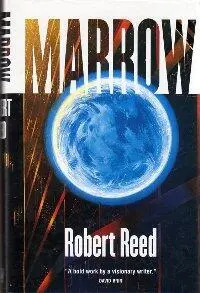
- Название:Marrow
- Автор:
- Издательство:Tor Books
- Жанр:
- Год:2000
- ISBN:0-312-86801-4
- Рейтинг книги:5 / 5. Голосов: 1
-
Избранное:Добавить в избранное
- Отзывы:
-
Ваша оценка:
Marrow: краткое содержание, описание и аннотация
Предлагаем к чтению аннотацию, описание, краткое содержание или предисловие (зависит от того, что написал сам автор книги «Marrow»). Если вы не нашли необходимую информацию о книге — напишите в комментариях, мы постараемся отыскать её.
Marrow — читать онлайн бесплатно полную книгу (весь текст) целиком
Ниже представлен текст книги, разбитый по страницам. Система сохранения места последней прочитанной страницы, позволяет с удобством читать онлайн бесплатно книгу «Marrow», без необходимости каждый раз заново искать на чём Вы остановились. Поставьте закладку, и сможете в любой момент перейти на страницу, на которой закончили чтение.
Интервал:
Закладка:
Suddenly Miocene heard the distant singing, muted by walls and the spiraling staircase, the voices ragged and earnest and in their own way beautiful.
She heard herself ask, “What is this… this something…?”
“I don’t have any idea.”
“Is it large?”
“Fifty kilometers across. Approximately’ The young man sucked on another braid, then said, “I want to find out what it is. Give me the staff and the resources, and I’ll determine if the buttresses are being fed from down there.”
The Submaster took a breath, then another. Then she quietly, honestly, told the defector, “That can’t be our priority. Interesting as it is, the question has to wait.”
Gray eyes stared, then pulled shut.
A bilious voice reported, “That’s exactly what Till told me. Word for fucking word.”
When the eyes opened, they saw a laser cradled in the Submaster’s right hand.
“Hey, now,” he whined.
Miocene aimed for the throat, then panned downward. Then she rose and came around the table, completing the chore with delicacy and thoroughness. Only the face and the mind behind it remained unconsumed, a voiceless scream having pulled the mouth wide open. The stink of cooked flesh and a burned wig made the air close, distasteful. Working quickly, Miocene opened a satchel and dumped the head inside. Then she walked between the stacks of books, her guard waiting as ordered, out of earshot.
He took the satchel without comment.
“As always,” was all she needed to say.
With a nod, the loyal guard left, using the emergency exit. The defector’s interrogations had only just begun; and if he could prove his worth, he would be reborn into a new, infinitely more productive life.
Miocene took her time repacking the electronic file-box and adding a vial of ash to the ash pile—exactly what would be left by a man’s head. Then she picked up the book that had so bothered her grandson, and on a whim, she opened it to the reactor. Virtue had been correct, she realized. And she made a footnote to future scholars before she carefully returned the volume to its proper shelf.
The temple administrator was waiting in the stairwell.
With her hands wrapped in front of her, half-hidden by her lumpy robe, she looked up at the Submaster, winced and began to ask, “Where is he-?”
Then she smelled death, or she saw it walking the stairs with Miocene.
“What…?” the woman sputtered, never more nervous.
“The defector,” Miocene replied, “was a spy. A transparent attempt to plant an agent in our midst.”
“But to kill him… here, in the temple…!”
“To my mind, there’s no more appropriate location.” The Submaster pushed past her, then remarked, “You may clean up. I would be most thankful if you would do me this favor, and that you never mention any of this to anyone.”
“Yes, madam,” a tiny voice squeaked.
Then Miocene was in the open hallway again, the rattling, ill-disciplined voices singing about the bridge soon to be built and the rewards to be won, and for no precise reason, it seemed important for her to step out into the expansive chamber, facing the ranks of devoted worshipers.
It was chilling and enchanting to realize how easily, almost effortlessly, children embraced the words and dreams of another. Miocene looked at the startled, smiling faces, seeing nothing but the purest belief.Yet these people knew nothing about the worlds beyond their own. None had walked t he ship’s smallest hallway, much less witnessed the beauty and majesty of the Milky Way. They sang of this great quest to return to the world above, ready to make any sacrifice to move past their simple silver sky. A sky unblemished, save for that lone patch of darkness directly above—the base camp, still and always abandoned.
Abandoned like the ship itself?
Billions might have died, and Miocene didn’t care. Perhaps she once hated the idea that her people, following her reasonable instructions, had triggered an elaborate, ancient booby trap, causing every organism above them to be murdered. But what had horrified once was now history, past and murky as only history can be, and how could Miocene accept any blame for what was surely unavoidable?
The ship might be dead, but she most definitely was alive.
To the pleasure of several thousand parishioners, this living embodiment of everything great about themselves joined in with their singing, Miocene’s voice strong and and relentless and untroubled by its melodic failures.
How easily they believe, she thought with a fond contempt.
Then as she sang about the sweet light of G-class stars, Miocene asked herself, in her most secret voice, “But what if it’s the same for the great souls?”
She wondered:
“What do I believe too willingly and too well…?”
Twenty-two
The cold iron would occasionally shift on its own, giving no warning. The old faults never moved quickly or particularly far, and they rarely caused damage of consequence. The tremor-abatement facilities absorbed the event’s energies, and where feasible, what was harvested was piped into the main power grid. In that sense, quakes were a blessing. But the unscheduled events had a nagging habit of interrupting a certain captain’s deepest sleep, causing her to awaken suddenly, her dreams swirling out of reach in those delicious few moments before she found herself lucid again.
That morning’s quake lingered. Awake in her bed, lying on her right side, Washen felt the shudder falling away slowly, turning into the quiet, steady, and purposeful drumming of her own heart.
The calendar on the wall displayed the date.
4611.277.
Sheer curtains cut to resemble the unfolded wings of a lusciousfly let in the anemic skylight, illuminating the bedroom in which she had slept for the last six centuries. Steel walls covered with polished umbra wood gave the structure a palpable, reassuring strength. The high steel ceiling bristled with hooks and potted plants and little wooden houses, drab as dirt, where domesticated lusciousflies roosted and made love. A rare species in the bright, hot days after the Event, the lovely creatures had been growing more abundant as the overhead buttresses diminished—a cycle presumably aeons old. At Promise-and-Dream’s Generic Works, the siblings had tinkered with their colors and size, producing giant butterfly-like organisms with elaborate, every-colored wings. Every Loyalist seemed to have his own flock. And since there were twenty million homes in the nation, the sibling captains had made themselves a tidy, even enviable profit.
As Washen sat up in bed, her lusciousflies came out to greet her. With the softness of shadows, they perched on her bare shoulders and in her hair, licking at the salt of her skin and leaving their subtle perfumes as payment.
She shooed them away with a gentle hand.
Her old clock lay open on the tabletop. According to the slow metal hands, she could sleep for another hour. But her body said otherwise. While the mirrored uniform dressed her, Washen remembered dreaming, and the tremor. For a few wasted moments, she tried to resurrect her last dream. But it had slipped away already, leaving nothing but a vague, ill-fed disquiet.
Not for the first time, it occurred to Washen that she could build a universe from her lost dreams.
“Maybe that’s their real purpose,” she whispered to her pets. “When my universe is finished, so am I.”
Laughing quietly, she set her mirrored cap on her head.
There.
Breakfast was peppered bacon over a toasted sweetcake, everything washed down with hot tea and more hot tea. The Genetics Works were responsible for the bacon, too. A few centuries ago, responding to the captains’ complaints, Promise and Dream had cultured several familiar foods in lab vats; respectable steaks and cured meats were the result. But it was a minor project, finished quickly and cheaply. Instead of trying to resurrect the genetics of cattle and boars, from memory, the siblings used the only available meat-bearer—humans—tweaking the genetics enough to make a fleshy product that wasn’t human. Not in texture, or in flavor. Or hopefully, in spirit.
Читать дальшеИнтервал:
Закладка:
Похожие книги на «Marrow»
Представляем Вашему вниманию похожие книги на «Marrow» списком для выбора. Мы отобрали схожую по названию и смыслу литературу в надежде предоставить читателям больше вариантов отыскать новые, интересные, ещё непрочитанные произведения.








Обсуждение, отзывы о книге «Marrow» и просто собственные мнения читателей. Оставьте ваши комментарии, напишите, что Вы думаете о произведении, его смысле или главных героях. Укажите что конкретно понравилось, а что нет, и почему Вы так считаете.