Robert Reed - Marrow
Здесь есть возможность читать онлайн «Robert Reed - Marrow» весь текст электронной книги совершенно бесплатно (целиком полную версию без сокращений). В некоторых случаях можно слушать аудио, скачать через торрент в формате fb2 и присутствует краткое содержание. Год выпуска: 2000, ISBN: 2000, Издательство: Tor Books, Жанр: Фантастика и фэнтези, на английском языке. Описание произведения, (предисловие) а так же отзывы посетителей доступны на портале библиотеки ЛибКат.
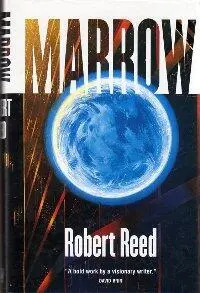
- Название:Marrow
- Автор:
- Издательство:Tor Books
- Жанр:
- Год:2000
- ISBN:0-312-86801-4
- Рейтинг книги:5 / 5. Голосов: 1
-
Избранное:Добавить в избранное
- Отзывы:
-
Ваша оценка:
Marrow: краткое содержание, описание и аннотация
Предлагаем к чтению аннотацию, описание, краткое содержание или предисловие (зависит от того, что написал сам автор книги «Marrow»). Если вы не нашли необходимую информацию о книге — напишите в комментариях, мы постараемся отыскать её.
Marrow — читать онлайн бесплатно полную книгу (весь текст) целиком
Ниже представлен текст книги, разбитый по страницам. Система сохранения места последней прочитанной страницы, позволяет с удобством читать онлайн бесплатно книгу «Marrow», без необходимости каждый раз заново искать на чём Вы остановились. Поставьте закладку, и сможете в любой момент перейти на страницу, на которой закончили чтение.
Интервал:
Закладка:
Another three-plus centuries, and Marrow would be immersed in darkness.
And for how long?
Maybe a ship-day. Or maybe twenty years. Either was a viable estimate, and nobody knew enough to feel certain. But each of the native species had a reservoir of unexpressed genes, and in laboratory conditions, bathed in night, the genes awakened, allowing the vegetation and blind insects to fall into a durable hibernation.
The buttresses would vanish, it was assumed. Or at least fade to negligible levels. And the Loyalists would climb up this wondrous makeshift bridge, reaching the base camp, then the ship beyond.
In polite company, nobody even discussed the possibilities that lay beyond that point. After forty-six centuries, the same theories ruled. And every other bizarre explanation had been offered, then debated in depth, and finally, mercifully, buried in a very deep, unmarked grave.
Whatever was, was.
That’s what Washen told herself as she entered her small, spartan office, taking her seat before a bank of controls and monitors and simple-minded AIs.
“Whatever is, is.”
Then like every other morning, she let herself gaze out the diamond window. Maybe the bridge was too much and too soon. But even still, it was a marvel of engineering and ad hoc inventiveness, and sometimes, in a secret part of herself, Washen wished there was some way to carry it along with the grandchildren.
To show the universe both treasures in which she felt such pride.
“Madam Washen?” She blinked, turned.
Her newest assistant stood in the office doorway. An intense, self-assured man of no particular age, he was obviously puzzled—a rare expression for him—and with a mixture of curiosity and confusion, he announced, “Our shift is over.”
“In another fifty minutes,” she replied, pushing aside her daily report. Washen knew the rime, but the habit of her hands was to open her silver watch, eyes glancing at the slow hands. “Forty-nine minutes, and a few seconds.”
“No, madam.” Nervous fingers tugged at the dangling Gordian braids, then attempted to smooth the crisp blue fabric of his uniform. “I was just told, madam. Everyone is to leave the bridge immediately, using every tube but the Primary.”
Washen looked at her displays. “I don’t see orders.”
“I know—”
“Is this a drill?” Drills happened from time to time. If the crust beneath them subsided, they might have only moments to evacuate. “Because if it’s an exercise, we need a better system than having you wandering about, tapping people on their shoulders.”
“No, madam. It’s not that.”
“Then what-?”
“Miocene,” he blurted. “She contacted me personally. On a secure line. Following her instructions, I’ve dismissed our construction crews, and I’ve placed our robots into their sleep mode.”
Washen said nothing, thinking hard.
With a barely restrained frustration, he added, “This is very mysterious. Everyone agrees. But the Submaster is fond of her secrets, so I’m assuming—”
“Why didn’t she talk to me?” asked Washen.
The assistant gave a big lost shrug.
“Is she coming here?” she asked. “Is she using the Primary?”
A quick nod.
“Who’s with her?”
“I don’t know if there’s anyone else, madam.”
The Primary tube was the largest. Fifty captains could ascend inside one of its cars, never brushing elbows with each other.
“I already looked,” he confessed. “It’s not a normal car.”
Washen found the rising car on her monitors, then tried to wake a platoon of cameras. But none of them would respond to her commands.
“The Submaster asked me to take the cameras off-line, madam. But I happened to get a glimpse of the car first, by accident.” The assistant grimaced as he made his confession.’It’s a massive object, judging by the energy demands. With an extra-thick hull, I would surmise. And there are some embellishments that I can’t quite decipher.”
“Embellishments?”
He glanced at his own clock, pretending that he was anxious to leave. But he was also proud of his courage, smiling when he explained, “The car is dressed up inside pipelike devices. They make it look like someone’s ball of rope.”
“Rope?”
With a dose of humility, he admitted, “I don’t quite understand that apparatus.”
In plain words, “Please explain it to me, madam.”
But Washen explained nothing. Looking at her assistant—one of the most loyal of the captains’ loyal oflsping; a man who had proved himself on every occasion—she shrugged her shoulders, took a secret breath, then lied.
She said, “I don’t understand it, either.”
Then, as an afterthought, she inquired, “Was my name mentioned, by any chance? While you and Miocene were chatting, I mean.”
“Yes, madam. She wanted me to tell you to stay here, and wait.”
Washen took a little breath, saying nothing.
“I’m supposed to leave you here,” he whined.
“Well, then, do what our Submaster wants,” was Washen’s advice. “Leave right now. If she finds you here, I guarantee she’ll throw you down the shaft herself.”
Twenty-three
For centuries, virtue had proved himself with his genius and his passion for the work. On all occasions, contrived or genuine, he had acted with as much loyalty as anyone born into the Loyalist nation. Yet even now—particularly now—Miocene couldn’t make herself completely trust the little man.
“It might not work,” he warned her, again.
She said, “It will,” and looked past him, watching the sealed and simple mechanical door, imagining it opening and her stepping that much closer to the end. Another barrier crossed, if only a small one. Then she reminded Virtue, “In your simulations, success is a ninety percent event. And we both appreciate how difficult you make your simulations.”
The Wayward scalp had grown hair. A Gordian bun and implanted gemstones made him look like any Loyalist, while the busy gray eyes had acquired a fondness for the Submaster, deeply felt and surprising to both of them.
Quietly, angrily, Virtue told her, “This is too soon.”
She said nothing.
“Another two years, and I can improve the odds—”
“One or two percent,” she quoted. Then staring at the fond eyes, Miocene wondered why she didn’t trust him. Was she that suspicious, or that girted? Either way, she would feel better if she could find a fair reason to send him home again. “Miocene.”
He said her name tenderly, hopefully. Fondness dissolved into a stew of deeper emotions, and where the voice stopped, a small tidy hand reached out, reached up, grabbing hold of her right breast.
After so long, a Wayward gesture.
She said, “No,” to him, or to herself.
Again, he said, “Miocene.”
The Submaster removed his hand with one of hers, bending back two of his fingers until his face filled with a pained surprise.
“That little quake helped the alignment,” she reminded him. “ ‘By nearly half a meter,’ you said. ‘But the next quake or two could steal our advantage.’ ”
“I said it,” he agreed. “I remember.”
“Besides,” she whispered. “If we wait, we’ll likely lose the gift of surprise.”
“But we’ve kept our work secret for this long.” When determined. Virtue could look like his father. Like Till. The narrow face was full of emotions, and you were never sure which emotion would bubble out next. “What would it injure? Give me another full day, and I’ll recheck every system and recalibrate the guidance system, plus both backups—”
“But,” Miocene interrupted, “this is the day. This is.”
He had no choice but to sigh and shake his empty hands, and surrender. And just like that, he suddenly looked nothing at all like Till.
Читать дальшеИнтервал:
Закладка:
Похожие книги на «Marrow»
Представляем Вашему вниманию похожие книги на «Marrow» списком для выбора. Мы отобрали схожую по названию и смыслу литературу в надежде предоставить читателям больше вариантов отыскать новые, интересные, ещё непрочитанные произведения.







Обсуждение, отзывы о книге «Marrow» и просто собственные мнения читателей. Оставьте ваши комментарии, напишите, что Вы думаете о произведении, его смысле или главных героях. Укажите что конкретно понравилось, а что нет, и почему Вы так считаете.