Robert Reed - Marrow
Здесь есть возможность читать онлайн «Robert Reed - Marrow» весь текст электронной книги совершенно бесплатно (целиком полную версию без сокращений). В некоторых случаях можно слушать аудио, скачать через торрент в формате fb2 и присутствует краткое содержание. Год выпуска: 2000, ISBN: 2000, Издательство: Tor Books, Жанр: Фантастика и фэнтези, на английском языке. Описание произведения, (предисловие) а так же отзывы посетителей доступны на портале библиотеки ЛибКат.
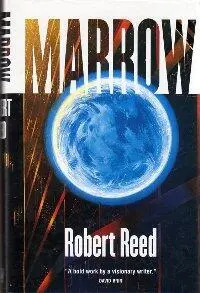
- Название:Marrow
- Автор:
- Издательство:Tor Books
- Жанр:
- Год:2000
- ISBN:0-312-86801-4
- Рейтинг книги:5 / 5. Голосов: 1
-
Избранное:Добавить в избранное
- Отзывы:
-
Ваша оценка:
Marrow: краткое содержание, описание и аннотация
Предлагаем к чтению аннотацию, описание, краткое содержание или предисловие (зависит от того, что написал сам автор книги «Marrow»). Если вы не нашли необходимую информацию о книге — напишите в комментариях, мы постараемся отыскать её.
Marrow — читать онлайн бесплатно полную книгу (весь текст) целиком
Ниже представлен текст книги, разбитый по страницам. Система сохранения места последней прочитанной страницы, позволяет с удобством читать онлайн бесплатно книгу «Marrow», без необходимости каждый раз заново искать на чём Вы остановились. Поставьте закладку, и сможете в любой момент перейти на страницу, на которой закончили чтение.
Интервал:
Закладка:
Then she turned, and never mentioning the Waywards, she said, “We’ve wasted enough time. Lets find out what’s upstairs.”
Tiny cap-cars remained in their berths, untouched by any hand and shielded by kilometers of hyperfiber. Their engines remained charged, but every system was locked into a diagnostic mode. The com-links refused to work. The ship was dead, said the silence. But then Washen remembered that the com-link was singular and tightly guarded, and after a century’s wait, the security systems would have ripped out the only tongue, as a reasonable precaution.
Miocene offered a code that brought one car to life.
Occasionally Washen would glance at the Submaster. measuring the woman’s stern profile, and her silence, wondering which of them was more terrified. The long access tunnel led straight upward, not a trace of damage or disruptions showing anywhere along the narrow shaft. Then the tunnel ended with a slab of hyperfiber. Touch codes caused the slab to detach and fall inward, revealing an abandoned fuel line—a vertical shaft better than five kilometers across.
Against that vastness, the doorway closed again, vanishing.
The car skimmed along the surface of the fuel line, always climbing, gradually turning onto its back as they slipped closer to the vast fuel tank. If the great ship’s engines were firing, not so much as a shiver reached them. But those engines rarely ignited, Washen reminded herself. The stillness meant nothing. Nothing.
Between the women, a pact had formed. Neither mentioned where they were going. After such an enormous wait, neither dared make the tiniest speculation. Possibilities had been exhausted. What was, was. Each said it with her eyes, her silence. It was implicit in the way their long hands lay in their laps, peacefully wresding with one another.
The vast tunnel passed sleeping pumps larger than some moons.
Quietly, Washen asked, “Where?”
The Submaster opened her mouth, then hesitated.
Finally, strangely, she asked, “What do you think is best?”
“The leech habitat,” Washen allowed. “Maybe someone lives there now. And if not, we could still borrow its com-lines.”
“Do that,” Miocene replied.
They entered through the fuel tank, flying high above the dark hydrogen sea. The leech habitat was exactly as Washen remembered it. Empty. Clean. Forgotten. A scan showed nothing alive and warm. She slipped into its docking berth, then they climbed into the gray hub. With a breath and a slack, numbed expression, Miocene touched the aliens’ only com-panel, and nothing happened. In frustration, she said, “Shit,” and stepped back, telling Washen, “Do it for me. Please.”
But there wasn’t anything to do.
“It’s malfunctioned, or there’s no com-system anymore.” Washen said the words, then felt her belly knot up and ache.
Miocene glared at the dead machinery.
After a long moment, they turned away, saying nothing as they climbed back into the waiting cap-car.
A narrow service tunnel angled upward, passing through a series of demon doors, an atmosphere building with each crisp crackle. And in a soft, whispering voice, Miocene asked, “How many were on board? Do you remember?”
“One hundred billion.”
The Submaster closed her eyes and held them closed.
“Plus the machine intelligences. Another one hundred billion, at least.”
Miocene said, “Dead. They all are.”
Washen couldn’t see through her tears. With the back of a hand, she wiped her face, and she muttered, “We don’t know,” with a contrived hopefulness.
But Miocene said, “Dead,” again. She was defiant about her pronouncement. Then she straightened the clumsy fabric of her uniform, staring at her hands and the reflections that seemed to float inside her chest, and she sighed and looked up, staring straight ahead and sighing once again before announcing, “There is a higher purpose. To all of this. Since we’re still alive, there must be.”
Washen didn’t respond.
“A higher purpose,” the woman repeated. Smiling now. That wide strange smile said as much as her words.
The service tunnel ended inside one of the deepest passenger districts. Suddenly they were skimming along the obsidian floor of a broad, flattened tunnel—a minor passageway barely half a kilometer across—and it was plainly, horribly empty. No traffic. No important, busy lights. And to herself, in misery, Washen said, “Maybe the crew and passengers… maybe we were able to evacuate everyone…”
“Doubtful,” was Miocene’s response.
She turned to stare at Washen, ready to say something else honest, and harsh. But her expression changed abruptly. The eyes went distant, and wide, and Washen looked back over her shoulder in time to see a vast machine appear behind them, bearing down on them until a collision was imminent, then skipping sideways with a crisp, AI precision. And the machine passed them. A car, it was. A light-filled diamond hull held a lake of warm saltwater, and floating in the center of the lake was the sole passenger—a whalelike entity with a forest of strong-handed symbionts rooted on its long back—and as it passed them at a blurring, impolite speed, the entity winked. Three of its black eyes winked just as humans would wink, offering them nothing but a friendly, casual greeting.
It was a Yawkleen.
More than four millenia removed from her post, yet Washen immediately remembered the species’ name. With a flat, disbelieving voice, Miocene said, “No.” But it was true.
Suddenly another dozen cars caught up with them, then slipped past. Washen saw four harum-scarums, and what could have been a pair of humans, and then an insectish creature that reminded her, with its intricate jaws and long black back, of the crap-sculptor beetle from the Marrow jungles.
From back home, Washen was thinking.
Where, if the truth were told, she’d almost prefer to be.
Twenty-five
A small, obscure waystation lay on the tubeway s floor.
With a pained voice, Miocene ordered Washen to stop. Their car passed through a series of demon doors, an atmosphere spun around them.Then they did nothing.The Submaster sat erect, hands trembling and her face iron-taut and her mouth opened just enough to pull in a series of quick deep breaths, that private little wind whistling across her angry lips, a wild fury spreading from her eyes into her face, her body, then filling the car until Washen couldn’t help but feel her own heart hammering against her new ribs.
Finally, with a soft choked voice, Miocene said, “Go into the station.”
Washen climbed from the car. “Do it,” Miocene commanded.
She was shouting at herself, staring at her folded legs and her trembling hands, then at the single hand that Washen offered, along with a quiet voice that reminded her, “Whatever is, is. Madam.”
The Submaster sighed and stood without accepting help.
The station’s lounge was small and tidy, flexible furnishings meant for almost any traveler, its floor and arching walls decorated with beds of false limestones, buttery-yellow and white and gray, each bed impregnated with a different stew of artificial fossils that looked terran at first glance. Which was the only glance that Washen allowed herself, stepping through the last demon door and finding no one present but the resident AI.
“The Master Captain!’ Miocene barked.’Is she alive and well?”
With a smooth cheeriness, the AI reported, “The woman is in robust good health. And she thanks you for inquiring.”
“How long has she been healthy?” Washen pressed, in case there was a new Master.
“For the last one hundred and twelve millenia,” the machine replied. “Bless her, and bless ourselves. How can we do otherwise?”
Читать дальшеИнтервал:
Закладка:
Похожие книги на «Marrow»
Представляем Вашему вниманию похожие книги на «Marrow» списком для выбора. Мы отобрали схожую по названию и смыслу литературу в надежде предоставить читателям больше вариантов отыскать новые, интересные, ещё непрочитанные произведения.






Обсуждение, отзывы о книге «Marrow» и просто собственные мнения читателей. Оставьте ваши комментарии, напишите, что Вы думаете о произведении, его смысле или главных героях. Укажите что конкретно понравилось, а что нет, и почему Вы так считаете.