Robert Reed - Marrow
Здесь есть возможность читать онлайн «Robert Reed - Marrow» весь текст электронной книги совершенно бесплатно (целиком полную версию без сокращений). В некоторых случаях можно слушать аудио, скачать через торрент в формате fb2 и присутствует краткое содержание. Год выпуска: 2000, ISBN: 2000, Издательство: Tor Books, Жанр: Фантастика и фэнтези, на английском языке. Описание произведения, (предисловие) а так же отзывы посетителей доступны на портале библиотеки ЛибКат.
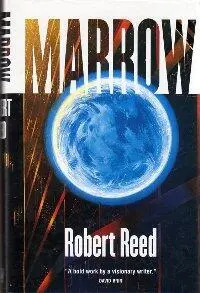
- Название:Marrow
- Автор:
- Издательство:Tor Books
- Жанр:
- Год:2000
- ISBN:0-312-86801-4
- Рейтинг книги:5 / 5. Голосов: 1
-
Избранное:Добавить в избранное
- Отзывы:
-
Ваша оценка:
Marrow: краткое содержание, описание и аннотация
Предлагаем к чтению аннотацию, описание, краткое содержание или предисловие (зависит от того, что написал сам автор книги «Marrow»). Если вы не нашли необходимую информацию о книге — напишите в комментариях, мы постараемся отыскать её.
Marrow — читать онлайн бесплатно полную книгу (весь текст) целиком
Ниже представлен текст книги, разбитый по страницам. Система сохранения места последней прочитанной страницы, позволяет с удобством читать онлайн бесплатно книгу «Marrow», без необходимости каждый раз заново искать на чём Вы остановились. Поставьте закладку, и сможете в любой момент перейти на страницу, на которой закончили чтение.
Интервал:
Закладка:
The captains sat back to back. Unable to see the Submaster’s face, Washen found herself thinking about little else. It was the same cold, confident face that it had always been, and it wasn’t. Washen always marveled at how Marrow had changed that rigid woman. A metamorphosis showed in the wasted, haunted eyes, in the taut corners of the pained mouth. And when she spoke, as she did now, even a simple word felt infinitely sad, and a little profound.
“Initiate,” that sad voice commanded.
There was a pause.
Then the little man said softly, with resignation, “Yes, madam.”
They were falling, accelerating down a dark, airless shaft. This wasn’t a bridge, and it was never supposed to be. It was a vast piece of munitions, and everything depended on its accuracy. Descending to the starting point, to the electromagnetic breech, Miocene whispered technical details. Terminal velocity. Exposure to the buttresses. The transit time. “Eighteen point three seconds.” Which was nearly as long as they spent inside the buttresses on their way down. But without the same levels of protection, or backup systems, or even a single field test beyond the laboratory.
The ugly cannonball stopped abruptly, then its thick walls began to hum. To crackle, and sputter, and seemingly ripple as the protective fields were woven tighdy around them.
Again, Miocene said, “Initiate.”
There was no response this time. Would the man obey? But as she thought those words, Washen was slammed back into her seat, bone pressed against dense padding, gee forces mounting, tearing flesh and bursting blood vessels.
Then came the sensation of drifting.
A pleasant, teasing peace.
After leaving the shaft, there was perhaps a half second of streaking up through the last breaths of the atmosphere, a cluster of little rockets firing on the hull, correcting for the very thin winds. In her mind’s eye, Washen saw everything: Marrow’s storm clouds and cities and tired volcanoes falling behind while the slick sliver of the chamber wall descended on them. Then they struck the buttresses, and her eyes filled with random colors and senseless shapes, while a thousand incoherent, terrified voices screamed inside her dying mind.
Madness.
Eighteen point three seconds of nothing else.
Time dragged. That’s what she promised herself when she managed to concentrate, carving a sensible thought out of that screaming chaos. It was a symptom of the buttresses, this compression of the seconds. Because if more than eighteen seconds had passed, they had simply missed their target, falling short, and now they were tumbling in a close, fatal orbit around Marrow.
No, we can’t be, Washen whimpered.
The frightened voices lent her their fear, and a ragged wild panic took her by the throat, by the colon. Nausea came in one savage thrust. Washen bent forward as far as the padded straps allowed, and with her left hand she managed to yank the silver clock from its pocket, then open it, that sequence of practiced motions requiring what seemed to be hours of relentless work.
She stared at the fastest hand.
A solid click meant that a full second had passed.
Then, another.
Then her seat, and Miocene’s, unlocked and slipped on the titanium rails, meeting at the opposite end of the little cabin, locking again with a crisp determination.
Washen looked up.
Swallowing a burning mouthful of bile and vomit, she stared up at where she had just been, and she saw herself restrained in an identical chair, her own face twisted in misery, gazing down, hair hanging loose and long, unlike Washen’s bunned hair, and the mouth opening as if this hallucination were ready to offer a few tortured words.
Washen watched herself, and in rapt attention, listened.
But then they had pierced the buttresses, and a string of angry rockets fired beneath Washen, braking the vehicle as it plunged, she hoped, into the battered remains of the original bridge.
Impact.
Washen felt the car scrape hard against hyperfiber. There was a sloppy shrieking on her right as pipes and boiling superconductors were stripped away. Then an instant of silence, followed by a second, deeper roar from her left, their car bouncing down the shaft.
Rockets barked again, killing momentum at all costs.
The final impact was abrupt and crushing, and it was over before her mind registered the barest pain.
The chair fell back into its original position.
A voice said, “There.”
Miocene’s voice. Then the Submaster fought her way out of her belts and made herself stand, holding her long sides as she sipped each breath, acting as if her ribs had been shattered.
Washen’s ribs were on fire. She eased herself out of her chair, feeling the delicious warmth as the curved bones knitted themselves. Emergency genes synthesized machinery that turned masticated flesh into new bone and blood, giving her strength enough to stand. She sipped one breath, then another. The hatch began to open itself, creaking with each slow millimeter. If it jammed, they were trapped. Doomed. But that would be a ridiculous finish. Ludicrous. Which was why she dismissed the possibility, refusing to worry.
The hatch gave a squeal and jammed.
Then after a prolonged silence, it freed itself with a white-hot screech.
Darkness fell on them. Miocene stepped out into the silence, into the darkness. Her exhausted black eyes were huge. She was staring at the empty berths as Washen climbed and joined her, the two women standing close enough to touch each other, but avoiding that gesture, busily scouring their memories for the way out of the unlit assembly station.
At the same moment they pointed in the same direction, saying, “That way”
Base camp had been without power for forty-six centuries. The Event had crippled every machine. Reactors, drones, all of it. The magnetic latches on every sealed door had failed. Pushing the last door aside, they stepped out into the soft, muted light of the dying buttresses.
“Wander,” Miocene ordered. “For half an hour. Then meet at the observation station, and we’ll go on from there.”
“Yes, madam.”
Washen started for the dormitories, then thought better of it. Instead she crept into the biolabs, opening curtains for light and dislodging dust that fell softly over dust. Ever)’ system was ruined. Cages with tough mechanical locks remained sealed—an ancient precaution—and inside each cage lay mounds of colorless dust. Washen found keys left hanging above a captain’s empty desk. Eventually she found the key that would fit and turn, and quietly, she crept into one of the cages, stepping over a child’s doll, then kneeling to reach into the largest dust pile.
Without food or water, the abandoned lab animals had dropped into comas, and as their immortal flesh lost energy and moisture, they had quietly and thoroughly mummified themselves.
Washen picked up one of the mandrill baboons—an enormous male weighing little more than a breath—and she held it against her own body, looking into the desiccated eyes, feeling its leathery heart beat, just once, just to say, “I waited for you.”
She set him down carefully, and left.
Miocene was standing on the viewing platform, impatient and concerned, gazing expectantly at the horizon. Even at this altitude, they could only see the captains’ realm. The nearest Waywards were hundreds of kilometers removed from them. Which might as well have been hundreds of light-years, as much as the cultures interacted anymore.
“What are you looking for?” Washen asked.
The Submaster said nothing.
“They’ll find out what what we’ve done,” Washen had to tell her. “If Till doesn’t know already, I’d be surprised.”
Miocene nodded absently, taking a deep, deep breath.
Читать дальшеИнтервал:
Закладка:
Похожие книги на «Marrow»
Представляем Вашему вниманию похожие книги на «Marrow» списком для выбора. Мы отобрали схожую по названию и смыслу литературу в надежде предоставить читателям больше вариантов отыскать новые, интересные, ещё непрочитанные произведения.







Обсуждение, отзывы о книге «Marrow» и просто собственные мнения читателей. Оставьте ваши комментарии, напишите, что Вы думаете о произведении, его смысле или главных героях. Укажите что конкретно понравилось, а что нет, и почему Вы так считаете.