Robert Reed - Marrow
Здесь есть возможность читать онлайн «Robert Reed - Marrow» весь текст электронной книги совершенно бесплатно (целиком полную версию без сокращений). В некоторых случаях можно слушать аудио, скачать через торрент в формате fb2 и присутствует краткое содержание. Год выпуска: 2000, ISBN: 2000, Издательство: Tor Books, Жанр: Фантастика и фэнтези, на английском языке. Описание произведения, (предисловие) а так же отзывы посетителей доступны на портале библиотеки ЛибКат.
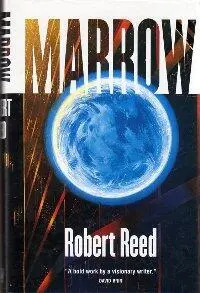
- Название:Marrow
- Автор:
- Издательство:Tor Books
- Жанр:
- Год:2000
- ISBN:0-312-86801-4
- Рейтинг книги:5 / 5. Голосов: 1
-
Избранное:Добавить в избранное
- Отзывы:
-
Ваша оценка:
Marrow: краткое содержание, описание и аннотация
Предлагаем к чтению аннотацию, описание, краткое содержание или предисловие (зависит от того, что написал сам автор книги «Marrow»). Если вы не нашли необходимую информацию о книге — напишите в комментариях, мы постараемся отыскать её.
Marrow — читать онлайн бесплатно полную книгу (весь текст) целиком
Ниже представлен текст книги, разбитый по страницам. Система сохранения места последней прочитанной страницы, позволяет с удобством читать онлайн бесплатно книгу «Marrow», без необходимости каждый раз заново искать на чём Вы остановились. Поставьте закладку, и сможете в любой момент перейти на страницу, на которой закончили чтение.
Интервал:
Закладка:
“The bridge,” some repeated. While others, distracted by the concrete and the present, watched Miocene and her guards pass behind the altar, followed closely by the flustered administrator. The altar was built from native diamonds mounted in a tube no wider than a human arm. At its base was an intricate mock-up of the city and the finished temple. The tube rose up to the domed ceiling that was painted to resemble a darker sky, and where the ragged stump of the first bridge clung tight, the diamond bridge joined seamlessly, flecks of bright light forever streaking upward, showing the migration of the loyal multitudes—their glorious reward for so much sacrifice and enthusiastic hope.
Miocene barely glanced at the parishioners.
It was perfectly acceptable for her to visit the temple, and she didn’t want them noticing anything remarkable in her manner or her eyes.
“When the time is right,” the priest shouted, “we shall climb. Climb!”
Then he whirled, his gray robe fluttering and one arm beginning an overly dramatic gesture at the diamond spire, and when he noticed the Submaster and her tiny entourage, his surprise collapsed into instant ritual.
Bowing, he cried out, “Madam.”
The audience behind him shouted, “Madam,” and fell forward in their iron seats.
Thankfully, she had reached the library stairs. After a hurried wave and the briefest look, Miocene turned and began to climb, leading her guards and them worrying because of it. The senior guard told her, “No, madam,” and unceremoniously slowed her with a strong hand to the shoulder.
Fine.
She eased her gait, perhaps more than necessary. The guard passed her as the staircase spiraled its way up through the heart of the great building. If memory served, the stair’s architect was a difficult grandchild with a narrow genius. She had used the shape of DNA as her inspiration. The fact that only a sliver of modern genetics were encoded in that delicate compound made no difference. It had struck the architect as a suitable symbol. Rising through the oldest language to reach the newest… or some equally forced symbolism, wasn’t it…?
To Miocene, symbols were crutches for the lame. It was a very old opinion for her, and the last three millenia had only reinforced it.
Like the temple, this quasi-religion was thick with symbols. G-class suns were equated with virtue seeds. What nonsense! There were only so many colors in the universe, at least to human eyes. And Miocene had seen many, many Sol-like suns. If she wished, she could warn the parishioners that under no circumstances would a sun and a seed be confused. Not in brightness, or in color. Gold was a simple thing, and sunlight never was. Ever.
And yet.
This temple and its cobbled-together faith were as much her idea as anyone’s. And the Submaster hadn’t ordered the temple’s construction for easy cynical reasons. No, the temple would serve as the foundation for the coming bridge. Physically, and otherwise. It was imperative that the Loyalists understood what was going to happen. If they didn’t comprehend and embrace these goals, and keep themselves unswayed by the Waywards’ bizarre faith, there was no point in escaping from Marrow. This temple, and dozens of smaller temples scattered across the land, were meant to be places of education and focus. If people required symbols and sloppy metaphors to build a consensus, then so be it. Miocene just wished that the grandchildren would stop being so inventive, and so earnest, particularly with things about which they knew almost nothing.
The lead guard slowed, then muttered something to someone around the bend. A full squad waited in the library, all armed with heavy-caliber weapons, all watching with a decidedly unscholarly interest as a boyish man, dressed in common clothes and a Gordian wig, paged his way through a dense technical synopsis of the ship.
According to his interrogators, he was named for the tree.
He went by Virtue.
Miocene said the name, just once and not loudly. The man didn’t seem to hear, eyes focused on a diagram of an antimatter-spiked fusion reactor. Instead of repeating his name, she stood on the far side of the table, and she waited, watching as the gray eyes absorbed the meaningful words and the elegant lines, these intricate plans drawn from memory by one of her colleagues.
Slowly, slowly, the defector grew aware of the newcomers.
He lifted his gaze, and as if emerging from some private fog, he blinked a few times, then said, “Yes.” He said, “This is wrong.”
“Excuse me?” Miocene inquired.
“It won’t work. I’m certain.” He touched the black corner of the page, and the book moved to the next page. The same reactor was pictured, conjured from the same memory but a different vantage point. “The containment vessel isn’t strong enough. Not by hall.”
Like so many grandchildren, he was a difficult genius.
With a look and a slashing gesture, Miocene told the guards and soldiers to leave the two of them alone.
The temple administrator had to ask, “How long will you need the library?” Then to explain her boldness, she added, “Researchers are coming from Promise-and-Dream’s biolabs. They’ve got some priority project—”
“Make them wait,” she growled.
“Yes, madam.”
Then Virtue told everyone, “I don’t know if I’d trust a word in this place.” He spoke loudly and without a hint of charm. “I thought I’d be drinking from some fucking fountain of wisdom, or something. But I just keep finding mistakes. Everywhere I look, mistakes.”
Mildly, the Submaster told him, “Well. Then it’s a good thing that you happened by.”
The defector closed his current volume, in disgust.
To her personal guards, Miocene said, “Out of earshot. Wait.” Then to the administrator, she said,’Go downstairs. Go down and tell all those worshipers that the Submaster would appreciate a long and very loud song.”
“Which song?” the woman sputtered.
“Oh, that’s their choice,” Miocene replied. “It’s always theirs.”
The defector was an emotional alloy: two parts arrogance, one part fear.
It was a useful combination.
Sitting at the table with Miocene, Virtue seemed to recall that smiles were a helpful gesture. But he wasn’t particularly skilled with the expression, his smile looking more like a pained wince, his light gray eyes growing larger by the moment.
“I told them that I absolutely had to see you,” he reported. “Only you, and as soon as possible.”
“Madam Miocene.”
His genius wavered. A stupid voice said, “Pardon?”
“I am your single hope,” she replied, leaning back in the tall chair as if disgusted by the creature before her. “You live out the day if I let you. Otherwise, you die. And I think that I’m entitled to hear my name used in the proper fashion, at the proper times.”
He looked at his own hands.
Then, quietly, “Madam Miocene.”
“Thank you.” She showed him a narrow grin, then with a slow, almost indifferent set of motions, she opened the bright chromium case of her electronic file box, pretending to read what she already knew by heart. “To my associates, you claimed that you had something to tell me. News fit only for my ears.”
“Yes… Madam Miocene…’ He swallowed hard, then said, “It has to do with this world of ours—”
“This isn’t my world,” she interrupted.
Virtue nodded, and waited. His eyes couldn’t have been larger.
Miocene pretended to concentrate on the screen. “It says here… that you’re a second-generation descendant of Diu—”
“He was my grandfather, yes. Madam.”
“And your father…?”
“Is Till.”
She looked up, staring as if she had never noticed the familial resemblance. After a lengthy pause, she mentioned, “Many Waywards are Till’s children. As I understand these things.”
Читать дальшеИнтервал:
Закладка:
Похожие книги на «Marrow»
Представляем Вашему вниманию похожие книги на «Marrow» списком для выбора. Мы отобрали схожую по названию и смыслу литературу в надежде предоставить читателям больше вариантов отыскать новые, интересные, ещё непрочитанные произведения.






Обсуждение, отзывы о книге «Marrow» и просто собственные мнения читателей. Оставьте ваши комментарии, напишите, что Вы думаете о произведении, его смысле или главных героях. Укажите что конкретно понравилось, а что нет, и почему Вы так считаете.