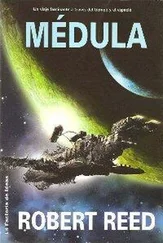
Robert Reed - Marrow
Здесь есть возможность читать онлайн «Robert Reed - Marrow» весь текст электронной книги совершенно бесплатно (целиком полную версию без сокращений). В некоторых случаях можно слушать аудио, скачать через торрент в формате fb2 и присутствует краткое содержание. Год выпуска: 2000, ISBN: 2000, Издательство: Tor Books, Жанр: Фантастика и фэнтези, на английском языке. Описание произведения, (предисловие) а так же отзывы посетителей доступны на портале библиотеки ЛибКат.
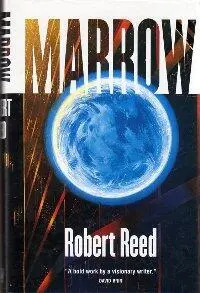
- Название:Marrow
- Автор:
- Издательство:Tor Books
- Жанр:
- Год:2000
- ISBN:0-312-86801-4
- Рейтинг книги:5 / 5. Голосов: 1
-
Избранное:Добавить в избранное
- Отзывы:
-
Ваша оценка:
Marrow: краткое содержание, описание и аннотация
Предлагаем к чтению аннотацию, описание, краткое содержание или предисловие (зависит от того, что написал сам автор книги «Marrow»). Если вы не нашли необходимую информацию о книге — напишите в комментариях, мы постараемся отыскать её.
Marrow — читать онлайн бесплатно полную книгу (весь текст) целиком
Ниже представлен текст книги, разбитый по страницам. Система сохранения места последней прочитанной страницы, позволяет с удобством читать онлайн бесплатно книгу «Marrow», без необходимости каждый раз заново искать на чём Вы остановились. Поставьте закладку, и сможете в любой момент перейти на страницу, на которой закончили чтение.
Интервал:
Закладка:
Nineteen
The captains and their favorite children began searching for the vaults. Every local vent and fissure was watched, first by volunteers, then by automated cameras. Inside their territory, and sometimes beyond, picked teams would inspect stretches of cold iron with the latest generation of seismographs, sonic probes, and eventually, neutron beams, each device making the crust a little more transparent, and knowable, and predictable—a mostly fruitless search for vaults, but yielding a fat wealth of information about ore deposits and quake predictions.
Occasionally, one of those search teams was sent deep into the Wayward lands. The volunteers were armed, but typically in secret ways. They usually stumbled across a village filled with adults and young children who spoke a broken dialect of the ship-terran, and who claimed to have never seen Loyalists. The villages were spartan, haphazard in their layout, but basically clean. Their inhabitants were fit and happy, and as a rule, they acted utterly incurious about life in the burgeoning cities.
The Loyalists happily chattered about their latest technological marvels and all the comforts being added to their daily lives. The Waywards seemed to listen, but they rarely asked even simple questions or offered the smallest, most glancing praise.
The evictions were inevitable, though they were usually polite.
A local chief or president or priest—his exact station was nebulous—would shove aside a plate of half-eaten mite cake or a bowl of raw steel-worms. Then he, or she, would rise with a certain majesty, reminding their guests, “You are very much our guests here.”
The Loyalists would nod, push aside their harsh food, and wait.
“Our guests here.” The pattern was repeated again and again, sometimes with the same words. “ ‘Here,’ ” the chief would tell them, “means the center of the universe. Which is Marrow. ‘Our’ implies the discretion always given to rightful owners. ‘Guests’ are always temporary. Impermanent. And when the Builders wish, we will have no choice but to exclude you from the center of the universe.”
The words were always delivered with a smile.
Then, with an easy gravity, the chief would add, “When you sit with us, you make the Builders unhappy. We can hear their anger. In our dreams and behind our eyes, we hear it. And for your sake, we think that you should return to your guest quarters. Now.”
They were talking about the Loyalist cities.
If the guests refused to leave, there would be a string of petty thefts. Then expensive sensors and field generators would evaporate mysteriously, and if that didn’t change their minds, then their munitions boxes would vanish from their hiding places, each one jammed full of the newest guns and grenades.
Just once, Miocene ordered a team not to retreat. She called for volunteers, then asked, “What are the Waywards capable of?” She was talking to herself, and to them. “Let them steal everything,” she ordered. “Everything short of your lives. That’s what I want.”
The team was flown to an eruption site two thousand kilometers from the capital, and after a few coded transmissions relayed from high-altitude drones, nothing more was heard of them. Then it was six years later, and Diu led a group of Waywards into a settlement on the border. He brought the missing team with him. Standing barefoot and virtually naked on a street paved with new steel, he said, “This shouldn’t have happened. It needn’t have. Tell that bitch Miocene if she wants to play, let her play with her own important life.”
A dozen bodies lay on a dozen sleds, unbound and on their backs, and alive only by the tiniest of degrees. Eyelids had been pinned back, letting the skylight blind them. Barbed hooks kept the mouths pulled open, allowing the light to bake tongues and gums. Famine and a total lack of water had shriveled their bodies to a third of their original size. But worst of all was the way each prisoner had his neck broken. Three times a day, without exception, one of the strong young Waywards would smash the vertebrae and the spinal cord, keeping ahead of the sluggish healing mechanisms, leaving their guests helpless, limp and cut free of their dignity in precisely the same way that Miocene had once treated her son.
Usually once every century, and sometimes twice, the Loyalists came across one of the ancient vaults.
They were always empty, and after a thorough examination, each vault was declared useless and available for sale to the Waywards, in exchange for sulfur and silicon and rare earths. Deals were typically made in the same little city where Diu had brought the prisoners. Happens River was named for a feature obliterated centuries ago, and the city had moved several times since. A Submaster always handled the prolonged, increasingly difficult negotiations, and Locke always represented the Waywards. Washen and Diu served as observers, present because they had always been, but unnecessary to any of the tedious, long-winded business.
Like any old lovers, they took a slightly uncomfortable pleasure in each others company.
Washen was under strict orders to speak with Diu, though she didn’t need prodding. Standing next to Diu, she looked tall and elegant, dressed in her newest uniform, ancient epaulets shining in the skylight as she strolled along a new river’s shoreline. Diu, by contrast, seemed small, his body a little shrunken by the hard Wayward existence, fadess muscle wearing nothing but the only breechcloth that he owned. A mock wool breechcloth, she noted. Not leather. He still was too much of a captain to skin himself alive.
Still and always, Diu was a jittery man. Nervous, quick. And relentlessly, effordessly charming.
Not thinking of her orders but curious for herself, Washen mentioned the Waywards. “Our best guess is that you’ve got twice our population. Or four times. Or eight.”
“Your best guess?” he laughed. “Stinks,” she allowed.
Then he nodded, and grinned, and after a dramatic pause, he admitted, “Eight times is too little. Sixteen times is closer to the mark.”
That gave the Waywards better than twenty-five million citizens. A huge mass of bodies and minds. She let herself wonder what so many modern minds, designed for endless and interesting lives, would think about. Without literature and digitals and sciences and history to embrace, and an ascetic’s endless denial of pleasure… what kinds of ideas could keep such a mind engaged…?
She was trying to frame the question. But when she spoke, something else entirely came out of her mouth.
“Do you remember ice cream?”
Diu giggled.
“That little shop.” She pointed, then said, “It sells the next best thing.”
In that perpetual heat, anything cold tasted fine. In a sugar-poor world, everything sweet was a treasure, even if the treasure was the product of dead chew-chews and biochemical magic. The shop owner conspicuously ignored the Wayward man. Washen paid for both treats as well the rental of the steel bowls and steel spoons. They sat by the river, on a little gold-embossed table set on a patio of iron bricks doctored with cyanides, giving them a blue cast. The river was a mixture of native springs and the runoff from local industries, creating a chemical stew to which Marrow had quickly adapted. The bacterial smell wasn’t pleasant, but it had a strength and an honesty. That’s what Washen was thinking as she watched Diu take a careful bite of the ice cream. Then his eyes grew wide, and he asked, “Is that how chocolate tastes?”
“We aren’t sure,” she admitted. “When you’ve got nothing to go on but your thousand-year-old memories…’ Both of them laughed quietly.
People sauntered past on the nearby walkway: lovers holding one another. Friends chattering. Business associates planning for a prosperous future. A couple had their toddler strapped into a wheeled cart. Like everyone else, they never quite looked at the Wayward sitting in plain view, eating ice cream. Only their child stared in amazement. Washen found herself thinking about the prisoners that Diu had brought back to Happens River. He had had no role in their torture. She had never asked, but he had volunteered his innocence just the same. Decades ago, now. Why even think about it? Then she looked at him, and smiled, trying to change the flow of her ancient mind.
Читать дальшеИнтервал:
Закладка:
Похожие книги на «Marrow»
Представляем Вашему вниманию похожие книги на «Marrow» списком для выбора. Мы отобрали схожую по названию и смыслу литературу в надежде предоставить читателям больше вариантов отыскать новые, интересные, ещё непрочитанные произведения.





Обсуждение, отзывы о книге «Marrow» и просто собственные мнения читателей. Оставьте ваши комментарии, напишите, что Вы думаете о произведении, его смысле или главных героях. Укажите что конкретно понравилось, а что нет, и почему Вы так считаете.