Robert Reed - Marrow
Здесь есть возможность читать онлайн «Robert Reed - Marrow» весь текст электронной книги совершенно бесплатно (целиком полную версию без сокращений). В некоторых случаях можно слушать аудио, скачать через торрент в формате fb2 и присутствует краткое содержание. Год выпуска: 2000, ISBN: 2000, Издательство: Tor Books, Жанр: Фантастика и фэнтези, на английском языке. Описание произведения, (предисловие) а так же отзывы посетителей доступны на портале библиотеки ЛибКат.
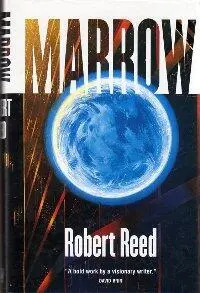
- Название:Marrow
- Автор:
- Издательство:Tor Books
- Жанр:
- Год:2000
- ISBN:0-312-86801-4
- Рейтинг книги:5 / 5. Голосов: 1
-
Избранное:Добавить в избранное
- Отзывы:
-
Ваша оценка:
Marrow: краткое содержание, описание и аннотация
Предлагаем к чтению аннотацию, описание, краткое содержание или предисловие (зависит от того, что написал сам автор книги «Marrow»). Если вы не нашли необходимую информацию о книге — напишите в комментариях, мы постараемся отыскать её.
Marrow — читать онлайн бесплатно полную книгу (весь текст) целиком
Ниже представлен текст книги, разбитый по страницам. Система сохранения места последней прочитанной страницы, позволяет с удобством читать онлайн бесплатно книгу «Marrow», без необходимости каждый раз заново искать на чём Вы остановились. Поставьте закладку, и сможете в любой момент перейти на страницу, на которой закончили чтение.
Интервал:
Закладка:
At a distance, it was obvious that this was a captain. A woman, wasn’t she? She wore a captain’s clothes and a captain’s disapproving face, but when everyone saw whose face it was, they gave a collective sigh of relief.
“Hello, Madam Washen!’ a dozen voices called out.
With another captain, there would have been immediate miseries. But not with smart old Washen. She had a reputation for understanding what was perfectly obvious to any happy grandchild, and for knowing how to punish without killing the happiness, too.
“Having fun?” she inquired.
Of course they were. Didn’t it look as if they were having fun?
“Not entirely,” the ancient woman admitted. She looked at each of their faces, saying, “I count twelve,” with an ominous tone.Then she sighed and shook her head, asking, “Where’s Blessing Gable? Was she with you?”
“No,” they said together, with a mixture of surprise and relief. Then one of the boys explained, “She’s way too old to float with us.”
The girl who liked Remoras realized what had happened. “Blessing has gone missing, hasn’t she?”
The captain nodded.
“To the Waywards, maybe?” Blessing was a quiet girl, and if she was too old for them, she was the perfect age for that nonsense.
“Maybe she’s left us,” Washen admitted with a sad, resigned tone. Then without another word, she stepped past the grandchildren.
Their prize sat in the middle of the trail, bright despite the tree’s shadows.
Someone asked, “See what we found?”
“No,” said Washen. As a joke. Then her long fingers played across the still-warm surface, the dark old eyes staring at her own distorted reflection.
“Do you know what it is?” asked the boy who wanted to live by the sea.
Washen fingered the knobs, and instead of answering, she asked. “What do you think it is?”
“A piece of the old bridge. The one you came down on.” The boy had given the matter some thought, and he was proud of his careful reasoning. “After it tumbled down, the iron swallowed this piece and kept it until now. I think.”
Several others voiced their agreement. Wasn’t it obvious?
The captain didn’t seem to think so. She looked at the Remora girl, then with her calm and smooth and happy voice asked, “Any other guesses?”
Someone asked, “Is it hyperfiber?”
“I don’t know what else it would be,” Washen admitted.
“But the bridge was ruined by the Event,” the Remora girl offered. “In our history books, it says it was made brown and weak, somehow, and all its little bonds kept breaking apart. Somehow”
Washen winked, making the girl feel important, and smart.
“And it isn’t just hyperfiber,” the girl added, talking too quickly now. “Because it’s so heavy, and hyperfiber isn’t. Is it?”
Washen shrugged, then said, “Tell me how you found it. And where.”
The girl tried. And she meant to be perfectly honest, though she never mentioned sex, and the story came charging out of her mouth as if she were taking credit for everything.
Her one-time lover protested. “I saw the stupid thing first,” he complained. “Not you.”
“Good eyes,” Washen offered. “Whoever was using them.”
The girl bit her own stupid, careless tongue.
“What does this look like?” asked Washen.
“A piece of the sky,” said the boy. “Sort of, it does.”
“Except it’s brighter,” another boy offered.
“And bumpy,” another girl offered.
With the salty taste of blood in her mouth, the Remora girl observed, “It’s sort of like a tiny, tiny version of the Great Ship. Those knobs are the rocket nozzles, see? Except they aren’t really big enough. Not like the nozzles in the paintings.”
“But there is a resemblance,” Washen conceded. Then she stood and wiped her hand on the leg of her uniform, and looking off toward the doomed High Spines, she said, “Honestly.” Her voice was gentle. “I don’t know what this is.”
Eighteen
For the next one hundred and eight years, the artifact lay in storage, wrapped within a clean purple woolbark blanket and tucked inside a steel vault designed to hold nothing else. Aasleen and her engineers had been given the fun of divining its secrets. But at least one Submaster had to be present whenever studies were undertaken, and if the artifact was to be moved, as it was during two eruption cycles, a Submaster as well as a platoon of picked and utterly trustworthy guards accompanied the relic, weapons politely kept out of sight but a palpable air of suspicion obvious to all.
For many reasons, that century was dubbed The Flowering.
There were finally enough grandchildren, mature and educated and inspired, that something resembling an industrialized nation was possible. A lacework of good smooth roads was built between the cities and largest villages, then rebuilt after each eruption. More important were the crude smear-signal transmitters, hung high on mountain peaks and steel poles, that network allowing anyone to speak with anyone within a thousand-kilometer zone. Clumsy carbide drills gnawed through the crust, reaching the molten iron, then simple-as-can-be geothermal plants were erected, supplying what seemed to be a wealth of power to the labs and factories and increasingly luxurious homes. Life on Marrow remained a hard, crude business. But that wasn’t what the captains said in public. In front of the grandchildren, they mustered up every imaginable praise for the new biogas toilets and the cultured bug-based meats and the frail, fixed-wing aircraft that could, if blessed with good weather, crawl all up into the cold upper reaches of the atmosphere. They weren’t trying to mislead so much as encourage. And really, they were the ones who needed most of the encouragement. Life here might not match the serene pleasures found inside the ship, but to a youngster barely five centuries old, it was obvious that his world had grown more comfortable in his lifetime, and more predictable, and if he could have known about the captains’ real disappointments, he would have felt nothing but a pitying, even fearful puzzlement.
The Flowering culminated with a clumsy but muscular laser, designed from Aasleen’s recollections and adapted to local resources, then helped along with her staff’s countless inspirations and other making-dos.
Hundreds attended the first full-strength firing of the laser.
The artifact was its target. The hyperfiber shell was presumably ancient, but it had to be a premium grade. To slice a hair-wide hole through the shell meant an enforced blackout, the power from some fifty-odd geothermal plants fed directly into Aasleen’s newest laboratory, into a long cramped room built for this precise moment, a series of microsecond pulses delivered in what sounded like a monster’s roar, lending drama to the moment as well as jarring quite a few nerves.
Miocene sat in the control room, hands tied together in a tense lump.
“Stop!’ she heard Aasleen bark. Finally.
The laser was put to bed. Then an optical cable was inserted into the fresh hole, and the engineer peered inside, saying nothing, forgetting about her audience until Miocene asked, “Is there anything?”
“Vault,” Aasleen reported.
Did she want the artifact set back into its vault?
But before anyone could ask, she added, “It looks a lot like a memory vault. Not human-made, but not all that strange, either.”
With an impatient nod, Miocene said, “What else?”
“A standard bioceramic matrix, with some kind of holo-projector. And a dense ballast at the center.” Aasleen looked in the general direction of her audience, blind to everything but her own quick thoughts. “No power cells, from what I can tell. But what good would they be after a few billion years? Even the Builders couldn’t make a battery that would ignore this kind of long-term heat…”
Читать дальшеИнтервал:
Закладка:
Похожие книги на «Marrow»
Представляем Вашему вниманию похожие книги на «Marrow» списком для выбора. Мы отобрали схожую по названию и смыслу литературу в надежде предоставить читателям больше вариантов отыскать новые, интересные, ещё непрочитанные произведения.







Обсуждение, отзывы о книге «Marrow» и просто собственные мнения читателей. Оставьте ваши комментарии, напишите, что Вы думаете о произведении, его смысле или главных героях. Укажите что конкретно понравилось, а что нет, и почему Вы так считаете.