Robert Reed - Marrow
Здесь есть возможность читать онлайн «Robert Reed - Marrow» весь текст электронной книги совершенно бесплатно (целиком полную версию без сокращений). В некоторых случаях можно слушать аудио, скачать через торрент в формате fb2 и присутствует краткое содержание. Год выпуска: 2000, ISBN: 2000, Издательство: Tor Books, Жанр: Фантастика и фэнтези, на английском языке. Описание произведения, (предисловие) а так же отзывы посетителей доступны на портале библиотеки ЛибКат.
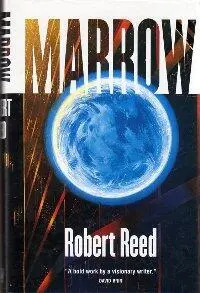
- Название:Marrow
- Автор:
- Издательство:Tor Books
- Жанр:
- Год:2000
- ISBN:0-312-86801-4
- Рейтинг книги:5 / 5. Голосов: 1
-
Избранное:Добавить в избранное
- Отзывы:
-
Ваша оценка:
Marrow: краткое содержание, описание и аннотация
Предлагаем к чтению аннотацию, описание, краткое содержание или предисловие (зависит от того, что написал сам автор книги «Marrow»). Если вы не нашли необходимую информацию о книге — напишите в комментариях, мы постараемся отыскать её.
Marrow — читать онлайн бесплатно полную книгу (весь текст) целиком
Ниже представлен текст книги, разбитый по страницам. Система сохранения места последней прочитанной страницы, позволяет с удобством читать онлайн бесплатно книгу «Marrow», без необходимости каждый раз заново искать на чём Вы остановились. Поставьте закладку, и сможете в любой момент перейти на страницу, на которой закончили чтение.
Интервал:
Закладка:
It had been an unusual evening. Washen happened by, and on a whim, the Submaster asked the woman to join her. Sitting on low stools outside Miocene’s house, they watched the nearly naked children, full grown and otherwise, moving about the public round. A low canopy of fabric and interwoven sticks supplied shade. But there were holes and gashes left by gnawing insects, little places where the skylight fell through. That light had barely diminished in the last one hundred and eighty years. It was still bright and fiercely hot, and on occasions, useful. The Submaster had set a parabolic steel bowl beneath one hole, focusing the raw energies on a battered, much-traveled teapot. The rainwater was coming to a fresh boil, and for her guest, Miocene used a rag, preparing a big mug of tea. Washen accepted the gift with a nod, remarking, “I already have a son.”
Miocene didn’t say what she thought first. Or what she thought next. Instead, she simply replied, “You do. Yes.”
“If I find a good father, I’ll have another one or two.”
Washen had difficulty picking lovers. Diu was a traitor. How else to describe him? But he was a useful traitor, finding ways to feed them information on the Waywards activities’ and whereabouts.
Washen said, “Mass-producing offspring… I just don’t believe that’s best…”
Miocene nodded, telling her, “I agree.”
“And I find myself…’ She hesitated, a smooth political sensibility causing her to shape her next words with care.
“What?” the Submaster prodded.
“The morality of it. Having children, and so many of them, too.”
“What do you mean, darling?”
The gift tea was sipped, swallowed. Then Washen seemed to decide that she didn’t care what Miocene thought of her. “It’s a cynical calculation, making these kids. They aren’t here because of love—”
“We don’t love them?” Miocene’s heart quickened, for just a moment.
“We do, of course. Absolutely. But their parents were motivated by simple pragmatic logics. First, and always. Children offer hands and minds that we can shape, we hope, and those same hands and minds are going to build the next bridge.”
“According to Aasleen’s plans,” Miocene added.
“Naturally, madam.”
“And aren’t those very important reasons?”
“We tell ourselves they are.” Marrow had changed Washen’s face. The flesh was still smooth and healthy, but her diet and the constant UV-enriched light had changed her complexion, her skin now a brownish-gray. Like smoke, really. And more than her flesh, her eyes were different. Always smart, they looked stronger now. More certain. And the mind behind them seemed more willing than ever to put a voice to its private thoughts.
“Shouldn’t we try to escape?” Miocene pressed.
“But what happens afterward?” the captain countered. “We need so many bodies in the next forty-eight hundred years. If we’re going to have the industrial capacity that Aasleen envisions, and assuming that Marrow continues to expand, of course. Assuming. Then we’re back home again, and let’s imagine that we’re heroes, and so on… but what happens to this raw little nation-state that we’ve spawned…?”
“Not everything needs to be decided now,” Miocene replied.
“Which is the worst problem, I think.”
“Excuse me?”
“Madam,” said the captain. “In the end, it’s not our place to decide. It’s our childrens’ and grandchildrens’ future.”
Suddenly, Miocene wished it was time for bed. Then she could excuse herself without losing face, and in her private darkness, she could replicate the day in her diary. A few lines of tiny script were enough. The paper was as thin as technically possible today, but as the years mounted, it was becoming increasingly difficult to carry the burgeoning history.
“Our ship,” said the Submaster, “has embraced every sort of passenger. An odd alien is more demanding than our children can ever be.”
Silence.
Miocene smoothed her uniform. It was a cool white fabric, porous to their fragrant, endless sweat, and sewn through it were threads of pure silver meant to symbolize the mirrored uniforms of the past. Out on the public round and everywhere else, the children wore nothing but breech-cloths and brief skirts and tiny vests. Miocene long ago accepted their near nudity, if only because it allowed the ancient captains, dressed in their noble garb, to stand apart.
Bored with waiting, she asked her companion, “What bothers you, darling?”
“These children,” said Washen.
“Yes?”
“As if they’re the only ones.”
“You mean the Waywards.” Miocene nodded and laughed, and she made a show of finishing her own tea. Then she told the first-grade, “I just assumed they’d want to remain here, where they’re happiest. On Marrow, and we could lock them in here. Nice and tight.”
A new category had eased its way into the Submaster’s scrupuously accurate tally of gains and losses. There were the born, of course, and the dead. And now, in small but swelling numbers, there were the missing.
It was presumed, with reason, that these new casualties were slinking away, taking nothing but the provisions and light tools suitable for a good march. If rumor and physical evidence could be believed, the nearest Waywards were a thousand kilometers past the horizon. It was a daunting journey to any reasonable soul, but Miocene could almost believe that children—the most susceptible to go missing—might convince themselves that here was a worthy challenge, an undertaking sure to answer some vague need or a trivial absence in their very brief lives. She could even picture their reasons. Boredom. Curiosity. Political ideas, sloppy or muscular. Or perhaps they didn’t see advancement for themselves here, inside the Loyalist camp. They were slow, lazy, or difficult people, and maybe the Waywards would be less demanding. Unlikely, but that’s what the missing must have told themselves. And off they marched, singly and in little groups, blissfully counting on youth and good fortune to bring them to their just rewards.
Some died en route.
Alone, in nameless and temporary’ valleys, they were swallowed by the flowing iron, or flash-baked in a burst of fiery gases.
Miocene’s first instinct had been to dispatch search parties, then punish the children for their treachery. But more charitable voices, including her own, cautioned against rough measures. Who mattered were those who remained behind, the willing and the genuinely far-sighted ones.
Each night, placing her daily entry into its asbestos envelope, then into the asbestos trunk, Miocene rewarded herself with small congratulations. Another day accomplished; another centimeter closer to their ultimate goal. Then she would sit on her little bed, typically alone, and because she often forgot to eat during the arbitrary heart of the day, she would force down a slice of heavily spiced fat. She made herself feed a body that rarely felt hunger anymore, but that needed calories and rest, and at least she was able to give it the former. Then Miocene would lie in the imperfect night, typically on her back, and sometimes she would sleep, and dream, and sometimes she just stared up into the contrived darkness, forcing herself to remain motionless for a full three hours, her mind working with a dreamy vagueness, planning the next day, and the next week, and the five thousand years to come.
The Five Hundredth was a ripe moment for grand gestures.
A year-long observance of their lives on Marrow culminated in a week-long celebration, and the celebration peaked with a lavish parade around the Grand Round of Hazz City. Half of the world’s Loyalists were in attendance. Painted bodies marched, friends and family locking arms, or they stood in the Round’s tent-shrouded center, or they watched the parade from one of the fifty wood and plastic buildings that rimmed the neat outside edge of the public area. Fifty thousand happy, well-fed souls were present, and each one of them looked up as Miocene stepped to the podium, glancing at the clock in one hand as the other hand lifted, a long thin finger dropping as a signal, her strong voice announcing:
Читать дальшеИнтервал:
Закладка:
Похожие книги на «Marrow»
Представляем Вашему вниманию похожие книги на «Marrow» списком для выбора. Мы отобрали схожую по названию и смыслу литературу в надежде предоставить читателям больше вариантов отыскать новые, интересные, ещё непрочитанные произведения.







Обсуждение, отзывы о книге «Marrow» и просто собственные мнения читателей. Оставьте ваши комментарии, напишите, что Вы думаете о произведении, его смысле или главных героях. Укажите что конкретно понравилось, а что нет, и почему Вы так считаете.