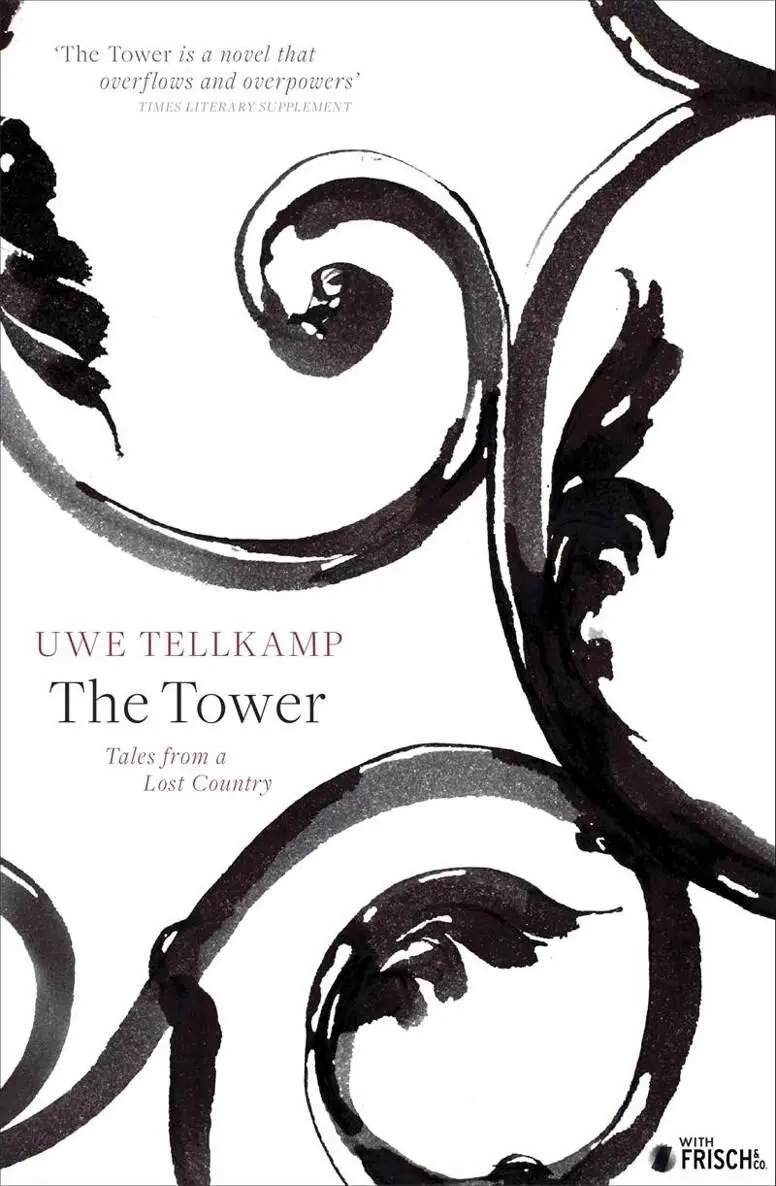
Uwe Tellkamp - The Tower
Здесь есть возможность читать онлайн «Uwe Tellkamp - The Tower» весь текст электронной книги совершенно бесплатно (целиком полную версию без сокращений). В некоторых случаях можно слушать аудио, скачать через торрент в формате fb2 и присутствует краткое содержание. Год выпуска: 2014, Издательство: Penguin, Жанр: Современная проза, на английском языке. Описание произведения, (предисловие) а так же отзывы посетителей доступны на портале библиотеки ЛибКат.
- Название:The Tower
- Автор:
- Издательство:Penguin
- Жанр:
- Год:2014
- ISBN:нет данных
- Рейтинг книги:5 / 5. Голосов: 1
-
Избранное:Добавить в избранное
- Отзывы:
-
Ваша оценка:
The Tower: краткое содержание, описание и аннотация
Предлагаем к чтению аннотацию, описание, краткое содержание или предисловие (зависит от того, что написал сам автор книги «The Tower»). Если вы не нашли необходимую информацию о книге — напишите в комментариях, мы постараемся отыскать её.
The Tower — читать онлайн бесплатно полную книгу (весь текст) целиком
Ниже представлен текст книги, разбитый по страницам. Система сохранения места последней прочитанной страницы, позволяет с удобством читать онлайн бесплатно книгу «The Tower», без необходимости каждый раз заново искать на чём Вы остановились. Поставьте закладку, и сможете в любой момент перейти на страницу, на которой закончили чтение.
Интервал:
Закладка:
‘Well?’ he said. ‘We’d better get a move on.’
‘Hmm,’ she replied.
‘You suddenly don’t feel like it any more?’
‘My lovely shoes … from the West, genuine Salamander, they were expensive! Judith, you’re …’ She gave herself a light slap on the face. ‘No more of that. They’re ruined now, so let’s get on with it.’
‘You can manage it?’
‘Now you sound like your boss. All you need is the mirror and comb.’ She gave an amused snort. With the supple swiftness of a cat she was on the garage roof in seconds. Picking up a few pebbles, Meno followed, he too without a sound, which drew a soft whistle of appreciation from her. ‘To be honest, I was going to ask you the same question. I seem to have underestimated you.’ They lay down flat on the roof and stared into the darkness in front of them.
‘Watch out,’ Meno said; they took cover behind a tree beside the roof. A searchlight flared up, scouring the terrain, they squeezed into the shadow of the tree trunk when it went across them.
‘We can use the tree to get back out,’ Schevola whispered.
‘Keep down.’
Once his eyes had adjusted to the darkness again, Meno threw a pebble. ‘If they’ve got dogs out there, they ought to come now,’ he whispered. Nothing happened. He couldn’t hear anything apart from the distant throbbing and the goods wagons carrying ash from the hospital heating plant; the radio had fallen silent.
‘They just chuck their ash down the hill,’ Schevola whispered. There was the hiss of a boiler, the slam of a door shutting, otherwise it was quiet.
The searchlight felt its way back, boring a tunnel of dazzling brightness in the dark, rolled over the garage roofs, abruptly shot up into the treetops, whitewashed the walls like a decorator painting a room systematically, suddenly jerked upwards, came back down in unpredictable swerves; cautiously Meno and Schevola raised their heads once the tunnel of light receded.
‘Did you see that?’
‘Yes,’ she murmured. ‘Let’s turn back.’
29. Blue vitriol
The record turns like a ship’s screw, the steamer Tannhäuser casts off, taking me into different times (and I heard the musical clock: Dresden … in the muses’ nests / the sweet sickness of yesteryear rests), on deck Captain Tenkes and Sinbad, Osceola and Four Men and a Dog — in a Tank , films we’d seen in the Round Cinema, in the Faun Palace, in the Schauburg in Neustadt, where it smelt of alum, where the fumes of Chlorodont toothpaste from the Leo Works mingled with the chocolate aromas from the factories on Königsbrücker Strasse; the curses of the coachmen with the disgruntlement of misunderstood wits (‘Shall I tell you what Dresden is? This emirate of floor polish and rubber plants?’), cinemas with threadbare seats and display cases with film posters and reviews cut out of Eulenspiegel that only I studied while Niklas had just a dismissive wave of the hand for them, and the boys, Christian, Robert, Ezzo, Fabian, had already joined the queue outside the cinema, they knew all these posters, Belmondo’s boxer’s face, attractive, cold depravity in Alain Delon’s handsome features, Lino Ventura’s sly, brawny correctness, which went with inspectors who, earlier on, before they were inspectors but honest criminals in their prime, had been made an offer, people who couldn’t give up smoking because they had seen things that went beyond the parting in their hair, their employee’s overalls, their briefcase; they have no illusions about the fact that the past will catch up with them and make them pay for what they’ve seen; they know that any dream they’ve put down will never be carried through, even if it’s waiting unchanged, even if they can take off their jacket, touch it and look for the point where it was interrupted; cinemas that had a supporting programme and the DEFA Eyewitness flickered across in front of us, a black-and-white sun, in earlier years the UFA Newsreel and different people in the cinemas to whom the wordsmiths spoke, they seemed to be providing the soundtrack to a law, those voices in the Olympia Picture House, in the Capitol on Prager Strasse, in the Stephenson and UT Picture Palaces, the law that the world is eternally divided into friend and foe, that there will for ever be command and betrayal, victory and defeat, and that the light is with the common people, the cruiser Tannhäuser put out to sea, radio location finders and beams of light probed the night-dark waters, villas under the Soviet star where the toxic roses grew, and sleep and brown snow came down on the town and acid rain from the brown-coal heating plants, glue crept into the river from the cellulose factory, and Pittiplatsch waved from the television tower and the Sandman scattered oblivion, the Bols ballerina danced at the apprentices’ celebration in the slaughterhouse to folk songs on a hurdy-gurdy and the tinkling of a dulcimer, and they shouted ‘pisspot’ beside the blood-channel, the bolt still stuck in the head of the wriggling pig, and ‘piddlebowl’ at the steaming dishes on the table where, following ancient custom, the master slaughterman adds meat dumplings to the cauldron of gruel; fiddles and friction-drum on the Titanic-, panic-deck (and I heard the musical clock: Dresden … in the muses’ nests / the sweet sickness of yesteryear rests) … benumbed, perhaps that’s what it was, Niklas sat motionless by the record player on evenings when the snow sank down or the light of a summer’s day made the pear tree outside the window glow, I had the feeling that the music sucked him dry and at the same time filled him with the delicious essence of oblivion, the record was a spindle with nettle threads that flew out and clung fast to him with barbed hairs, twined themselves tighter with every revolution and pulled his inner being over: where to? there, there … I asked myself how it was possible for a person to live so much in the past, to be able to wipe away the present with an inner flap of the hand — I didn’t see one outwardly, Niklas didn’t position himself in front of me and raise his arm in a theatrical condemnation of everything that was in the light and shade of our day and that we summed up as ‘now’ — a gesture that was a brusque ‘no’, made with all the unmitigated fury with which a grown-up capitulates in the face of their fear; how could he declare this ‘now’ non-existent — was he a fool who’d made an agreement and would pay for it and could do as he liked until then? — I sometimes thought he’d met the Mistress of the Clocks and that she had granted him a clock face that went differently from those she had allotted us … but what was he doing there, in the past? What was it for him? What was it for the Tower-dwellers? Was he present when I thought of him, visited him, imagined him sitting alone at night in the music room listening to opera voices from long-ago recordings that he preserved and perhaps Trüpel or Däne as well, perhaps this or that person we knew nothing about (but one day they would join Däne’s Friends of Music, it had to happen, and Däne suspected there were these still undiscovered connoisseurs, that was why he liked to put special recordings, rare performances, hidden works on his programme in order to lure them), and when Niklas was going home from Lindwurmring, his worn midwife’s bag in his hand, his beret pulled down sideways over his cheek, the way he approached with dignified steps, gently waving his hand up and down (the echo of music from a performance?), his expression one of strict absorption, still not having noticed me, then I thought: Yes, that’s him, one from up here, one of the Tower-dwellers: who spoke of the past as of a Promised Land, surrounded themselves with its insignia, heraldic badges, its postcards and photographs, what was that past to them? A constellation of names, a Milky Way of memories, a planetary system of Sacred Writings and the holiest, the Sun, was called OLD DRESDEN , written by Fritz Löffler (and I heard the musical clock: Dresden … in the muses’ nests / the sweet sickness of yesteryear rests) … and I remember evenings in Guenon House: you went in through the scratched swing door, walked down the wall-to-wall carpeting, time-bleached to the colour of ailing rosewood and fraying at the edges, that daily roused Herr Adeling’s displeasure, past potted plants at the stair corners that reminded me of nicotine-yellow octopuses sulking away for years in the formalin jars of zoological collections, felt crumbling plaster decorated with scenes from the Mastersingers , had accustomed yourself to the panes of glass in the corridor doors held together with Ankerplast adhesive tape — and ended up facing an index finger, pale as a fish and knotted with arthritis, over which a conspiratorial smile appeared: ‘Come in, Herr Rohde, we’re just looking at it.’ There it lay, on a damask-covered table, on a carved lectern, polished to a shine with walnut oil and meticulously rubbed dry, spreading its paper pinions like angel’s wings: the book; come all ye that are heavy laden and refresh yourselves and find rest in the unalterability of my dwelling, come and restore your souls. Open at: the Zwinger, photograph of the Cabinet of Mathematical and Physical Instruments. ‘It was built between 1711 and 1714 as the first of M. D. Pöppelmann’s pavilions during August the Strong’s period as Imperial Regent, as is proved by the use of the imperial eagle in the decoration of the pediment frieze.’ Voices, at first husky but then lubricated by coffee with cream, cherry brandy and Dresden custard pie, reading out, forefinger sliding along the lines, fingernails boring into individual letters, reading glasses telescoping up and down over the paper: ‘Proved, Herr Rohde, did you hear: proved. You will recall the little discussion we had in our circle here on that very topic. Herr Tietze and Herr Malthakus were both here then and agreed with me while you, Herr Pospischil, were a little wide of the mark, as we can see.’ Herr Sandhaus ran his tongue between his teeth, a soft slurping noise could be heard, executed a slight turn of his upper body to the left where Ladislaus Pospischil, born in Vienna, stranded in the chaos of a chaotic century in Dresden, hotelier, wine waiter, dealer in second-hand goods, briquettes, agent for concert artists, presently manager of the Schlemm Hotel on Bautzner Strasse, scrutinized one of Frau Fiebig’s exceedingly brightly polished silver spoons: ‘Proved, Herr Pospischil. It’s in Löffler, I’ve also taken it out of one of my older copies for you. We also talked about it with Herr Knabe.’ Herr Sandhaus handed the hotelier some sooty typewritten carbon copies, with precise references to place of origin, page and line number added and, as far as the appearance of the imperial eagle in the pediment frieze of the Cabinet of Mathematical and Physical Instruments was concerned, an enlarged photograph. ‘There you are. Herr Löffler has also personally confirmed everything to me. I always say: in the next edition he must improve the appearance of the imperial eagle. Just a little. But there it is. It does indeed appear in the pediment frieze, does our much-lauded bird. A drop of liqueur, perhaps? That custard pie’s delicious as usual, Frau Fiebig, tell me, where d’you get it?’
Читать дальшеИнтервал:
Закладка:
Похожие книги на «The Tower»
Представляем Вашему вниманию похожие книги на «The Tower» списком для выбора. Мы отобрали схожую по названию и смыслу литературу в надежде предоставить читателям больше вариантов отыскать новые, интересные, ещё непрочитанные произведения.





Обсуждение, отзывы о книге «The Tower» и просто собственные мнения читателей. Оставьте ваши комментарии, напишите, что Вы думаете о произведении, его смысле или главных героях. Укажите что конкретно понравилось, а что нет, и почему Вы так считаете.