Amir Gutfreund - Our Holocaust
Здесь есть возможность читать онлайн «Amir Gutfreund - Our Holocaust» весь текст электронной книги совершенно бесплатно (целиком полную версию без сокращений). В некоторых случаях можно слушать аудио, скачать через торрент в формате fb2 и присутствует краткое содержание. Год выпуска: 2006, Издательство: Toby Press Ltd, Жанр: Современная проза, Прочая документальная литература, на английском языке. Описание произведения, (предисловие) а так же отзывы посетителей доступны на портале библиотеки ЛибКат.
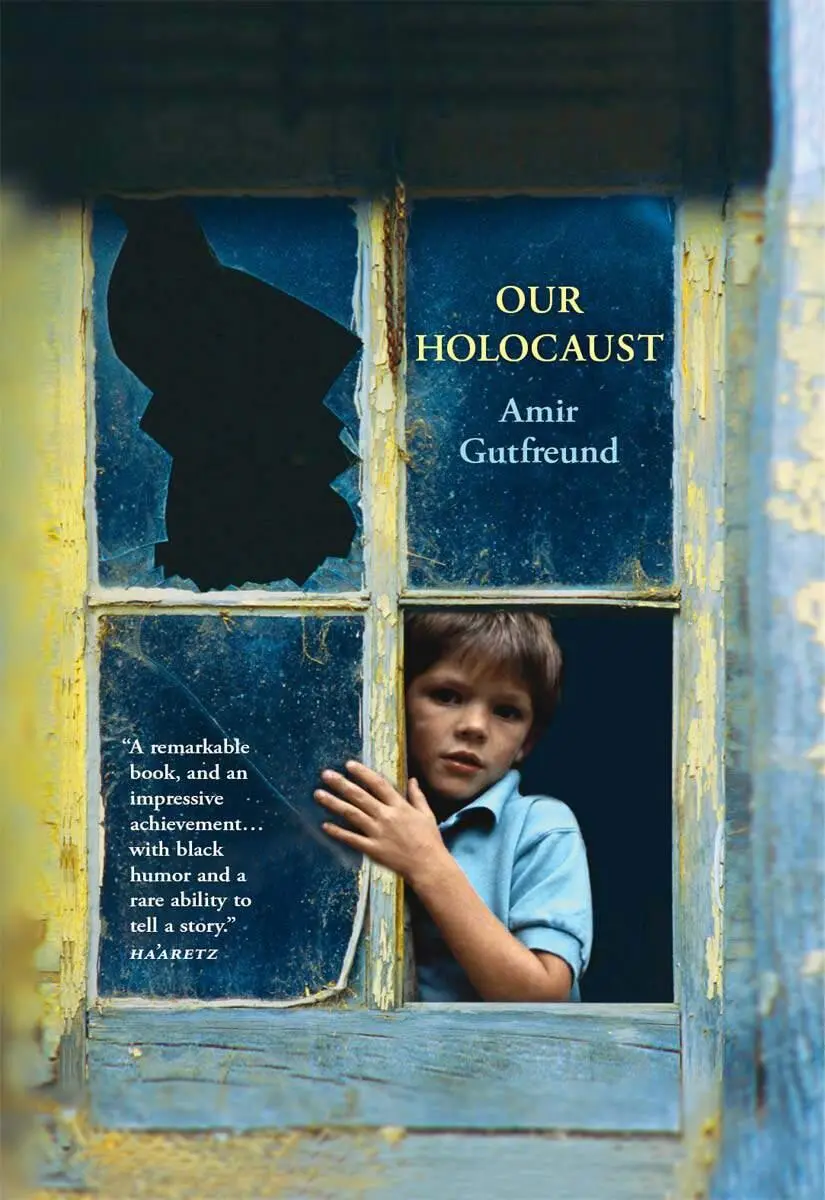
- Название:Our Holocaust
- Автор:
- Издательство:Toby Press Ltd
- Жанр:
- Год:2006
- ISBN:нет данных
- Рейтинг книги:4 / 5. Голосов: 1
-
Избранное:Добавить в избранное
- Отзывы:
-
Ваша оценка:
Our Holocaust: краткое содержание, описание и аннотация
Предлагаем к чтению аннотацию, описание, краткое содержание или предисловие (зависит от того, что написал сам автор книги «Our Holocaust»). Если вы не нашли необходимую информацию о книге — напишите в комментариях, мы постараемся отыскать её.
Our Holocaust — читать онлайн бесплатно полную книгу (весь текст) целиком
Ниже представлен текст книги, разбитый по страницам. Система сохранения места последней прочитанной страницы, позволяет с удобством читать онлайн бесплатно книгу «Our Holocaust», без необходимости каждый раз заново искать на чём Вы остановились. Поставьте закладку, и сможете в любой момент перейти на страницу, на которой закончили чтение.
Интервал:
Закладка:
The next day I ask Grandpa Yosef if he happens to know a Hermann Dunevitz. Grandpa Yosef struggles. His memory digs deep and enquires. Nothing. “Hermann Dunevitz, who is that?” He takes me into his house, although I have only come to pick up Grandpa Lolek’s Vauxhall. It’s Friday, Shabbat is almost here, and everyone has lots to get done. Grandpa Yosef pleads, “Come in, eat something, help me out. My pots and pans are bursting with food already. I don’t know how it happened, the whole house is full of food.” He takes my hand; the Vauxhall can wait, as well as my other errands. He sits me down in the kitchen and serves me plates of food. He chops, slices and waits for my reaction. Last night he insisted the Vauxhall had to go back to Grandpa Lolek’s so it wouldn’t be in the way here in his parking lot. Now the urgency is drowned out in steaming soup on the stovetop, in hot fritters he serves with grated fresh horseradish and ginger on top. “Taste these please.” From the window I can see the edge of the parking lot. How is the Vauxhall in anyone’s way? (Perhaps he wishes to erase all traces of the former tenant before he can host Hans Oderman wholeheartedly.)
Grandpa Yosef rushes off to his pots and in the window between the bushes, crazy Hirsch pops up. Motionless, he watches, looking straight at me. The man from the Lodz ghetto, the beadle of the Admor of Tipow, still dwelling on his question, “Only saints were gassed?” Perhaps he will come right up to the windowsill and scream his impenetrable question, shattering the days of my childhood. Yet the question is becoming clearer and clearer to me — I even have an answer. If he comes up to the window I will simply reply: Regular people were gassed. Righteous and evil people too, but mainly regular people, just like the ones who walk past me on the streets. If they were tossed into a reality of concentration camps, they would quickly settle into their roles — the attempts, the failures, the loss of sanity, the revelation of greatness. Hirsch knew this all along, and he questioned it. Ever since he began to ask in the Lodz ghetto, “Why, why the annihilation?” and to reply, “Because of the diminishment of life,” all the way through the day he began asking his new question in the neighborhood, many thoughts must have passed through his mind, a theological debate beneath a cloak of filth and madness. Perhaps the debate continues still in secret, under cover of insanity. Perhaps he has found his role, to wander an entire lifetime on the path to one single conclusion— the conclusion, the essence of all contemplation.
I look at Hirsch in a new light. Perhaps he truly is the servant of a theological journey. But Hirsch simply disappears, going off to his daily routine in the bushes, and Grandpa Yosef comes back with a dish of sausage and cooked sauerkraut.
“Did you see Mr. Hirsch?” I ask.
Grandpa Yosef is daydreaming, not listening to my question, answering instead a question that was not asked at all. “Hans Oderman will stay with me, of course. He’ll sit here and finish his research.” He waits to see what I think about the dish. “Delicious, isn’t it?”
Delicious.
“The Germans call it ‘ Bratwurst mit sauerkraut .’ Except of course, my sausage is kosher!”
I have trouble starting the Vauxhall. It would be better if Green the Mechanic took it to Grandpa Lolek’s, but Grandpa Yosef called me last night urgently, as if the Vauxhall had to disappear at once.
“What’s so urgent?” I angrily ask out loud. It’s not as if Hans is arriving tomorrow. But the Vauxhall comes to Grandpa Yosef’s assistance and wakes up. We can go, no answers needed.
On the way up to the Carmel neighborhood I pass by lights, intersections, a busy Friday coming to life. In the cars I see glum faces calculating lost time, trying to imagine a burst of salvation, a long wave of green lights rushing like a river all the way along their route. I have time. I only have to pick Yariv up from kindergarten at twelve. I need to talk to Grandpa Lolek and find out when he’s planning to have the surgery — the tumor is still there and the doctors have urged him to get it treated.
“He’s waiting for brain surgery to go on sale,” Effi said.
She doesn’t know why the name ‘Hermann Dunevitz’ sounds familiar to me either. I ask her when she comes over to talk with Anat. Anat is trying to recruit her to her army of volunteer women, to help them give out gift baskets to the poor on Purim. They sit talking in the kitchen, and before Effi leaves she comes by my desk.
“What’s the deal with all the stuff you’re documenting? Everyone’s talking in the family. When will you show me?”
“Most of it’s already finished, but not everything. There’s so much material, you have no idea.”
“Then show me what’s ready, come on, the Shoah isn’t a secret.”
“You have no idea how much material there is.” (My desperation grows right in front of her eyes.)
“Another reason why it’s good the Shoah ended in ’45. And oh yes, talking of Germans, I told you, didn’t I? Hans Oderman is coming!”
“Yes, you told me already.”
“Show me what you’ve finished.”
She examines the pages, amazed at the length of the testimonies. She didn’t know that Uncle Antek and Aunt Frieda and Aunt Zusa could remember so much, that there was so much unknown inside them.
“You know, I saw Hirsch today.”
“So?”
“Hirsch…who we used to see around the neighborhood.”
“Yeah, I know. So what happened?”
“Oh, nothing. But I was thinking about him. And you know, I dreamt about him a few days ago.”
“About Hirsch? Nice choice.”
“Well, never mind…”
She looks at me sitting among the pages, the drafts, the index cards. “You’re going a little crazy,” she opines.
“A little,” I agree.
“It’s only out of politeness that I still love you.”
“Thanks.”
“I really love you.”
“Thanks again.”
She leaves.
I really did have a dream about Hirsch, and my encounter with him has summoned up a fragmented memory of the extremely vivid dream. Hirsch was sitting in his hut in the woods. I came to him to ask for something. Something I’d been wanting for a long time, that everyone used to want, and now only the two of us had, except I didn’t know where mine was. Hirsch’s hut was surrounded by stray dogs, limping, exhausted. Tortured dogs with runny eyes, bald dogs. Old dogs thrown out of moving cars, resting with broken legs among bowls of bread and meat. Hirsch came out to me in his incarnation as the upright beadle of the Admor of Tipow, and said, “This is my penance. To right in dogs what I could not right in humans.”
Crazy or not, that’s what I dreamed. Crazy or not, I continue to document. It must be documented, the criminals and the victims. I must try and understand what is understandable. Crazy Hirsch struggles in his own way, Attorney Perl in his, and I in mine. Effi doesn’t understand that something greater than the individual stories is emerging. Out of the chaos, a logic is transpiring. Everything can finally be combined, the framework comprehended. We can understand the clear process of the Nazi plan. Combine my father’s story, random from his point of view, with the despotic framework of the plan around him, the simple cold calculation that declared Aktionen on certain dates in Bochnia, declared Bochnia “clean of Jews” on October 1, 1943, performed a liquidation Selektion in Plaszow camp towards the middle of May, 1944, and sent his mother — Dad was saved — to a transport where no Selektion was held at all; they went straight from the train cars to the ovens, because in the organized formal procedure, the massive shipments from Hungary were supposed to have arrived at Auschwitz, according to the destruction plan drafted by Adolf Eichmann and Franz Novak. Orders, reports and commands were issued, postal trains passed by trains transporting Jews, Dad included, and documents containing action plans, dates, quotas — all of these together could explain each day in Dad’s Shoah. They could also explain the transfer of Grandpa Yosef from one camp to the next and clarify why Attorney Perl was transferred to Dora-Mittelbau and why he was transferred again. Everything was in the documents, even answers to questions the family members asked themselves, sometimes out loud, sometimes silently, over and over and over again.
Читать дальшеИнтервал:
Закладка:
Похожие книги на «Our Holocaust»
Представляем Вашему вниманию похожие книги на «Our Holocaust» списком для выбора. Мы отобрали схожую по названию и смыслу литературу в надежде предоставить читателям больше вариантов отыскать новые, интересные, ещё непрочитанные произведения.









Обсуждение, отзывы о книге «Our Holocaust» и просто собственные мнения читателей. Оставьте ваши комментарии, напишите, что Вы думаете о произведении, его смысле или главных героях. Укажите что конкретно понравилось, а что нет, и почему Вы так считаете.