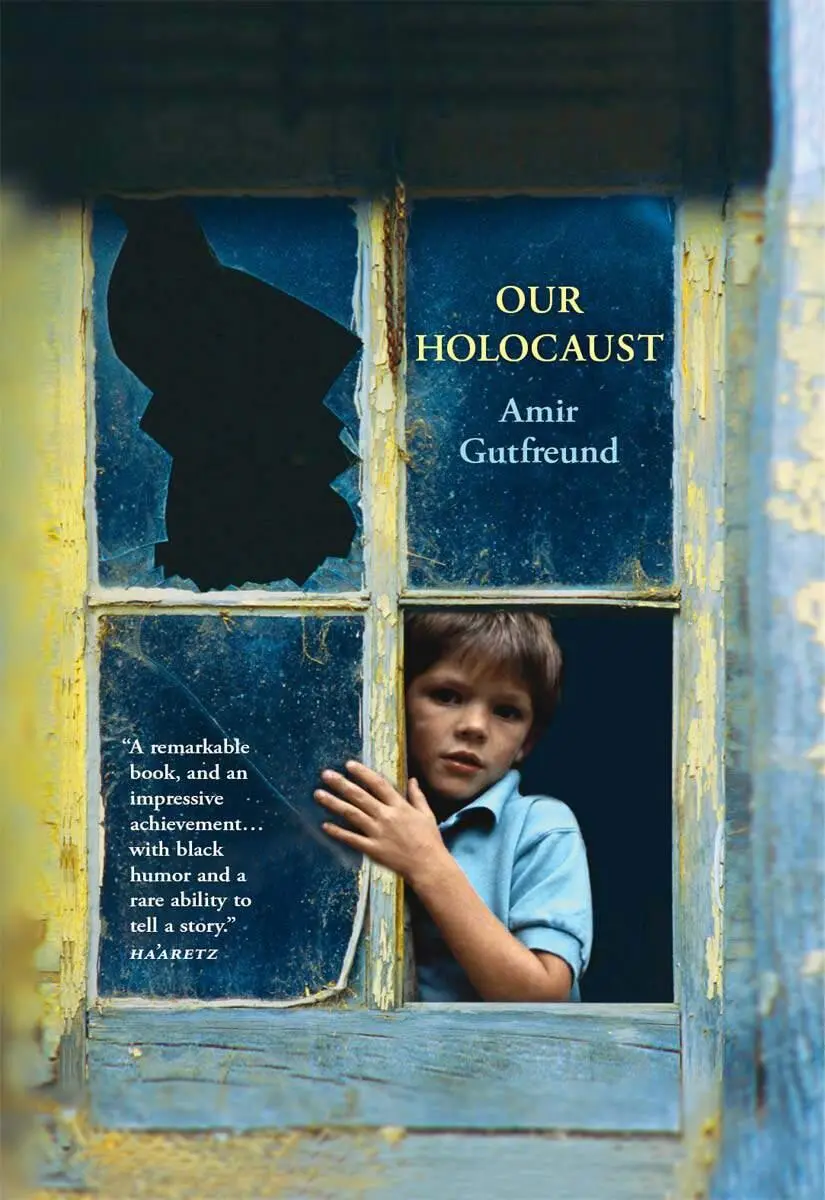
Amir Gutfreund - Our Holocaust
Здесь есть возможность читать онлайн «Amir Gutfreund - Our Holocaust» весь текст электронной книги совершенно бесплатно (целиком полную версию без сокращений). В некоторых случаях можно слушать аудио, скачать через торрент в формате fb2 и присутствует краткое содержание. Год выпуска: 2006, Издательство: Toby Press Ltd, Жанр: Современная проза, Прочая документальная литература, на английском языке. Описание произведения, (предисловие) а так же отзывы посетителей доступны на портале библиотеки ЛибКат.
- Название:Our Holocaust
- Автор:
- Издательство:Toby Press Ltd
- Жанр:
- Год:2006
- ISBN:нет данных
- Рейтинг книги:4 / 5. Голосов: 1
-
Избранное:Добавить в избранное
- Отзывы:
-
Ваша оценка:
Our Holocaust: краткое содержание, описание и аннотация
Предлагаем к чтению аннотацию, описание, краткое содержание или предисловие (зависит от того, что написал сам автор книги «Our Holocaust»). Если вы не нашли необходимую информацию о книге — напишите в комментариях, мы постараемся отыскать её.
Our Holocaust — читать онлайн бесплатно полную книгу (весь текст) целиком
Ниже представлен текст книги, разбитый по страницам. Система сохранения места последней прочитанной страницы, позволяет с удобством читать онлайн бесплатно книгу «Our Holocaust», без необходимости каждый раз заново искать на чём Вы остановились. Поставьте закладку, и сможете в любой момент перейти на страницу, на которой закончили чтение.
Интервал:
Закладка:
A reflection. A transparency. An unwanted world of mirrors, all the lines between me and him are reflected, joined together, inseparable. Since the day I let him carry his own suitcases, it was clear — he was destined to finish my search. To show me that everything was more complicated than I could even conceive.
A gleaming cloud whose center hung over the brown wooden table in Grandpa Yosef’s house opens up. All the wonders shower down, all the treasures, all the miracles. All the secrets, all the riddles, all the questions.
I did not go straight home that evening. After what Hans had told me, after the Lebensborn , after what I had come to understand, the reflection that trapped me and the realization that there was no simple explanation, I just stayed there. I could not leave. In order to be capable of being at home with Anat and Yariv, in order to be capable of living my life, the world had to operate differently. Like turning a sock inside out, the world simply spun around us, leaving us in our place, in our time, but it came in closer, upside-down, joining in. Time would have to figure out how to make things settle down — with us everything continued as usual. Hans stayed at Grandpa Yosef’s, washing dishes I suppose, speaking German. Effi disappeared somewhere — probably home, or perhaps to another place in her life (she too had bridges), and I found myself walking down Katznelson in the direction of home. At the end of all days, I believe, I will be sitting on a couch opposite Hans Oderman in Grandpa Yosef’s house. That will be the revenge of time. But that night, I walked down Katznelson without a thought in my head, and looked up at one of the tall poplar trees. Some of its bark was starting to shed, hanging limply as if I had caught it in the middle of an escape attempt. I stood and thought of those neighborhood trees for a long time. Who had planted them? Who had chosen poplars and poincianas and pepper trees and pink bauhinias and purple jacarandas and divided them up among the yards by some secret code? Who had taken the time? The people who lived here had never planted a tree, and I could not imagine a single one of them dropping everything to dig a hole for a sapling. Someone, perhaps a municipal clerk, must have picked out the trees when this neighborhood was designed. It was designed, after all, wasn’t it? And the trees, to which I had never given much thought before, suddenly appeared before me: the poplar, the poinciana, Gershon Klima’s Indian bombax. Hirsch emerged from the hibiscus shrubs, as if summoned for a purpose. Hirsch.
He looked at me with his lost gaze, seeming unsure of how he had come to be standing in front of me. The usual madness was gone from his face. He looked at me as if he knew me, as if I were doomed to be his audience, the first to hear the conclusion of a lifetime of enquiry, a theological exploration that, to the outside, had always appeared to be a frightening madness, but inside was profound erudition.
Hirsch stood facing me and found himself with no choice but to expose, precisely and terrifyingly, the final, definitive sentence, the conclusion of an irrevocably sealed life: Everything, the Shoah, had been an ordinary occurrence. Ordinary people made it happen and ordinary people were its victims.
I looked at him and answered silently, yes.
Afterword
Lolek and Hainek were my father’s cousins, the sons of Gustava Gutfreund, who died of cancer at the age of thirty-one, before Dad was born. They lived in Kielce with their father, the educator Doctor Feuer, headmaster of the Hebrew Gymnasium in Kielce, and with his second wife. Dad never saw Hainek and Lolek. Only his sister, Aunt Anola, once saw Hainek, the younger brother. She was around twelve, he was thirteen or so, and to this day she carries the impression of their encounter. From their one conversation, as they walked down the streets of Bochnia, she remembers that he was handsome and had the aura of being a “man of the world.” Fifty years later, she remembers exactly what he told her.
His older brother, Lolek, who was several years older than Hainek, was never seen. They know he had planned to go to Eretz Yisrael to study, but did not make it. The war broke out. As far as is known, Dr. Feuer and his sons, Hainek and Lolek, were killed in the region of Lvov, or perhaps somewhere else. The Kielce memorial book mentions Dr. Feuer and his second wife. Hainek and Lolek are not mentioned. We looked for the grave of their mother, Gustava, in the Bochnia cemetery, but it is gone too.
I continued the lives of Lolek and Hainek in their new, surviving, personas, two brothers from the generation of our grandfathers. Grandpa Lolek’s service in the volunteer army of the Polish General Anders is based on the service of Avraham (Romek) Gutfreund, my father’s uncle, in that same army.
Grandpa Yosef is a purely invented character. He is probably inspired by my true grandfather, Grandpa Shalom, who was tortured by the Gestapo. The tortures caused the onset of his disease, and I only knew him through the barriers of illness. When I grew up I heard stories of the man he had been before he became ill, and I recreated his character with a different name, far from the one and only persona of Grandpa Shalom I can imagine.
Attorney Perl from Stanislaw lived in the house at 7 Leonarda Street in the Bochnia ghetto, with my father’s family. He and his wife, whose name I do not know, were killed in Belzec together. Dad remembers him as an educated and dignified attorney, an imposing persona. He was born in 1872 and his full name was Solomon (Shlomo) Perl. During the course of writing this book I discovered that the couple had a daughter, Genya, and a granddaughter, Danusha, of whom the Perls spoke incessantly. I have no information about their fates. I recreated him so that he could expose a little of the truth about that period. The names, quotes and other details from Attorney Perl’s index card are true, to the extent I was able to verify through publicly available sources.
Only a fraction of the Nazi criminals were tried or served any significant sentences. Contrary to popular belief, the vast majority of those who committed or collaborated in atrocities accepted no responsibility for their actions. Formal pardons, shady deals, and a conspiracy of forgiveness and silence enabled the committers of atrocities to live out their lives in freedom.
Characters who are part of the plot, such as Ahasuerus and Obersturmführer Licht, never existed, but were forged out of a mosaic of the extreme figures who most certainly did exist in the mad world of the Nazi regime.
Persons mentioned in the plot such as Kurt Franz, ‘Doll,’ of Treblinka, or the Jewish kapo Yehezkel Ingster, absolutely existed. One can read of their misdeeds and those of hundreds and thousands like them, in the Yad Vashem library and archives.
The mad enterprise of the Lebensborn , the “Fountain of Life,” is chronicled in Of Pure Blood , by Mark Hillel and Clarissa Henry.
About the Author

Amir Gutfreund
Amir Gutfreund was born in Haifa in 1963. After studying applied mathematics at the Technion, he joined the Israeli Air Force and became a Lieutenant Colonel. Our Holocaust was his first novel. It was awarded the Buchman Prize by the Yad Vashem Holocaust Remembrance Institute. His second novel, Shoreline Mansions , won the prestigious Sapir Prize in 2003, and is forthcoming from the Toby Press. His third novel, The World, a Little Later , was recently published in Israel. Gutfreund lives in the Galilee with his wife, Netta, a clinical psychologist, and their two children, Romi and Nimrod.
Интервал:
Закладка:
Похожие книги на «Our Holocaust»
Представляем Вашему вниманию похожие книги на «Our Holocaust» списком для выбора. Мы отобрали схожую по названию и смыслу литературу в надежде предоставить читателям больше вариантов отыскать новые, интересные, ещё непрочитанные произведения.




Обсуждение, отзывы о книге «Our Holocaust» и просто собственные мнения читателей. Оставьте ваши комментарии, напишите, что Вы думаете о произведении, его смысле или главных героях. Укажите что конкретно понравилось, а что нет, и почему Вы так считаете.