Amir Gutfreund - Our Holocaust
Здесь есть возможность читать онлайн «Amir Gutfreund - Our Holocaust» весь текст электронной книги совершенно бесплатно (целиком полную версию без сокращений). В некоторых случаях можно слушать аудио, скачать через торрент в формате fb2 и присутствует краткое содержание. Год выпуска: 2006, Издательство: Toby Press Ltd, Жанр: Современная проза, Прочая документальная литература, на английском языке. Описание произведения, (предисловие) а так же отзывы посетителей доступны на портале библиотеки ЛибКат.
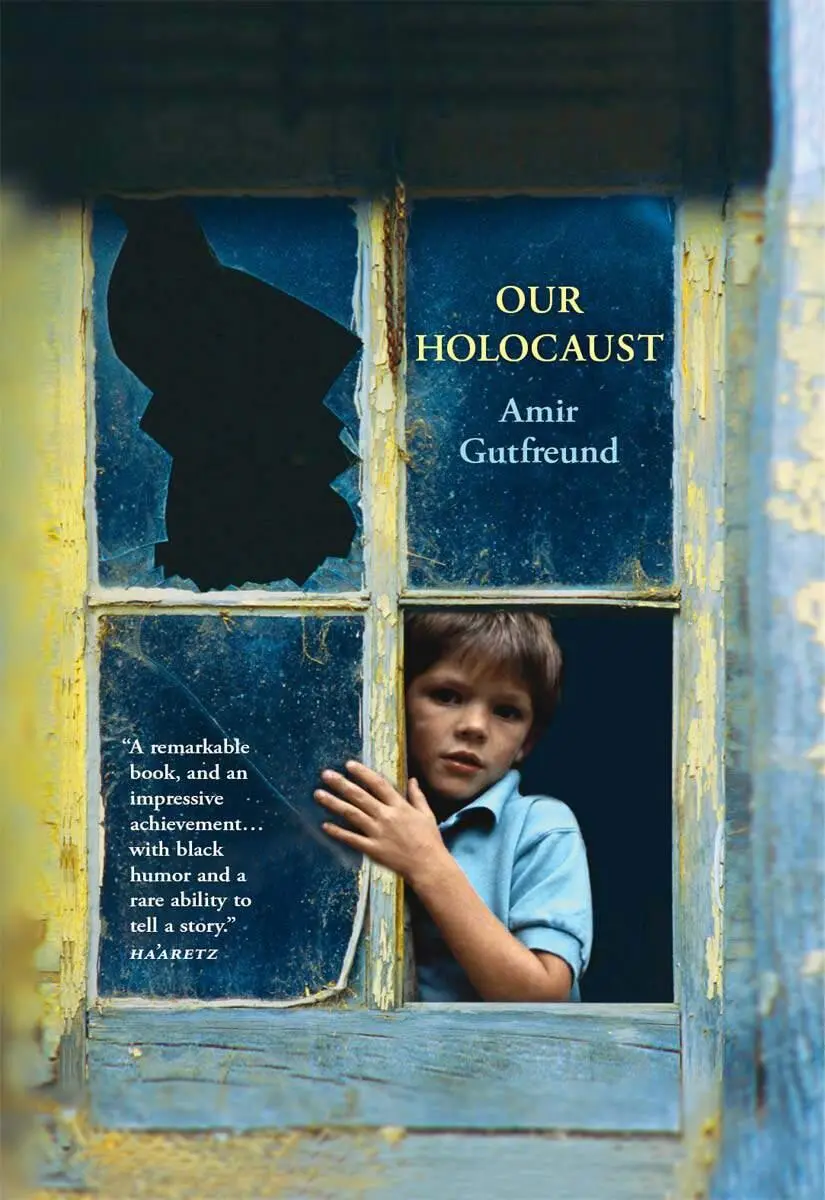
- Название:Our Holocaust
- Автор:
- Издательство:Toby Press Ltd
- Жанр:
- Год:2006
- ISBN:нет данных
- Рейтинг книги:4 / 5. Голосов: 1
-
Избранное:Добавить в избранное
- Отзывы:
-
Ваша оценка:
Our Holocaust: краткое содержание, описание и аннотация
Предлагаем к чтению аннотацию, описание, краткое содержание или предисловие (зависит от того, что написал сам автор книги «Our Holocaust»). Если вы не нашли необходимую информацию о книге — напишите в комментариях, мы постараемся отыскать её.
Our Holocaust — читать онлайн бесплатно полную книгу (весь текст) целиком
Ниже представлен текст книги, разбитый по страницам. Система сохранения места последней прочитанной страницы, позволяет с удобством читать онлайн бесплатно книгу «Our Holocaust», без необходимости каждый раз заново искать на чём Вы остановились. Поставьте закладку, и сможете в любой момент перейти на страницу, на которой закончили чтение.
Интервал:
Закладка:
I cut myself another slice of cake. To cheer him up. A cake he made from Feiga’s recipe. Where did Feiga have recipes from? From her home, most likely, there, in Bochnia. We eat cake made from a recipe from a world destroyed. Grandpa Yosef, lost in thought, digs his fork into the crumbs. We don’t know what to talk about. We try. There is always a way.
“ Nu , what’s new in the neighborhood?”
Littman from the grocery store may be closing down. His son might take over, or he might sell it to someone else. Adella Greuner has started singing. She’s really disturbing the neighbors. They went to talk to her, and she promised, but nothing. (We both remember her brother who came from America in a taxi to slap her and go back home). Gershon Klima’s bombax has started creaking in the wind, the branches must be old. Someone said it should be chopped down, but they won’t let that happen.
“And Asher Schwimmer?”
“Asher Schwimmer. I really should go see him one of these days, poor man. I heard he’s still slapping people. They don’t know what to do with him.”
“And Gershon?”
“Klima is all right. He asks about you and Effi. He’s at home for now. Nu , things move slowly with him.”
Before we say goodbye, Grandpa Yosef presents me with a twin brother of the lekach cake and a pie wrapped in foil (“In this one, thank God, I forgot to put cardamom”). He offers some homemade jam (“a little sour, but it’s energizing”). He is back to his old self, our Grandpa Yosef. What happened to him before must have just been nerves. The preparations for Hans Oderman’s arrival are exhausting him, and we all have bad days. He sends regards to Anat. “You have a wonderful wife,” he says as he walks me down Katznelson. I mustn’t forget that I have a wonderful wife. He stops when a bark comes from the direction of his house. “Well, I have to go back to put out food. I’m sorry.”
Of everything that happened at Grandpa Yosef’s, his yelling, and our conversation, and the documentation that didn’t affect him, and the corpse wagons, I suddenly think of Asher Schwimmer. I have to go and see him. He is the final riddle, the place where the marvel might be hiding, a true splinter from the Big Bang. I must go to his new place near Nazareth and talk to him, no matter in which language, whatever enables us to talk, to find some gem of King Solomon’s wisdom that will bring us together. Why did he forget his Hebrew? Why did he start slapping people? Grandpa Yosef spoke of him with worry, but I know that the slaps are in fact a sign that something has awoken. A blossoming of sorts. For fifty years he was quiet, his Hebrew lost ( The Carmel peaks shall I ascend / in His forest shall I prophesize. / The rivers of Levy shall be mine / a nest for the crow and a bed for the brambles ), but now he is returning, his powers are being restored and he has the courage to accuse. Something inside him is sprouting those slaps like brave flowers in a desert. I must see Asher Schwimmer. Whatever he says, I will use — kindling for everything I need.
I run after Grandpa Yosef, shouting, “Grandpa Yosef! Grandpa Yosef!” I explain to him, almost begging, and yet also commanding: “I’m taking the Vauxhall, I’ll bring it back in a few hours.” I run with the cake, the pie and the jam. I put them on the back seat next to the blender (I almost forgot about it, almost left it as prey for Hans Oderman). Forget about bridges and punishments. I’m going to Asher Schwimmer, a dung beetle rolling a ball of hatred, but I already know: everything’s all right with Anat, and with Yariv. An eighth of him — so what? That, I can forget. But I cannot rest inside. I have to keep going, to understand. To read everything I can about the Nazi criminals, the ideas, the acts committed by people who realized that everything-was-allowed-everything-was-allowed-no-one-would-punish-them. I have time. On the inside, I have time. But I must go on. Get help from Attorney Perl and investigate until I reach all the dead-ends. That is the goal, to reach every dead-end, to stop and realize that from there onwards only people like Hirsch can continue. Attorney Perl and I will stop at the dead-ends, we have no half-century-long theological journey, we do not have the strength not to die, to walk around Katznelson ill and injured, to be Mr. Hirsch-Who-Yells.
I drive the grumbling Vauxhall, lagging behind passing cars. I feel out of place — not spectacular enough, not as wonderful as Grandpa Lolek. Like an unwanted guest at the wheel. The Vauxhall carries me on and I try to imagine how it looks. (When Grandpa Lolek drove the Vauxhall it was always enveloped in velvety clouds and rings of cigarette smoke. The Vauxhall was a stormy tropical island. Something you could see only in the Tarbut encyclopedia and in Grandpa Yosef’s parking lot. When Grandpa Lolek drove the Vauxhall, cigarette butts rolled around on the floor, sometimes still lit, under the seats too, embers scheming with red eyes. Every time he took a sharp turn, sparks flew, a substitute for the bulbs of the turn signal lights which had burned out in 1976 and could not be repaired because Green the Mechanic could not figure out what the matter was with the electrical wires.) The Vauxhall greets me with a restrained grumble and drives on. I am a grayish figure, propelled towards the convalescence home.
It was afternoon when I arrived. A pleasant corridor of large windows stretched from the entryway to the wards, displaying lawns and shrubs on either side. A bright, clear, beautiful light shone in. You could see almost the entire valley, but it was doubtful that anyone here looked at it. I passed elderly people wearing morbid looking robes, strolling along to somewhere. Elderly people sat on armchairs. They looked at me.
I did not have to search for long. I saw him in the hallway, standing opposite a doctor. He was waving his hands and shouting something and a frail group of old people surrounded him, talking excitedly. Only when I got closer did I realize they were translating. Asher Schwimmer was making accusations in Polish, and they were doing their best to interpret into old-fashioned Hebrew while the doctor listened. The slap came, not hard, but the doctor did not lose his attentive look, as if both the translated words and the slap itself contained a hint. Asher Schwimmer turned around, walked feebly to a bench and sat down. A friend wearing a faded suit hurried to his side, supporting Asher Schwimmer and sitting down beside him. I went up to him, wondering if he would recognize me. I scanned him as he sat with his eyes closed.
“Oh, oh! He once had a head of hair! Wild hair!” said his friend, as if, having noticed my look, he had assumed I was not doing justice to Asher Schwimmer in my thoughts. He held out his hand. “Nice to meet you. Dov Ber.”
“Nice to meet you, Mr. Ber. I’m Amir. How is Mr. Schwimmer?” I addressed Mr. Ber as if he were Asher Schwimmer’s spokesman, a position that he clearly aspired to. He accepted my greeting for both of them, and his look seemed to indicate that he would, at the very first opportunity, convey my good wishes to Asher Schwimmer himself (and for a moment it seemed that the transmission of the greeting would be delayed due to the infinite distance of Asher Schwimmer, rather than his sealed, extinguished face here on the bench beside us). “Not many people come here. One could say we’ve been forgotten. And your honor is…?”
I told him about Grandpa Yosef, about the little poetry book in his library, Asher Schwimmer’s poems from the days when he knew Hebrew. I also sent warm regards from Grandpa Yosef to Asher Schwimmer. Asher Schwimmer opened his eyes. “Hello, Mr. Schwimmer. I said that Yosef Ingberg sends his warm regards!”
Читать дальшеИнтервал:
Закладка:
Похожие книги на «Our Holocaust»
Представляем Вашему вниманию похожие книги на «Our Holocaust» списком для выбора. Мы отобрали схожую по названию и смыслу литературу в надежде предоставить читателям больше вариантов отыскать новые, интересные, ещё непрочитанные произведения.












Обсуждение, отзывы о книге «Our Holocaust» и просто собственные мнения читателей. Оставьте ваши комментарии, напишите, что Вы думаете о произведении, его смысле или главных героях. Укажите что конкретно понравилось, а что нет, и почему Вы так считаете.