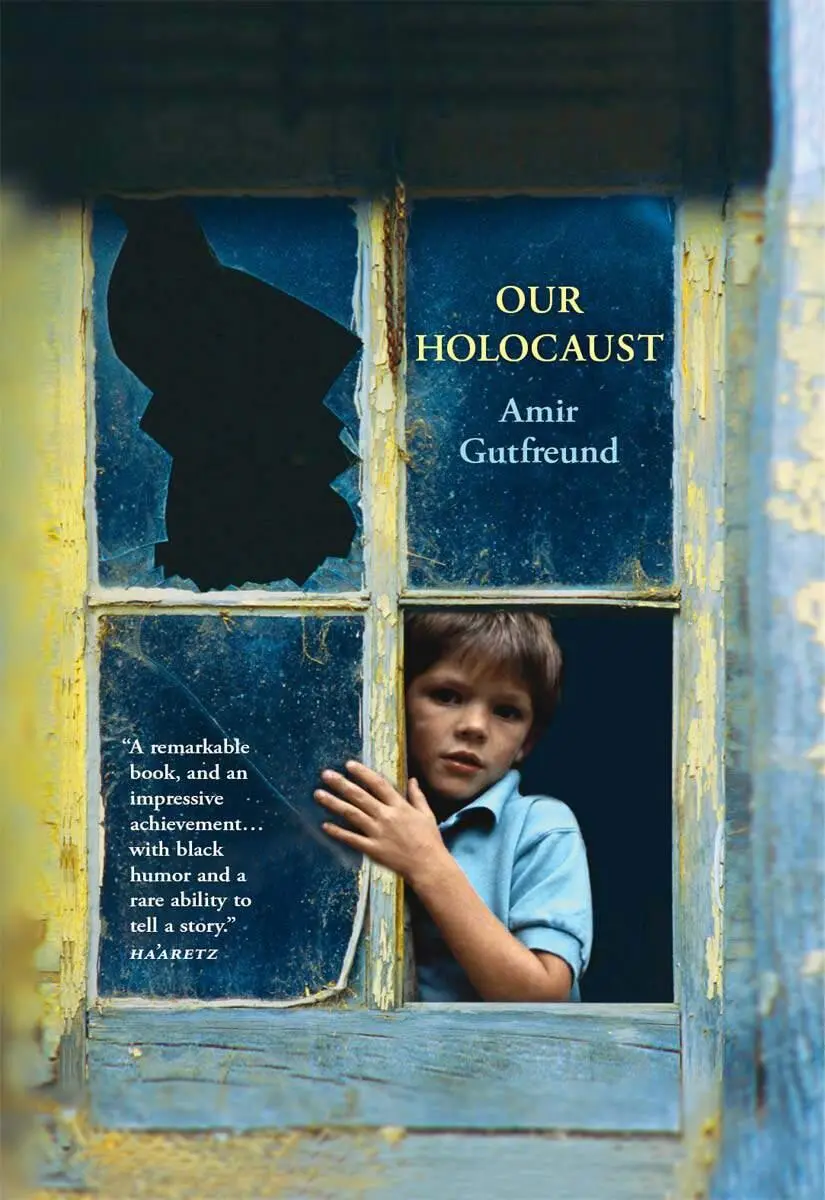
Amir Gutfreund - Our Holocaust
Здесь есть возможность читать онлайн «Amir Gutfreund - Our Holocaust» весь текст электронной книги совершенно бесплатно (целиком полную версию без сокращений). В некоторых случаях можно слушать аудио, скачать через торрент в формате fb2 и присутствует краткое содержание. Год выпуска: 2006, Издательство: Toby Press Ltd, Жанр: Современная проза, Прочая документальная литература, на английском языке. Описание произведения, (предисловие) а так же отзывы посетителей доступны на портале библиотеки ЛибКат.
- Название:Our Holocaust
- Автор:
- Издательство:Toby Press Ltd
- Жанр:
- Год:2006
- ISBN:нет данных
- Рейтинг книги:4 / 5. Голосов: 1
-
Избранное:Добавить в избранное
- Отзывы:
-
Ваша оценка:
Our Holocaust: краткое содержание, описание и аннотация
Предлагаем к чтению аннотацию, описание, краткое содержание или предисловие (зависит от того, что написал сам автор книги «Our Holocaust»). Если вы не нашли необходимую информацию о книге — напишите в комментариях, мы постараемся отыскать её.
Our Holocaust — читать онлайн бесплатно полную книгу (весь текст) целиком
Ниже представлен текст книги, разбитый по страницам. Система сохранения места последней прочитанной страницы, позволяет с удобством читать онлайн бесплатно книгу «Our Holocaust», без необходимости каждый раз заново искать на чём Вы остановились. Поставьте закладку, и сможете в любой момент перейти на страницу, на которой закончили чтение.
Интервал:
Закладка:
Asher Schwimmer replied, “ Todah .” Thank you. In Hebrew. In Hebrew! I must have looked astonished.
Mr. Ber beamed. “I’m teaching him Hebrew.” Teaching him Hebrew! Asher Schwimmer closed his eyes again, but Mr. Ber would not let his prodigy disappear from our conversation. “Just like he taught me Hebrew! From him I learned! Everything!”
“Did you know him there ?” I emphasized the last word and Mr. Ber nodded, confirming, but he did not understand what I meant. As far as he was concerned, there was Warsaw, before the war, where Asher Schwimmer had ruled the eager poetry circles, the lovers of the Hebrew language.
Mr. Ber called out, “He was born for great things! Tremendous! At nineteen, we all surrounded him! Worshipped him!” He pointed to Asher Schwimmer, whose eyes were shut tightly as if the memories that gripped him were too strong, as if the Hebrew he was learning was illuminating difficult things. Mr. Ber continued excitedly. “The Romantic style, that was his style. A Byronist! Roses! Pallor! Affairs of the heart! Then he began to take an interest in Eretz Yisrael and all his poetry became filled with carobs and sunshine! We loved the carobs and the sunshine too! He was not like us. We ran around trying to find someone who would agree to publish our verses. But him, they chased after him. And he? He only allowed the very best to publish him. If only you had been fortunate enough, such verses!”
“Yes, I know. My grandfather has a copy of his book at home.”
Mr. Ber ignored me. “A Zionist, he became! A Zionist! I was a Zionist too, but to go to Palestine? Being a Zionist was talking! Arguing! Proving a point! Big meetings! Good for the soul! But Asher Schwimmer? He was really bitten! He decided to go to Eretz Yisrael , to Palestine. To see with his own eyes the Carmel, and Jerusalem. Nu , such a young man! And where did he end up? The war broke out, and who knows? Neither in Polish nor in Hebrew, about that matter, he will not talk. But they said he was in Gräditz. Suffering! That’s what they said!”
(I pulled out the information easily. Gräditz. Yehezkel Ingster was there. The Jewish kapo who was tried in Israel and sentenced to death. Was it possible that Asher Schwimmer had lost his Hebrew in Gräditz? Did he know Yehezkel Ingster? Could I find out about Yehezkel Ingster from him? But no, I did not want to ask. I had to stop. Enough. Stop right now.)
But I asked Mr. Ber, “You weren’t with him?”
“Me? No! No! In Israel too, I didn’t see him for fifty years. Here, I found him. Right here, suddenly standing in front of me, Asher Schwimmer! Hebrew I teach him! And take care of him! I serve him gladly! If only you had seen him in Warsaw!”
Asher Schwimmer opened his eyes. I smiled at him.
(Leave. Leave now. There is nothing for me here. It doesn’t matter if he slaps people. It doesn’t matter what happened in Gräditz. Leave. The bridge is starting to crumble.)
I gently shook Asher Schwimmer’s hand. “I’ll come and visit again. Grandpa Yosef will come too.”
“Pass the salt, please,” said Asher Schwimmer, his mouth slowly plucking out the letters.
And his teacher, Mr. Ber, beamed. “See? He’s learning! We’ll bring back all the Hebrew! All the Hebrew!” He pats Asher Schwimmer’s shoulder. “God willing, before we die we’ll be reading new verses! Poems by Asher Schwimmer! Here! In Zion! Begone with your feeble poets — long live Asher Schwimmer! Rage on!” He grabbed my hand as it held Asher Schwimmer’s. I gently disengaged my hand and turned to leave. As I said goodbye to them both, Mr. Ber helped Asher Schwimmer stand up. “We’ll go and sit in the sun. He likes the sun very much!”
( Roaming opposite your fields / fading / opposite the houses of wine and bread, from evil departing. / She alone yields crops — my soul implored / stalks of grain for her alone / Make golden my maternal sky — wheat of radiance ).
In the Vauxhall, the blender still sat on the back seat. I took it out and ran back. I found Mr. Ber and Asher Schwimmer on their way to the sun. “Here, a little gift. I almost forgot,” I said, out of breath.
Mr. Ber was moved. “A blender! A food processor!” He grasped Grandpa Lolek’s gift (I would have to come up with an excuse and buy something else for him), waving it at Asher Schwimmer. “A food processor! A food processor!”
We both waited silently to see if the drooping mouth would form the necessary words. But no. Mr. Ber covered for his silence, instantly trampling the failure with his words. “He’s tired today. He’s just tired!”
Asher Schwimmer stood up — perhaps about to slap me. But no. He ambled over to the shade, fleeing the sun, and Mr. Ber hurried after him to correct his error. I walked back to the Vauxhall. I had to tell Grandpa Yosef to visit.
When I got home, Anat said, “Yakov the assistant called. Attorney Perl passed away.”
The next day they carried him on a black stretcher, wrapped in burial shrouds.
1900–1993.
They put his body down in front of us, beneath a sheet. As if this were the proper way to explain, to make us understand. I thought, with us, the ones we need don’t die (like Brandy, like Linow Community, who some say has already died, it’s just Sarkow Community who makes her keep walking to the grocery every day.) With us people last. But Attorney Perl died.
His body was covered with earth, and I realized that despite the gathered crowds, he was a solitary man. I never asked him about children. Why weren’t there any? His life with Laura was not talked of much. Everything that, in his memory, had contained the beautiful days of their married life, shrunk in my memory to a wife led away to Belzec, living ever after in the house at 7 Leonarda Street. Now there was only me, and the remainder of her life would be shut up in train cars, on a slow voyage that would continue on with me. And children? Why weren’t there any children? Hadn’t he talked once about the eternity of procreation? He had glorified fertility. Like an elaborate agricultural plan in which he was not to participate, only to admire. Why didn’t he have any children? I considered infertility, random happenstance, or perhaps a joint decision, or simply the fruits of bad luck. Reasons. Then I thought, And if he had had children? If they had grown up to be Dad’s age during the Shoah, would they have survived? They would have been around ten in 1939, and would have fallen into the hands of Hermine Braunsteiner, “the Stomping Mare,” or Kurt Franz, “Doll,” or all the hands that had waited unknowingly from the moment the children of the thirties were conceived. Anat and I had Yariv. Eternity was ours. And Attorney Perl? His eternity was broken down on little index cards, and I could already envision them as crumbling shreds in a crate stored in a faraway basement. Seventy years on, someone nosy would find the swollen box and investigate the round handwriting. Hermine Braunsteiner, “the Stomping Mare,” was charged with the sadistic murder of children and infants at Majdanek. She shot children at close range and whipped their eyes. She managed to immigrate to the United States, was exposed in the early seventies, extradited to Germany and sentenced to life imprisonment. Attorney Perl’s eternity was assigned by topic, separated in drawers, hopeless. Why did he not have children?
Anat and I had already discussed having more children, and we probably would (the castles they convince us to build). I thought about the madness of procreation. The families who at the beginning of the century raised children who would become inmates of concentration camps. The families who raised children who would become SS officers. Pitted against one another. At the beginning of the century, on both sides, families feared for the fates of their loved ones on the front of the First World War. My family sent four sons to the war. Four sons who fought for Germany, shoulder to shoulder with people who would one day join the SS and participate in the extermination. Dad’s father, Ze’ev, marched all the way to the Italian front. His brother, Dr. Anatol, served in a military hospital. Moshe Gutfreund, aged nineteen, was killed on the Carpathian front, and Leon Gutfreund was taken hostage by the Russians and came home after many years; in World War II he was taken to Belzec. Among those who guarded them, among the jailors, the commanders, the shooters, were the war veterans who-could-be-trusted, the people who didn’t flinch at a few heaps of women and children.
Читать дальшеИнтервал:
Закладка:
Похожие книги на «Our Holocaust»
Представляем Вашему вниманию похожие книги на «Our Holocaust» списком для выбора. Мы отобрали схожую по названию и смыслу литературу в надежде предоставить читателям больше вариантов отыскать новые, интересные, ещё непрочитанные произведения.








Обсуждение, отзывы о книге «Our Holocaust» и просто собственные мнения читателей. Оставьте ваши комментарии, напишите, что Вы думаете о произведении, его смысле или главных героях. Укажите что конкретно понравилось, а что нет, и почему Вы так считаете.