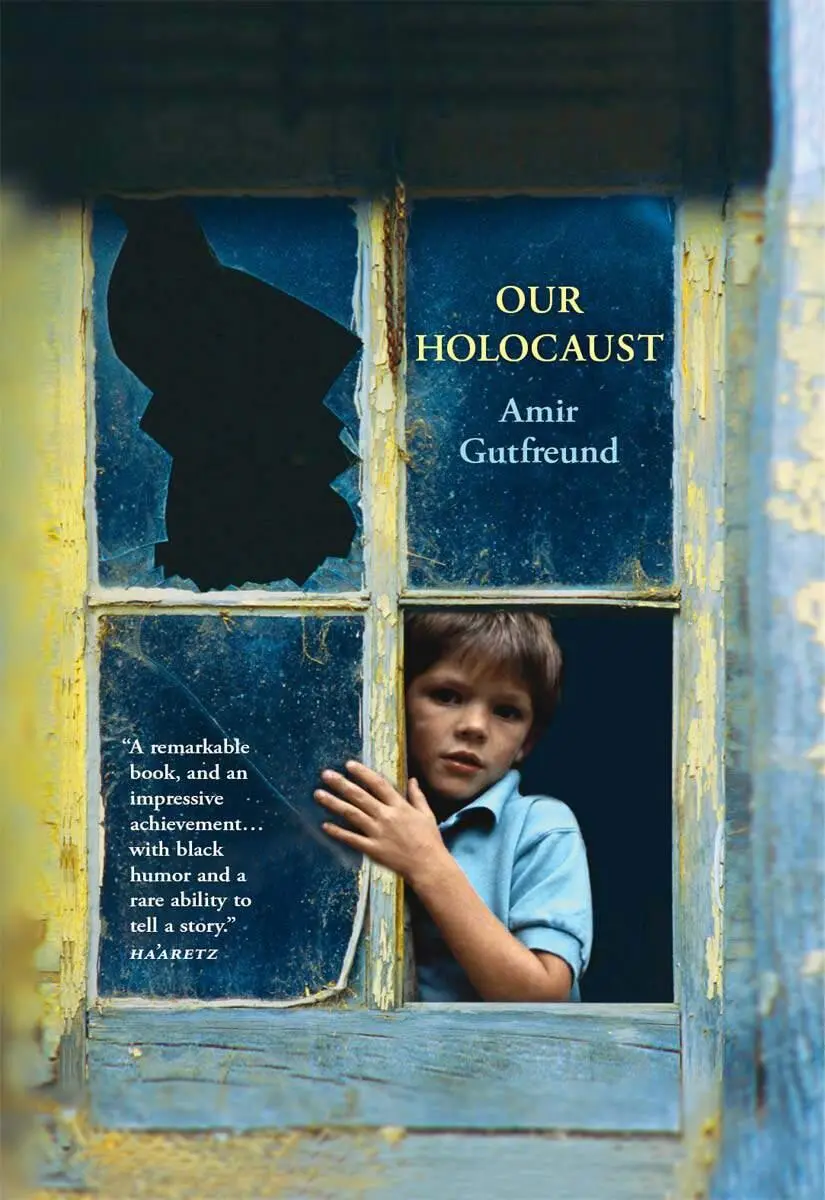
Amir Gutfreund - Our Holocaust
Здесь есть возможность читать онлайн «Amir Gutfreund - Our Holocaust» весь текст электронной книги совершенно бесплатно (целиком полную версию без сокращений). В некоторых случаях можно слушать аудио, скачать через торрент в формате fb2 и присутствует краткое содержание. Год выпуска: 2006, Издательство: Toby Press Ltd, Жанр: Современная проза, Прочая документальная литература, на английском языке. Описание произведения, (предисловие) а так же отзывы посетителей доступны на портале библиотеки ЛибКат.
- Название:Our Holocaust
- Автор:
- Издательство:Toby Press Ltd
- Жанр:
- Год:2006
- ISBN:нет данных
- Рейтинг книги:4 / 5. Голосов: 1
-
Избранное:Добавить в избранное
- Отзывы:
-
Ваша оценка:
Our Holocaust: краткое содержание, описание и аннотация
Предлагаем к чтению аннотацию, описание, краткое содержание или предисловие (зависит от того, что написал сам автор книги «Our Holocaust»). Если вы не нашли необходимую информацию о книге — напишите в комментариях, мы постараемся отыскать её.
Our Holocaust — читать онлайн бесплатно полную книгу (весь текст) целиком
Ниже представлен текст книги, разбитый по страницам. Система сохранения места последней прочитанной страницы, позволяет с удобством читать онлайн бесплатно книгу «Our Holocaust», без необходимости каждый раз заново искать на чём Вы остановились. Поставьте закладку, и сможете в любой момент перейти на страницу, на которой закончили чтение.
Интервал:
Закладка:
American planes kept bombing, and their shattering trail of bombardments fell inside the camp too. The Ukrainian guards began to flee. Obersturmführer Licht did not stop them. He remained alone with his two pistols among the inmates still at work on his play, at his side only two Ukrainians who chose to continue their puppet-building work.
On April 6 theverything was ready. Obersturmführer Licht set curtain time for six in the evening. Planes had been attacking in the distance as early as noon, sounds of artillery reverberating through the air. The distant noise grew closer and closer, as if the planes were about to blindly assail the camp. Two Ukrainians tried to escape. From over forty yards away, with only two bullets, Obersturmführer Licht shot them. There were whispers among the inmates, some conjectured that he had no bullets left, but no one dared attack him. Alone among twenty-one inmates and three Ukrainians, Obersturmführer Licht annihilated any intentions of rebellion, any hopes of liberation, any lust for revenge; the play would go on at six.
At six in the evening he sat down in his armchair on the rugs. The rectangular stage was lit up and the play began. Attorney Perl stood on the little wooden stage and began the opening speech in his lucidly thundering voice, just as a pulverizing barrage of artillery landed between the fences. Obersturmführer Licht drew his pistol and placed it on his lap. “Continue!”
The artillery was merciless. A battle was raging in the distance. When the puppet of the Communist teacher appeared in the window, about to confiscate little Obersturmführer Licht’s flag, a shell exploded at the foot of the hill and shrapnel sparked through the night sky. The puppeteers ran away. Behind the curtain they fled on their hands and knees and ran down the hill as Obersturmführer Licht’s bullets whistled around them. The remaining inmates burst out of the camp and disappeared into the dark. The dim thundering of plane engines could be heard, and after a few moments there were bombardments that set a nearby hill ablaze. The only figures remaining on the theater hilltop were Obersturmführer Licht and Attorney Perl.
Anyone who says, There is no limit , and thinks they can imagine the limit, must believe.
Obersturmführer Licht looked at Attorney Perl as he stood thundering on the wooden stage. The Commandant approached his prisoner. He thrust his silver pistol into Attorney Perl’s hand and set the terms. “Ten steps, then turn and shoot!” He turned and began walking.
And I have no idea if the Jew Attorney Perl will fight the Nazi officer, like the Jew Grandpa Lolek did, or if he will wisely escape, like the Jew Grandpa Yosef did. Or whether he might do something unexpected, like the Jew Hirsch, something that will transcend logic and imagination.
Anat will ask me, “So, what happened?”
And I will smile at her and say something like, “He ran away.” I have to say something. After all, we know he survived. “Attorney Perl lived, as you know.”

All the wonders, all the treasures, all the miracles. All the secrets, all the riddles, all the questions. It all spun into a gleaming cloud whose center hung over the brown wooden table in Grandpa Yosef’s house.
For three days he asked, and finally I came to meet Hans Oderman at his house. Effi said, “Come this evening, I’ll be there too.” So I did.
We sit within circles of pleasant conversation, bringing each other up to date on what’s new, telling stories, reporting how we’re doing. But over the circles looms a pulsating cloud, its vapors dripping down and baptizing us — the end is near. The childhood riddles, Gershon Klima’s sewage, the letter from Finkelstein, the battle at Monte Cassino, Grandpa Hainek’s sons, the questions I asked Attorney Perl, Grandpa Yosef’s journey, Adler’s philosophy, Hirsch’s theological inquiries, a ray of light from the Rabbi of Kalow, and the memory of Rothschild — all come together like clouds at the edge of a landscape. We sit at the table and talk comfortably, and I am certain: There will be closure here.
Grandpa Yosef serves us dinner. He brings out more and more dishes of increasingly peculiar concoctions. Effi helps him, leaving me and Hans to face one another. Six-foot-three-sapphire-blue-eyes-golden-locks and I converse. Every so often she comes in to interfere:
“I told Hans about your documentation. Talk to him, he’s very interested.”
She has an agenda; she’s promoting a scheme.
Hans smiles awkwardly, having partially understood what Effi said in Hebrew.
“They told me that you have documented what happened to your family in the war. I’m very interested in this.”
“Interested?”
“Yes, Mr. Ingberg said he would translate what you wrote into German for me, if you would agree.” Hans looks at me with a certain discomfort on his face. As if things are about to float to the surface and he can already sense them erupting. “Effi said you found out some unpleasant things about your wife’s grandfather.”
(What else did she tell him? She looks like she’s plotting something. She seems too directed, too arrow-like. As if she is assassinating the life I have now. But she walks past us innocently and asks, “Coffee, anyone?”)
“Umm…yes. He was a sort of Jewish collaborator,” I tell Hans. That’s enough.
“You know, something similar happened to me.”
Similar?
Tribal stories unfold around the campfire, and Grandpa Yosef arrives from somewhere and sits down, and Effi comes, with the coffee miraculously already brewed. We linger over our mugs for a while. Add sugar cubes. Stir politely. More milk?
“When I was here last year and you asked me what my family did during the war, you could say that I lied. Actually, I did not lie. Everything I said was the truth, but it was the truth that I am comfortable with. My father really was an orphan, and he was adopted by a family when he was ten. Everything I told you was about that family. I did not tell you about the real family, not because of lies, but because I have no idea who my family is.”
(All of us are sitting at the table, yet Hans Oderman is talking to me.)
“My father grew up an orphan. As a child, he was moved around from one orphanage to another. He told me very little about that period. It was an unspoken matter in our home. I’m sure you understand…”
(All the secrets, all the riddles, all the questions.)
“It was as though his orphanhood concealed a great secret. Perhaps because of how little he told and how much I tried to fill in with my imagination, I began to take an interest in orphanages. That was how I got to my academic research. And when I was writing my dissertation, I read one day something about the “Fountain of Life” project, Lebensborn in German. This is not something that is talked about very much. There I was, an academic researcher in the field, and I had never even heard of Lebensborn . Much less a layman. The Lebensborn was part of a plan devised by Himmler to encourage the procreation of the Aryan race. That word, Lebensborn , would not leave my thoughts. I felt that it had some connection to my father. I had a clear intuition. Something you cannot understand, but still you sense. I’m sure you understand…
“I began to make calculations, you see. My father never mentioned any details, and in Germany it was not so customary to investigate what had happened during the war years. But I began asking Father about his early years and, as if he had been waiting all that time for me to uncover his secret on my own, he said, ‘Yes, I am a Lebensborn child, and I have no idea where I come from.’”
Читать дальшеИнтервал:
Закладка:
Похожие книги на «Our Holocaust»
Представляем Вашему вниманию похожие книги на «Our Holocaust» списком для выбора. Мы отобрали схожую по названию и смыслу литературу в надежде предоставить читателям больше вариантов отыскать новые, интересные, ещё непрочитанные произведения.





Обсуждение, отзывы о книге «Our Holocaust» и просто собственные мнения читателей. Оставьте ваши комментарии, напишите, что Вы думаете о произведении, его смысле или главных героях. Укажите что конкретно понравилось, а что нет, и почему Вы так считаете.