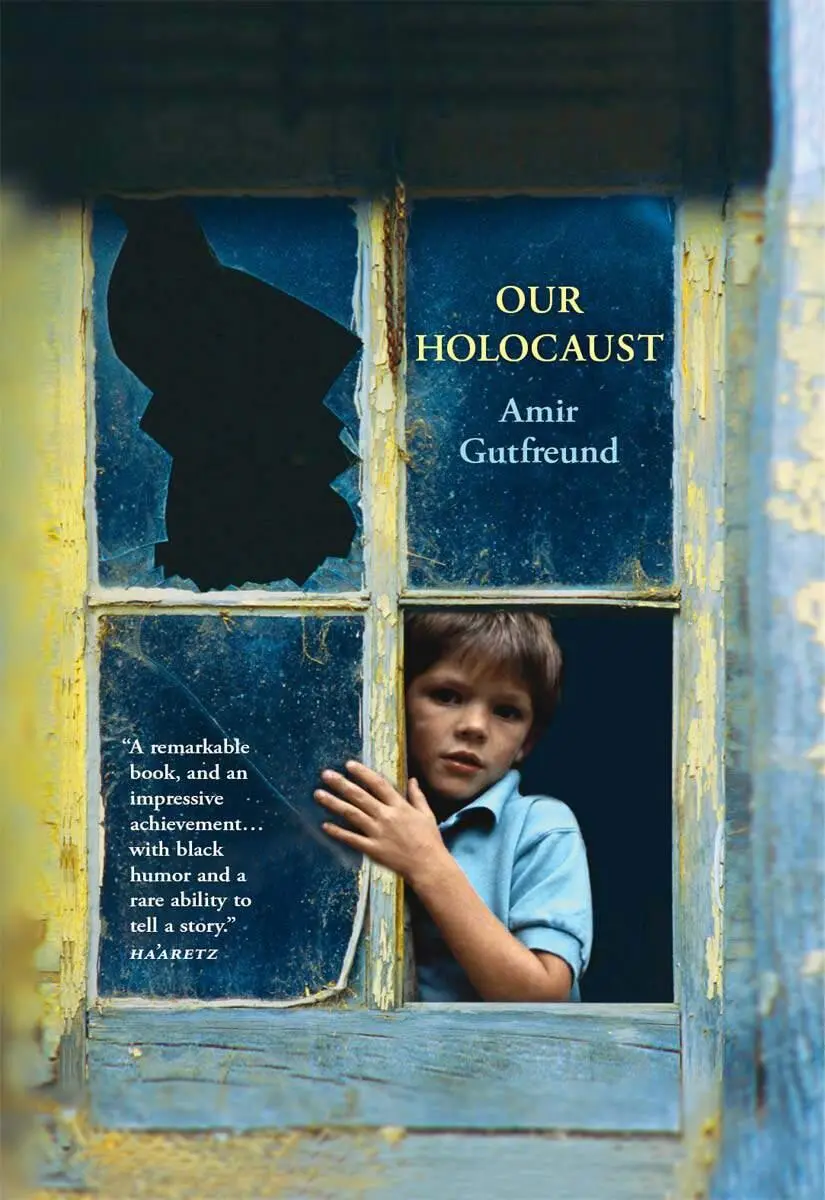
Amir Gutfreund - Our Holocaust
Здесь есть возможность читать онлайн «Amir Gutfreund - Our Holocaust» весь текст электронной книги совершенно бесплатно (целиком полную версию без сокращений). В некоторых случаях можно слушать аудио, скачать через торрент в формате fb2 и присутствует краткое содержание. Год выпуска: 2006, Издательство: Toby Press Ltd, Жанр: Современная проза, Прочая документальная литература, на английском языке. Описание произведения, (предисловие) а так же отзывы посетителей доступны на портале библиотеки ЛибКат.
- Название:Our Holocaust
- Автор:
- Издательство:Toby Press Ltd
- Жанр:
- Год:2006
- ISBN:нет данных
- Рейтинг книги:4 / 5. Голосов: 1
-
Избранное:Добавить в избранное
- Отзывы:
-
Ваша оценка:
Our Holocaust: краткое содержание, описание и аннотация
Предлагаем к чтению аннотацию, описание, краткое содержание или предисловие (зависит от того, что написал сам автор книги «Our Holocaust»). Если вы не нашли необходимую информацию о книге — напишите в комментариях, мы постараемся отыскать её.
Our Holocaust — читать онлайн бесплатно полную книгу (весь текст) целиком
Ниже представлен текст книги, разбитый по страницам. Система сохранения места последней прочитанной страницы, позволяет с удобством читать онлайн бесплатно книгу «Our Holocaust», без необходимости каждый раз заново искать на чём Вы остановились. Поставьте закладку, и сможете в любой момент перейти на страницу, на которой закончили чтение.
Интервал:
Закладка:
“What do you mean, ‘no idea where he comes from’?” I ask.
But Hans Oderman heatedly continues a flow of talk that has long been welling inside of him. Questions can be answered later. He tells me about Heinrich Himmler — Reichsführer Himmler — who, more than all the other Nazi leaders, had the appearance of a modest clerk, shy and withdrawn. Behind his small glasses hid a disturbed personality bound by hallucinations, aspiring to fame, unfeeling. He constructed ideals of an eternal Reich and tried to make them come true; he failed, but the remnants of his ideas were left in the world to suffer. He had his scientists calculate the rate of exterminating unwanted peoples and the rate of building the German Aryan race, and they indicated a discrepancy between the required number and the expected outcome. Riechsführer Himmler hatched a scheme. He promised his Führer a hundred and twenty million Aryan Germans by 1980. He came up with a plan that would, in the future, produce half a billion Aryan Germans if everything went according to his calculations. First he began a campaign to encourage higher birthrates, supporting every German child-bearing woman through any possible circumstances of childbirth — every child was adopted by the Reich. Even children born from relations between German soldiers and suitable women in the occupied lands were adopted by the Reich. Heinrich Himmler instructed that not even a drop of German seed should be lost. Still, that was not enough. The population growth was too small and too slow. Himmler ordered that children and babies in occupied countries with potentially Aryan qualities be either kidnapped or purchased. Children were taken from their parents by bribery or by force. In problematic cases, the parents were liquidated, labeled as partisans or outlaws or enemy agents. The children, from all over Europe, were educated in special boarding schools. Those who grew up to be disappointments, lacking in Aryan traits, were exterminated. Those who met expectations joined the Reich. The little girls were treated with hormones to expedite their sexual maturation — without the ability to quickly produce offspring, their annexation to the Reich would be fruitless.
Despite the kidnapping and adoption programs, the birthrate was not promising. And so Himmler declared a new program: Lebensborn , the Fountain of Life. Pure Aryan women were housed in convalescence homes in order to bear children for the Reich. The fathers were all SS men, the purest of the race. Each woman and her offspring were awarded the finest of conditions, in a world completely cut off from the hardships and hunger that were slowly descending upon the people of Germany. All that was required of these women was to give birth, to produce more and more babies for the Reich. The essence of the Lebensborn scheme was to fill the wombs of German women with fetuses, to quickly manufacture rushed progeny and deliver them so the wombs would be available for the next batch of offspring.
Hans Oderman keeps talking without a pause, and I realize that the two polarities of the German Reich are coming to light simultaneously: On the one hand, a twisted enterprise of death is taking place, a burning urgency to shove more and more transports into the gas chambers, each transport making way for the next. On the other, an equally twisted enterprise of life, the chambers of female wombs being stuffed to capacity, one fetus making way for the next. This animalistic machine does not rest for a moment, so urgent are the needs of the Reich.
Within this wild, confused enterprise, born of the yearnings of Reichsführer Himmler, Hans Oderman’s father is created. Born, perhaps, or possibly kidnapped and reeducated. Hans Oderman has no idea. Hans’s father did not remember the Lebensborn years. The four-year-old’s memories go back only to the post-war years, after German defeat. He told Hans very little about those blurred years of hunger. Huge orphanages, endless hours of enforced sleep. Facing the broken window of an abandoned house. A large hole behind a tree. For some reason, the hole becomes his friend, he likes to look at it, in the dark too, when he must sleep, sleep, sleep.
The war left thousands of infants, a master race that no one wanted, and there was no one to keep the promises that had created them.
“I began a tireless investigation. Most of the Lebensborn files were destroyed by the officials before the Lebensborn houses were occupied. A few papers were left, some memos, but there was no way to find my father. He was born a Lebensborn , that much he knew. An elderly childless couple had taken him in after the war, but they died and my father went back to the orphanages. He still had an aunt from his adoptive parents, and she told him everything she knew, which was very little. I searched through all the remaining files and documents. My father’s father might have been an SS man, my father might have been a kidnapped child, perhaps Polish. Hundreds of thousands of children were kidnapped in the war years, and who knows? I asked my dad what he thought, and he told me that sometimes he felt as if the Polish language sounded familiar. I would like to think that my father was kidnapped, rather than the planned child of an SS man, but look at me…”
Six-foot-three-sapphire-blue-eyes-golden-locks looks at me and I find myself convicting him against my own will. Then I think, “So what? So what if his father’s father was in the SS?”
(All the wonders, all the treasures, all the miracles.)
“I would like to believe that my father was kidnapped. The children they kidnapped were usually a little older, but still. Or maybe my father was the offspring of a simple German army man. They usually only allowed party members to impregnate women in the Lebensborn houses, but sometimes, towards the end, regular soldiers were given the chance too.”
We sit quietly. Grandpa Yosef remembers that we haven’t eaten dessert yet. Something hovers over Hans and myself, the story of my documentation and the story of his research, the truth I did not want to reach and the truth Hans wished not to find. From that clashing of wings comes a deceitful sort of lesson that says loudly: Never enquire.
“When you asked me what my family did during the war, I told you what was convenient, I didn’t exactly lie.”
(Still making excuses, Hans Oderman the artiste of awkwardness.)
“My father built his life without complaints. He built a house. He built a family. He started from nothing and achieved everything. I respect him very much, admire him even. It’s a shame I never had a grandfather like everyone else did. There was the aunt, and I called her Grandma, but it wasn’t really….”
(All the wonders, all the treasures, all the miracles.)
As I look at Hans Oderman, I realize what his role is, what it has been from the first day I saw him. He is my reflection. That’s it. I can no longer say us and them . Every move I make, every line I draw, there will be a line on my reflection too. Every thought of mine will produce a thought on the other side too. There is no more us and them .
“I want to write a book about the Lebensborn , about the kidnapping operation and the breeding farms. Today in Germany there are hundreds of thousands of people who are assumed to be Lebensborn children. There were more. Some were returned to their parents, if there were any. But there are many left without fathers, without mothers, without memories. You know, no one ever punished the Lebensborn directors, Dr. Gregor Ebner and Dr. Max Sollmann. And they were the people who signed documents ordering that a disappointing baby be liquidated. They allowed transports of kidnapped children with unsatisfactory data to be left to die. No one even bothered to investigate them. Strange, isn’t it?”
Читать дальшеИнтервал:
Закладка:
Похожие книги на «Our Holocaust»
Представляем Вашему вниманию похожие книги на «Our Holocaust» списком для выбора. Мы отобрали схожую по названию и смыслу литературу в надежде предоставить читателям больше вариантов отыскать новые, интересные, ещё непрочитанные произведения.




Обсуждение, отзывы о книге «Our Holocaust» и просто собственные мнения читателей. Оставьте ваши комментарии, напишите, что Вы думаете о произведении, его смысле или главных героях. Укажите что конкретно понравилось, а что нет, и почему Вы так считаете.