Amir Gutfreund - Our Holocaust
Здесь есть возможность читать онлайн «Amir Gutfreund - Our Holocaust» весь текст электронной книги совершенно бесплатно (целиком полную версию без сокращений). В некоторых случаях можно слушать аудио, скачать через торрент в формате fb2 и присутствует краткое содержание. Год выпуска: 2006, Издательство: Toby Press Ltd, Жанр: Современная проза, Прочая документальная литература, на английском языке. Описание произведения, (предисловие) а так же отзывы посетителей доступны на портале библиотеки ЛибКат.
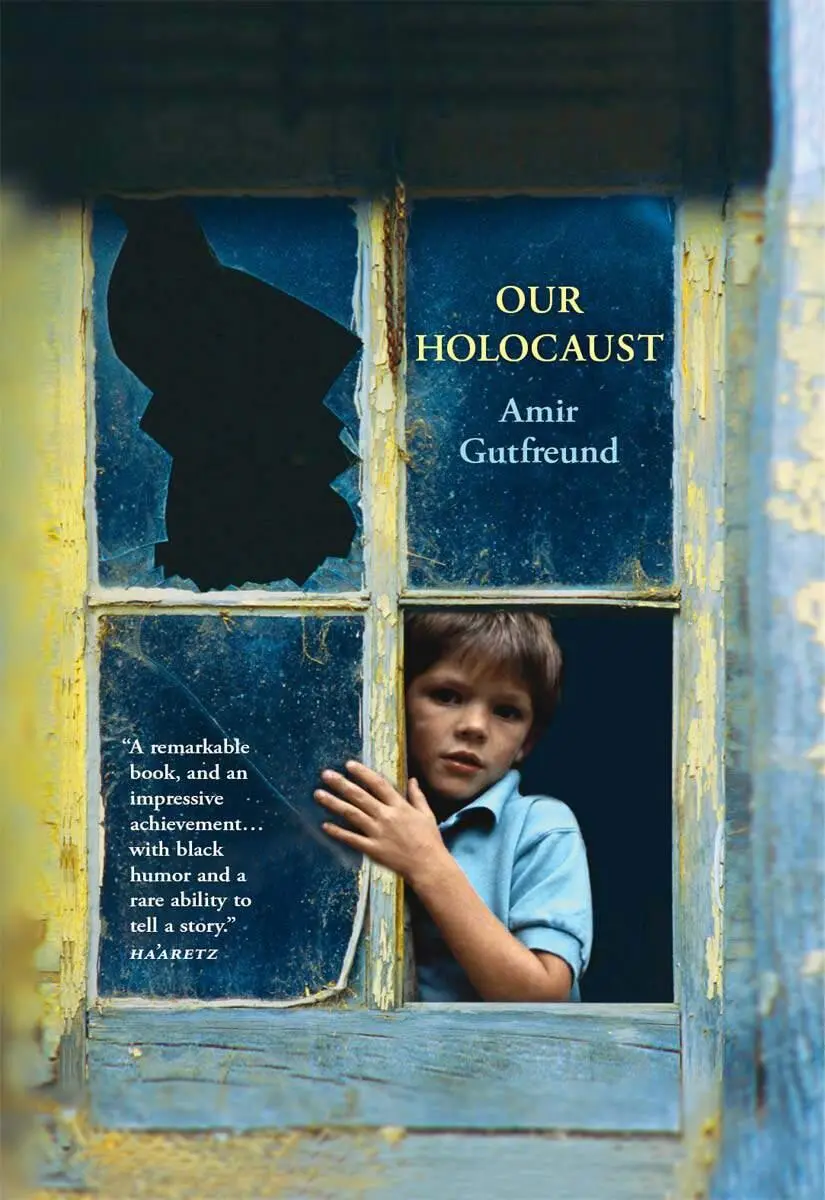
- Название:Our Holocaust
- Автор:
- Издательство:Toby Press Ltd
- Жанр:
- Год:2006
- ISBN:нет данных
- Рейтинг книги:4 / 5. Голосов: 1
-
Избранное:Добавить в избранное
- Отзывы:
-
Ваша оценка:
Our Holocaust: краткое содержание, описание и аннотация
Предлагаем к чтению аннотацию, описание, краткое содержание или предисловие (зависит от того, что написал сам автор книги «Our Holocaust»). Если вы не нашли необходимую информацию о книге — напишите в комментариях, мы постараемся отыскать её.
Our Holocaust — читать онлайн бесплатно полную книгу (весь текст) целиком
Ниже представлен текст книги, разбитый по страницам. Система сохранения места последней прочитанной страницы, позволяет с удобством читать онлайн бесплатно книгу «Our Holocaust», без необходимости каждый раз заново искать на чём Вы остановились. Поставьте закладку, и сможете в любой момент перейти на страницу, на которой закончили чтение.
Интервал:
Закладка:
“Okay, stop, enough.”
I have to go on, so she understands. (This is our lust for the abyss). So she realizes that she thinks she knows what went on in the concentration camps, but she doesn’t. That only these drawers can bring the truth out. That only through these drawers will she know that Dr. Gohrbandt, in Dachau, investigated how inmates would behave when forced to stand naked for fourteen hours in sub-zero temperatures. She needs to know that because of their screams they could not continue the experiment in Dachau; it was too close to civilian residential areas. And she needs to know that inmates were infected with epidemics and pus was injected under their skin, to see how they would handle the infection. She needs to know that Dr. Mengele pierced the eyes out of little children and he was never caught. She needs to know.
I keep quiet and Anat shuts the drawers, looking pale. “What are you planning to do with all this?”
(Meaning, how far are you intending to go — where are you thinking of arriving?)
“I’m planning to leave it, to quit. I’ll put it all in a sealed box in Grandpa Lolek’s basement.”
(Seventy years from now, someone nosy will find the bloated box and investigate the round handwriting. Hermine Braunsteiner, “the Stomping Mare” of Majdanek.)
She understands — I am quitting for her. Building a bridge. She hugs me.
“Okay…All right, well…” I say. Not only my words are mumbled, but my thoughts too. (We embrace, everything seemingly back to the elemental materials. We will have to refurnish our emotions. Refurnish what is now empty and hard. And the documentation? Should I betray it? Betray Attorney Perl? Should I really quit?)
Anat picks up the photograph of Laura Perl, who was killed in the gas chambers at Belzec, and whose husband taught himself what she had been through in her final moments, and was sad because she had always been so conscientious about cleanliness, even in the harsh ghetto conditions. From the day they took his wife from the house at 7 Leonarda Street, he had launched himself on a route of investigation, pierced a pinhole in the atmosphere and shot off into the distance to watch the ongoing world from high above.
Anat asks, “And the things Attorney Perl went through in the war, did you document them?”
No.
I didn’t have time.

Obersturmführer Licht mobilized the whole camp to work on Verbrecher. But then what? I had no idea. But I had read so much, so many survivor testimonies, that from that endless mass I learned that in fact there were not that many stories, only a multitude of versions of one story, versions that duplicated themselves and were distinguishable only by minute details. I realized I could tell Anat the rest of the story without making too many mistakes. Only trivial details would differentiate what I told her from the truth. The main thing was not to say “Licht,” but “Obersturmführer Licht.” It could have been another part of the bridge, and the bridge itself was more important than the little details. I would tell her about Obersturmführer Jürgen Licht, about his deadly gray eyes and his love of guns and puppet theater. After all, here in the store I was taking revenge on her for Attorney Perl’s death, and again — what fault was it of hers? Instead of taking revenge, better to tell her about Obersturmführer Licht’s play, Verbercher , and convince her that a grown man had actually written these things. Explain to her how in the camp that was at his disposal, where everything was allowed, where nothing-can-stop-us-when-we-want-something, a seed of insult planted in his childhood sprouted, and he used his prisoners to produce the play. Yes, that madness too was allowed in the world of the camps, something as innocent and colorful as a puppet theater, among guard towers and fences. Yes, a world in which they could say, “The Aktion is over, be at work on time tomorrow,” was a world of fairytales, and from what Attorney Perl had started to tell me about the true existence of the puppet theater, anything could have happened.
In order to tell her, one would have to imagine that the puppet theater had become the main facet of life in the camp, and to guess that even so, routine was not abandoned. Every morning rows of prisoners were taken out to dig pits and chop wood. Only those involved in the theater in some way were treated well. It is easy to imagine how work on the theater progressed, and how Obersturmführer Licht treated Attorney Perl like a personal assistant in a striped uniform. The adjutant was cast aside — his reports and documents were uninteresting. Obersturmführer Jürgen Licht avoided almost any interference in the camp life — that work had always bored him. He devoted all his attention to the play, ignoring orders that came from the outside, until one of his officers, the adjutant for example, complained to senior officers. Then Sturmbanführer Hes came to conduct an inspection visit and Obersturmführer Licht gave him an SS officer’s word of honor that everything was as it should be in the camp. In the meantime, the inmates on their way to work began to see refugees on the streets. German civilians. They traveled in long lines with wagons, and the looks on their faces told the inmates that the war was coming to an end. Then the rumors sprung up: all the inmates would be marched on long walks whose purpose was death.
In the camp things were no longer in order. Roll-call was held later and later in the day. Work was stopped before dark and the SS officers hurried back behind the fences. The skies were now the domain of the Americans, and almost every day there were planes dropping bombs, engines always roaring in the distance. Obersturmführer Licht’s camp did not constitute a target, but stray bombs found their way inside every so often. The officers were nervous, looking up at the sky even when it was empty. Some of them simply left, and Obersturmführer Licht did not object. Some inmates escaped too. I can already picture the final scene, in which Obersturmführer Licht and Attorney Perl remain on their own on the theater hilltop. Yes, that will be the scene. I will use all the adventure stories I used to read in Mrs. Gottmartz’s library, all the Karl May books about the Wild West, to imagine the finale. Anat will believe it, she has to. Anyone who says “there is no limit” and thinks they are capable of imagining the limit, must believe. Because if Sobibor happened and Majdanek happened, anything could happen between Obersturmführer Licht and Attorney Perl, even a duel. No one could protest even if that was the final scene, even if I decide right now that Obersturmführer Licht’s black pistol has a twin, a silver pistol on his right hip.
Up until the final duel, everything was devoted to the play. That was the new order of the camp. The production of Verbercher had to go on. Some of the Ukrainian policemen, perhaps because they liked working with wood, were assigned to work on the puppets. Whips and guns were laid down, and guards and inmates began conversing with one another. Everything revolved around the theater, while planes flew through the skies and a stream of refugees filed past the camp. Obersturmführer Licht’s officers had already decided to wrest the reins of power from him, but he outsmarted them by quickly ordering a rapid organization of death marches. Three rows left the camp, all of his officers and soldiers leading lines of those inmates who were not essential to the theater. Most of the puppet makers were sent off too, and the carvers and tailors — anyone who’s work was already done. Obersturmführer Licht instructed that the camp gates be locked and guard posts reinforced. He summoned his adjutant and shot him. The Ukrainian guards were ordered not to allow anyone in, not even SS. The camp became Obersturmführer Licht’s fortress. There would be a puppet theater.
Читать дальшеИнтервал:
Закладка:
Похожие книги на «Our Holocaust»
Представляем Вашему вниманию похожие книги на «Our Holocaust» списком для выбора. Мы отобрали схожую по названию и смыслу литературу в надежде предоставить читателям больше вариантов отыскать новые, интересные, ещё непрочитанные произведения.










Обсуждение, отзывы о книге «Our Holocaust» и просто собственные мнения читателей. Оставьте ваши комментарии, напишите, что Вы думаете о произведении, его смысле или главных героях. Укажите что конкретно понравилось, а что нет, и почему Вы так считаете.