Amir Gutfreund - Our Holocaust
Здесь есть возможность читать онлайн «Amir Gutfreund - Our Holocaust» весь текст электронной книги совершенно бесплатно (целиком полную версию без сокращений). В некоторых случаях можно слушать аудио, скачать через торрент в формате fb2 и присутствует краткое содержание. Год выпуска: 2006, Издательство: Toby Press Ltd, Жанр: Современная проза, Прочая документальная литература, на английском языке. Описание произведения, (предисловие) а так же отзывы посетителей доступны на портале библиотеки ЛибКат.
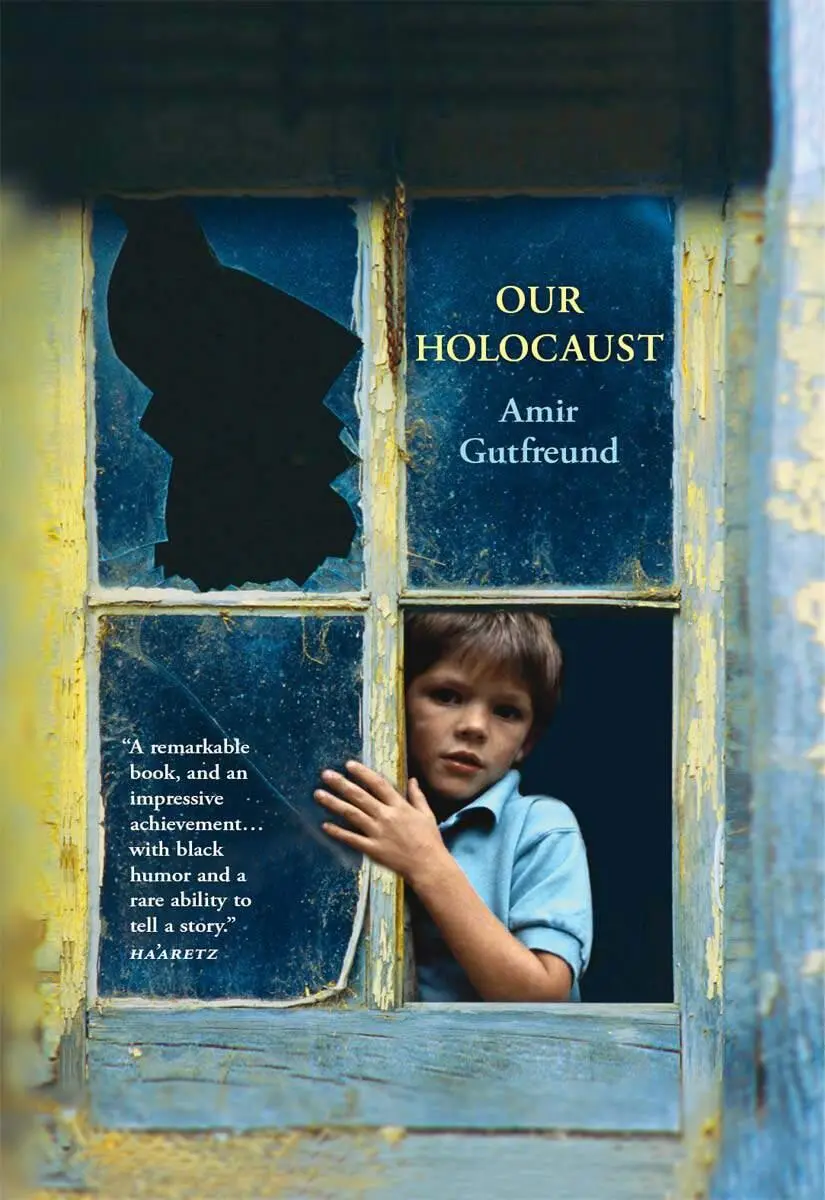
- Название:Our Holocaust
- Автор:
- Издательство:Toby Press Ltd
- Жанр:
- Год:2006
- ISBN:нет данных
- Рейтинг книги:4 / 5. Голосов: 1
-
Избранное:Добавить в избранное
- Отзывы:
-
Ваша оценка:
Our Holocaust: краткое содержание, описание и аннотация
Предлагаем к чтению аннотацию, описание, краткое содержание или предисловие (зависит от того, что написал сам автор книги «Our Holocaust»). Если вы не нашли необходимую информацию о книге — напишите в комментариях, мы постараемся отыскать её.
Our Holocaust — читать онлайн бесплатно полную книгу (весь текст) целиком
Ниже представлен текст книги, разбитый по страницам. Система сохранения места последней прочитанной страницы, позволяет с удобством читать онлайн бесплатно книгу «Our Holocaust», без необходимости каждый раз заново искать на чём Вы остановились. Поставьте закладку, и сможете в любой момент перейти на страницу, на которой закончили чтение.
Интервал:
Закладка:
But at nights, our glaciers floated on as we slept.
Around the time Grandpa Lolek decided to leave me the lands in Gedera, I started feeling that I couldn’t, I just couldn’t. Not because of Anat, but because of Hermann Dunevitz. He had cunningly found a way to live on through me. To give himself a great-grandson, an eighth of himself, through me. Not only Hermann Dunevitz, but all the traitors, the murderers, the sadists. The people who made Hirsch wander the streets and gave Rachela Kempler that look . And Gershon Klima and Mr. Pepperman and Itcha Dinitz and Mr. Bergman and Linow Community and everyone.
In Effi’s kangaroo court, I declared, “It won’t leave me alone. You see, he’s her grandfather, and Yariv is one eighth of him. One eighth. His blood is living on through her, through Yariv, through everyone who will come in the future. Precisely what shouldn’t happen. Do you see?”
Effi bristled. “Are you listening to yourself? That’s exactly what the Nazis said. They also looked for people with one eighth Jewish blood in them. They also said it coursed through one’s blood and could not be helped. You’ve really lost your mind.”
Attorney Perl said, “You have a wife, you mustn’t do anything. Give it time. Trust me, don’t do anything.” He caressed the cover of a book, The Protocols of the Nazi Trials, Volume IV , printed in 1950. These were the protocols that should have explained, should have told us what the grandfathers did in Germany. They all kept telling me, “So what?” They told me to forget. But something stronger than “so what” had to come, it had to. I would give anything to be told how to go on, what to do. They told me, “So what?” and “Forget it,” as if they were selling shiny objects to savages. As if I were incapable of understanding on my own that Anat was not to blame and neither were the German grandchildren who come here every summer to plant forests. Every summer, so I heard, they came to plant trees. Where were all these forests? Maybe you couldn’t see them from the roads, but after a few more years of apologies, their trees would suddenly shoot up over the bald, white shoulders of the highways, and the roads would have to be paved through wooded fields. It wasn’t her fault. I wished it was, so I could grasp at something. There wasn’t even the edge of a thread, nothing to point to, to imagine, to locate the pain, to know what to heal. There was nothing to do, no way to go on. Still they disembarked on my island to sell me shiny objects. (My suffering could not be traded for simple glass beads.)
“You have a major problem,” Effi said. “Everywhere you go, you take your hatred with you, like a dung beetle rolling a ball along. You need to stop. Get it in your head that there isn’t as much black and white in the world as we would like. Just stop it.”
“I don’t want to stop it.”
“I understand why it’s bothering you, but enough, stop it. You’re a grown man, you need to resolve this.”
“How?”
“Well, think of a bridge, for example.”
“A bridge?”
“Yes. When there’s a river you can’t cross, you build a bridge over it. It doesn’t mean the river is gone, it just means now you can cross it. See?”
“Yes.” I get the analogy. I get what she means. But Effi is enthusiastic about the idea and wants to keep explaining it. So what if I get it.
“That’s what people do. They need bridges. See, no one is telling you to stop feeling what you’re feeling. Just build a bridge. So you can cross over. You can even stand on the bridge and look down at the river, just without being inside it. Do you know how many bridges I’ve built?”
A bridge. I’m already taking measurements for the first supports, and Effi says, “Or maybe you could punish her.”
“Punish?”
“Punish Anat, you know, maybe that’s what you need.”
“What do you mean, punish?”
“It has to be something you choose. Like you do with kids.”
Punish Anat. Why should I punish Anat?
Effi comes to life. “For instance, another woman. Yes, something like that, so it won’t be easy. Another woman, at least once, yes.” (She is falling in love with the idea. She talks quickly, thinking, another woman, that’s what will help.)
“What are you talking about?”
“Then think of something else.”
“But why would I be with another woman?”
She gets annoyed. “Okay, you find something then. You’re the child. Figure out what will make you feel that it’s over and done with.”
Another woman? Where did she get that peculiar idea? Anat is the only one, I’m not attracted to other women. Why would I be with another woman?
(There is one, oddly. We met not long ago at Yariv’s kindergarten. I went to pick him up and it started raining. We stood beneath a small cornice that leaked; we were the last people in the kindergarten except for one of the teaching assistants, who jingled a large bunch of keys, put it in her bag, and stood next to us. She asked if I was Yariv’s dad. I said, no, I was the infamous child-kidnapper, Heinrik Chapinski. She laughed and said, “Why didn’t you say so? We give top honors to child-kidnappers around here!” I looked at her and wondered when kindergarten assistants got so pretty. Mine, Chana, was a half-mad dwarf who only liked quiet children, but she didn’t like me even though I was quiet. I plucked up the courage to ask if she really was the teaching assistant. She laughed again and said actually she wasn’t the assistant, she was also a child-kidnapper. In fact, Yariv was in her sights too because he was the cutest kid, but I, Heinrik Chapinski, had got to him first. I was surprised at how she had picked up the name and repeated it correctly. She didn’t even know that Heinrik Chapinski was tried after the war for the sadistic extermination of Jews in the Bochnia ghetto. She smiled and said that if we were both child-kidnappers then we should get together some time to discuss professional hazards. I told her I was married. Happily, I stressed. I pointed to Yariv: “That’s the result.” She looked hurt and said she hadn’t meant anything, she was just being nice. I wanted to say something friendly, to take it back, but Yariv started crying and tugged my hand. He wailed as only he knows how, without sentences, only words, leaving me responsible for the syntax. Half the words he was saying were “Itzik.” Itzik was a daunting entity in Yariv’s world, a kid who hit other kids and lorded over the sandbox and told all the other kids what to do. A kapo. Ever since that day, every time I come to pick Yariv up, I’m the embarrassed one. She seems quite cheerful. (“Hello, Heinrik!” She smiles prettily.)
Nothing will happen. There is love between Anat and me, six years of ever-growing love. I have no friends. Only Anat. I can’t understand how other people keep up with their friends from the army. Effi is family. There are no other friends. Why would I punish her?
Just before Purim I come home to find Anat sitting with gift baskets for the poor scattered all over the living room. She conducts her campaigns from our little headquarters, all the rooms filled with cardboard boxes, items and notes. Everything has to fit in the packages and be sent off. Not everything is straightforward. There are different types of recipients, three sizes of boxes (the size of the package corresponds to the extent of the recipient’s misfortune). She sits exhausted among the items. Yariv sits with her, curled up, obedient. He is as big as one of the packages. He doesn’t try to reach into the gifts and sabotage them. A well bred and polite child.
I stand in the doorway and say, “Over there, just so you don’t get mixed up, is our son. Should I mark him for you?”
Читать дальшеИнтервал:
Закладка:
Похожие книги на «Our Holocaust»
Представляем Вашему вниманию похожие книги на «Our Holocaust» списком для выбора. Мы отобрали схожую по названию и смыслу литературу в надежде предоставить читателям больше вариантов отыскать новые, интересные, ещё непрочитанные произведения.









Обсуждение, отзывы о книге «Our Holocaust» и просто собственные мнения читателей. Оставьте ваши комментарии, напишите, что Вы думаете о произведении, его смысле или главных героях. Укажите что конкретно понравилось, а что нет, и почему Вы так считаете.