Amir Gutfreund - Our Holocaust
Здесь есть возможность читать онлайн «Amir Gutfreund - Our Holocaust» весь текст электронной книги совершенно бесплатно (целиком полную версию без сокращений). В некоторых случаях можно слушать аудио, скачать через торрент в формате fb2 и присутствует краткое содержание. Год выпуска: 2006, Издательство: Toby Press Ltd, Жанр: Современная проза, Прочая документальная литература, на английском языке. Описание произведения, (предисловие) а так же отзывы посетителей доступны на портале библиотеки ЛибКат.
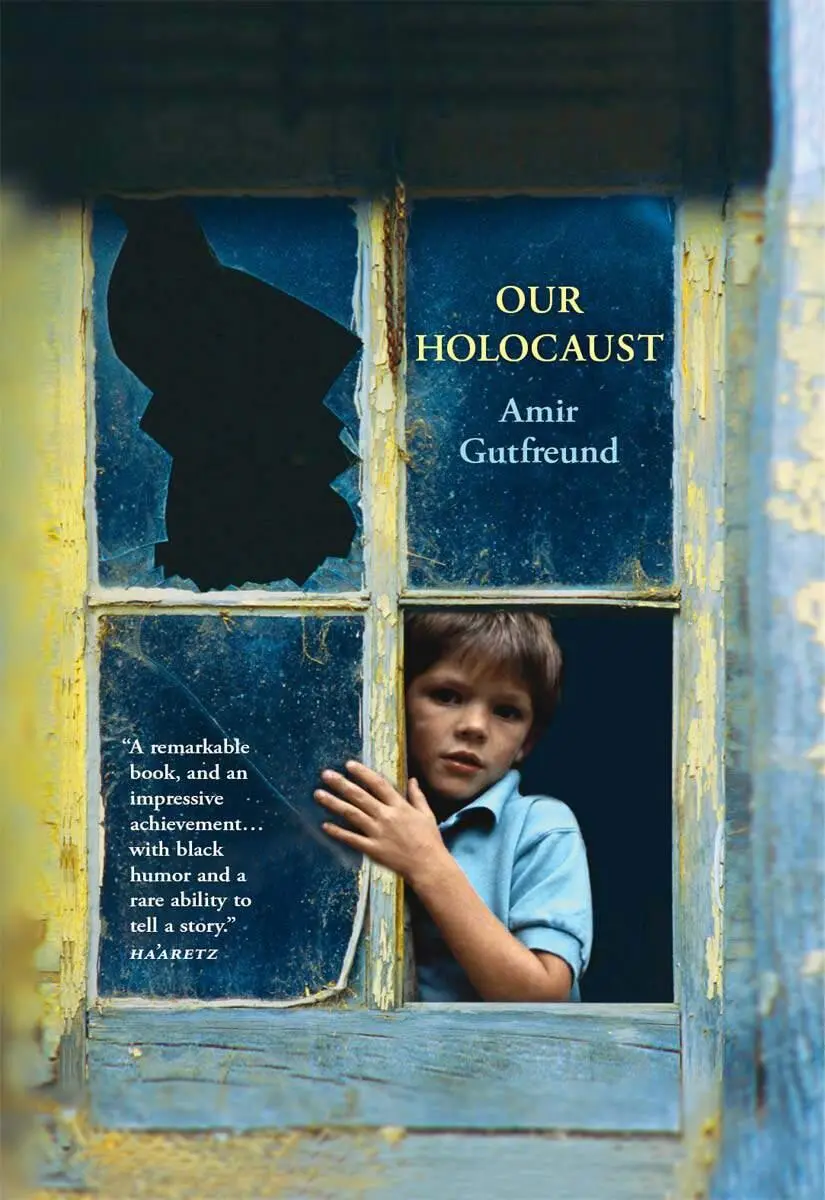
- Название:Our Holocaust
- Автор:
- Издательство:Toby Press Ltd
- Жанр:
- Год:2006
- ISBN:нет данных
- Рейтинг книги:4 / 5. Голосов: 1
-
Избранное:Добавить в избранное
- Отзывы:
-
Ваша оценка:
Our Holocaust: краткое содержание, описание и аннотация
Предлагаем к чтению аннотацию, описание, краткое содержание или предисловие (зависит от того, что написал сам автор книги «Our Holocaust»). Если вы не нашли необходимую информацию о книге — напишите в комментариях, мы постараемся отыскать её.
Our Holocaust — читать онлайн бесплатно полную книгу (весь текст) целиком
Ниже представлен текст книги, разбитый по страницам. Система сохранения места последней прочитанной страницы, позволяет с удобством читать онлайн бесплатно книгу «Our Holocaust», без необходимости каждый раз заново искать на чём Вы остановились. Поставьте закладку, и сможете в любой момент перейти на страницу, на которой закончили чтение.
Интервал:
Закладка:
Dinner. The volcano breathes heavily, absorbing little relief from the air, the omelet, the salad.
“Is everything all right?” Anat asks. She wants to talk. It’s Purim soon and she’ll be busy preparing the gift baskets.
The volcano asks, “What do you know about your grandfather, Hermann Dunevitz?”
“Grandpa Hermann?”
“Yes.”
“Not much. He died in Canada, a long time ago. My mother was five.”
“He came from the Lvov region, didn’t he?”
“Maybe, yes, one of those towns. I don’t know. Why? What have you found out?”
“What have I found out? I’ll tell you what I’ve found out. Your grandfather was a murderer. He murdered Jews in the camps.”
Her expression turns grave. “Really?”
I look at her face. Where will this go?
Anat wonders, “But he was Jewish, wasn’t he?”
I tell her almost gleefully, “Yes, but he was a sadist, he was crazy. He hung around the camps and murdered Jews like the worst of the Nazis.”
Silence. She spreads margarine on a slice of bread. The knife moves over the bread. Salt. Pepper. That’s how she eats. “All right, well what do you want now?”
“Nothing.”
I’m not accusing her, it’s not her fault, is it? There’s nothing to accuse her of. And if what came of Hermann Dunevitz is Anat, then everything must be all right, and the theories don’t hold up. Except that now we have to forgive them too, the grandchildren of Nazis, who come here to plant forests.
Anat won’t let it go. “It doesn’t seem like nothing by the look on your face. Come on, tell me, what do you want?”
“Nothing, really nothing. It’s not your fault.”
We eat in silence. Pass the salt. I spread margarine on a slice of bread. I add salt, pepper. The flammable air above us — will it ignite or not?
“Just don’t say anything to my mother! Even if it’s true!”
“Okay.”
We sit quietly. Drink coffee. Read the paper. We hear a noise and sigh. It’s just Yariv stirring in his bed. We toss and turn on our bed until morning comes. Hermann Dunevitz is Anat’s grandfather.
Grandpa Lolek’s surgery became an urgent matter, something to busy ourselves with, because Grandpa Lolek was beginning to behave oddly. Whether it was old age or the tumor was unclear, but it became apparent that he had to have the surgery, and soon. Little defects flowed through his memory and thoughts. He announced that he was leaving the lands in Gedera to me — me and Joyce the dancer, jointly, as long as we didn’t fight. He asked us all to give her the news when she arrived for her usual evening visit, and hoped she wouldn’t be late this time. He was clearly going senile.
We gathered around him with suggestions and data. We took him to the doctor, and together consulted and recommended having the surgery here in Israel, at Hadassah Hospital — the best department. Grandpa Lolek looked frightened as he sat on his chair trying to understand our franticness and the urgent need to undergo surgery. He closed his light blue eyes for a moment, weighing the important decision. Then he opened them and said, “All right. You can have operation.” And so we had to explain everything again, reintroduce the doctor, the room, the Sick Fund, and that the surgery was for his head, not anyone else’s, and that it would be cheap and successful. The doctor would explain everything, here he was. Anat was among us, urging Grandpa Lolek, reassuring him, introducing him to the doctor. We all encouraged him and the doctor encouraged us, saying we should leave Grandpa Lolek in the room with him and let him explain. And Anat was among us, and we were living a quiet married life, kind to each other (shoving reasons to fight into the abyss). The panic over Grandpa Lolek’s confusion was good for us, it softened our dormant troubles. Besides, I had convinced myself that everything was fine. At first I was angry, unable to tolerate the thought that she was the granddaughter of Hermann Dunevitz. But it all passed and I managed to say, “So what?” and to really feel, “So what?” So what if she’s his granddaughter? We’ve been married for six years and I know everything about her, her love, her capacity to truly love people, to help them. She has a love of humankind. (“She has an ego that lives on the back porch,” Effi said). I said, “So what?” and I felt, “So what?” I had simply been alarmed for a moment by the sound of shattering glass. I wasn’t prepared for it. But nothing was broken, nothing had shattered.
Life got back on track. Documenting, talking with Attorney Perl, reading his books. Everything attested to routine. Grandpa Lolek broke an appliance and asked that my friend “who fixes things cheap” repair it. Effi found a new boyfriend. Anat said she’d be busy on Purim. Grandpa Yosef asked if I could bring back the Vauxhall, which Grandpa Lolek couldn’t use anyway, because Hans might want to use it (for some time, his entire life had been dedicated to paving roads for Hans). I told him I had finished documenting most of the family stories, everything was ready, and he asked me to come over. He served me a dish of okra and banana. (Did I think Hans would like these sorts of exotic flavors?) I put down a neatly bound copy of everything I had documented. My documentary, on Grandpa Yosef’s brown wooden table.
Grandpa Yosef left the bound pages where they were and did not even reach out a curious hand. He talked about how things were going in the neighborhood. Everything was the same as usual. Gershon Klima had decided he needed a rest and had found himself a suitable place near Tel Aviv. They were thinking of renting out his house here, but weren’t sure they’d be able to. Not long ago, the Meretz party had rented the late Orgenstern’s house and set up a local branch, but they had to leave after visiting dignitaries were bitten by dogs on two separate occasions, for no apparent reason. (Grandpa Yosef and I knew it was Brandy, who had become an extreme right-winger after her death.) Mr. Pepperman had stopped getting his mail, which alarmed him. They had to have a search. At the post office they said everything was in order. In the end they found all his mail lying in a puddle and no one knew who had done it. There was also a strange affair with the poet, Asher Schwimmer. He no longer lived with his brother; the brother had passed away. They took him to a place near Nazareth, a quiet place, so he’d be happy. But he suddenly started slapping people for no reason — the staff, the doctors, the caregivers. He yelled and made accusations and hit. Here in the neighborhood, Uncle Antek was losing his hearing, he couldn’t hear at all in his right ear. The doctors were looking into it, and so was Effi. In the meantime she suggested he turn up the volume on his radio. Uncle Mendel was also losing his hearing, but he never listened to anyone anyway so it didn’t matter.
“And how’s Mr. Levertov?”
Mr. Levertov was absolutely fine. Ever since Effi had become his primary physician, he’d been truly exceptional. Like a young boy. People were envious; they wanted Effi to be their doctor too. Even Mrs. Tsanz. (And we both knew, because Effi had told us confidentially, that she was probably going to leave the clinic soon. A position had opened up for her at Hadassah Hospital in Jerusalem.)
The conversation naturally shifted to Grandpa Lolek. We agreed that he had to have the surgery — what was he waiting for? Grandpa Yosef asked about Yariv and how Anat was. We didn’t talk about Hermann Dunevitz. As long as we didn’t talk and didn’t ask, everything would be fine. If-we-shut-our-eyes-the-monster-would-leave. Everything was fine. Simply fine. And really, I thought, it’s no fault of hers. Everything is fine, I thought. Simply fine.
Читать дальшеИнтервал:
Закладка:
Похожие книги на «Our Holocaust»
Представляем Вашему вниманию похожие книги на «Our Holocaust» списком для выбора. Мы отобрали схожую по названию и смыслу литературу в надежде предоставить читателям больше вариантов отыскать новые, интересные, ещё непрочитанные произведения.








Обсуждение, отзывы о книге «Our Holocaust» и просто собственные мнения читателей. Оставьте ваши комментарии, напишите, что Вы думаете о произведении, его смысле или главных героях. Укажите что конкретно понравилось, а что нет, и почему Вы так считаете.