Amir Gutfreund - Our Holocaust
Здесь есть возможность читать онлайн «Amir Gutfreund - Our Holocaust» весь текст электронной книги совершенно бесплатно (целиком полную версию без сокращений). В некоторых случаях можно слушать аудио, скачать через торрент в формате fb2 и присутствует краткое содержание. Год выпуска: 2006, Издательство: Toby Press Ltd, Жанр: Современная проза, Прочая документальная литература, на английском языке. Описание произведения, (предисловие) а так же отзывы посетителей доступны на портале библиотеки ЛибКат.
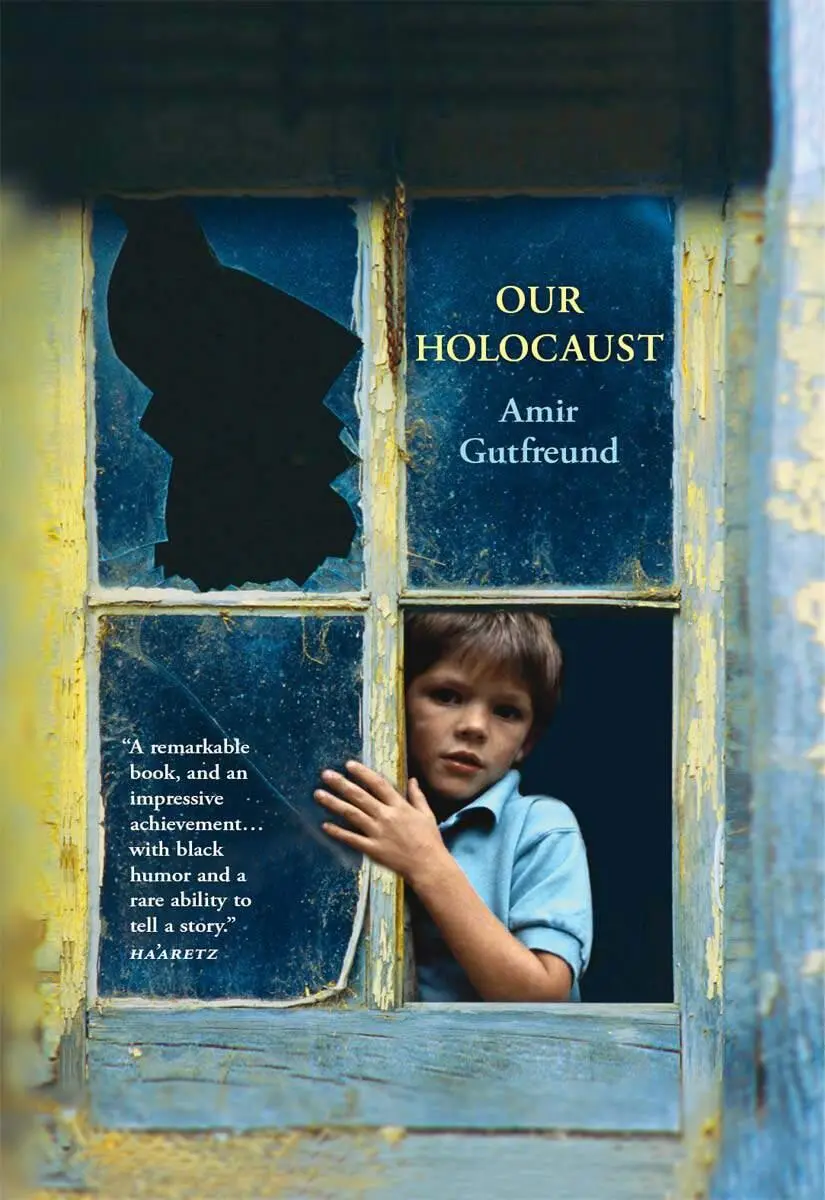
- Название:Our Holocaust
- Автор:
- Издательство:Toby Press Ltd
- Жанр:
- Год:2006
- ISBN:нет данных
- Рейтинг книги:4 / 5. Голосов: 1
-
Избранное:Добавить в избранное
- Отзывы:
-
Ваша оценка:
Our Holocaust: краткое содержание, описание и аннотация
Предлагаем к чтению аннотацию, описание, краткое содержание или предисловие (зависит от того, что написал сам автор книги «Our Holocaust»). Если вы не нашли необходимую информацию о книге — напишите в комментариях, мы постараемся отыскать её.
Our Holocaust — читать онлайн бесплатно полную книгу (весь текст) целиком
Ниже представлен текст книги, разбитый по страницам. Система сохранения места последней прочитанной страницы, позволяет с удобством читать онлайн бесплатно книгу «Our Holocaust», без необходимости каждый раз заново искать на чём Вы остановились. Поставьте закладку, и сможете в любой момент перейти на страницу, на которой закончили чтение.
Интервал:
Закладка:
“Day after day went by and not much hope was left. But late one night after a week, the head of my hut told me to go to Obersturmführer Licht’s office. My heart sensed disaster. He had already summoned someone to his office once, a typist, and had dictated an entire letter to him and then shot him in the head. What did Obersturmführer Licht want of me? They took me into his room. It was warm in there. A nice fire was burning, and there were dogs lying on a rug. My body was stiff as a rock. In front of the desk where Obersturmführer Licht sat was an empty chair. Was I supposed to sit down? Greet him? Salute? His adjutant handed me some papers. Obersturmführer Licht had written a play about his childhood, and my job was to read the pages out loud for him.
“His play was called Verbrecher —Criminals — and it recounted the story of an affair from his school days — some incident where he was assigned the duty of carrying the flag on a holiday parade, but something happened and the teacher let another boy carry it. Obersturmführer Licht gave precise instructions for making the puppet that would represent the teacher. It had to have small, Communist, Jewish eyes. He spent half a page on how to make the puppet of the other boy. And the kids who laughed at little Obersturmführer Licht. And the Jewish headmaster. And the priest. All of them. Lots of instructions in German. How the puppet makers managed to finally build the marionettes the way he instructed, God only knows. Perhaps they were helped by the fear of death. After the teacher and the headmaster and the priest, on a fresh new page, there were instructions on how to portray his beloved mother’s voice; there was to be no puppet representing her body. Then there was Zibrus the Knight, who in Obersturmführer Licht’s play had to appear and put a stop to the parade, take the flag away from the other boy and give it to Obersturmführer Licht.
“Obersturmführer Licht had poured many words onto paper, and I was required to read the lines aloud, to pleasure his ears with his own composition. I did the best I could, acting the parts out as I read. I cackled evilly when the teacher — who was a traitor, a Jew and a Communist — tripped up Obersturmführer Licht in class. I was emotional when the flag was given to the other child. And then Obersturmführer Licht the boy got up from his seat in class to make a speech. That was how it went in the play. He had written himself a long speech and as I tried to deliver it expertly, Obersturmführer Licht the commandant sat at his desk and, with his eyes shut and his hands beneath his chin holding a little pencil like a baton, instructed me to repeat my lines, make corrections, slow down the pace.”
“How did you understand what he wanted?”
“I understood. Believe me, I understood. I was so scared, I almost went in my pants. I followed the pencil beneath his chin and understood everything Obersturmführer Licht wanted.”
“And what happened in the end?”
“I got to the point where the voice of little Obersturmführer Licht’s mother was supposed to come from behind a screen. She was to try and persuade the Jewish headmaster to reverse his terrible decision. I recited her noble pleas, some of which he had found, I believe, in party propaganda, and some of which were the sorts of things mothers really would say. The headmaster refused to listen to the mother’s reasoning because little Obersturmführer Licht had a mark for misbehavior on the class roll, because he had thrown a spit-ball. I remember the headmaster’s response to her: ‘In our regime, as it is designed at present, in the year 1922, I am the one who decides which pupil shall march with the flag in the parade, and I am the one who decides that your son is not worthy of this great honor because he threw a spitball!’”
Attorney Perl does not need to recite the play for me. The tearful voice of a wronged child comes through amply in the space of the room: “But it was Heinrich who threw the spitball!” The mother’s response is also superfluous. It is obvious that the headmaster, for whose puppet the prisoners will have to find a thick log of wood, will throw her out of his office. Obersturmführer Licht’s lines need not continue either.
“He held up his hand: ‘Stop!’ and the play recitation ceased. The dogs perked up their ears and looked at me. The adjutant gave a brisk order and two guards came to take me away and deliver me back to the head of the hut. From the next day onwards, the whole camp was busy setting up the new theater and producing Obersturmführer Licht’s play, Verbrecher .”
Attorney Perl gets up to make us some more tea. With his back turned to me he looks small and hunched. His feet still give him the strength to work. His hands tremble slightly, but he carries the tea confidently, cautiously, without spilling a drop. He sits down opposite me with a lucid mind — mercilessly lucid. I thank him, and from some troubled region of my memory I insist on murmuring, “I would still like to find out about Hermann Dunevitz.”
Attorney Perl sighs. “You know, I think that maybe, somehow, with all my cards, you’ve gotten yourself headed in a bad direction. For every dreck like that Hermann Dunevitz or Yehezkel Ingster, there was a wonderful man who did more than you could imagine. Think about Mordecai Anielewicz, the leader of the Warsaw ghetto uprising — what a leader this country could have had if only he hadn’t stayed in a bunker with the last of the insurgents. And think about Adam Czerniaków, head of the Warsaw Judenrat. Read about him. Such a wonderful man. And Robert Stricker, who could have used his connections to stay out of Auschwitz, but he insisted on going with his congregation precisely because ‘that was where he was needed.’ You have surely heard of Janusz Korczak. And just think of all the people whose names we don’t even know but who gave morsels of bread to people who had no strength to get to the food because they were pushed away by the strong ones. Think of all the rabbis who did not flee but went with their people to death. Some of them carried Torah books in their hands, to give people courage in the train cars. And the people who sung Hatikvah , the national anthem, on the way to the crematoria. So many were killed in this Shoah — if only I had the courage and the strength to behave as they did. What happened there, in the Shoah, is more complex than what you can derive from my cards. All the educated people who committed acts of betrayal, and the simple Polish peasants who saved lives and were sometimes killed with their whole families because they hid a Jewish child. All the monks who were exterminated because they were caught hiding Jewish children. The people who informed on Jews, the people, even within the SS, who turned a blind eye and gave a prisoner one more chance to live. I told you, there were SS camp commandants who did their jobs without hating Jews. It didn’t stop them from carrying out all their orders, and they killed prisoners to maintain discipline, but they tried to provide the Jews with the calorie quota dictated by their regulations, even during shortages. Then there were the Hanoch Bayskis, the Jews who hurried after hangmen to let them know a victim needed to be hanged again. Complicated, very complicated. Think of the Polish monk, Maximilian Kolbe, who volunteered at Auschwitz to go to his death in place of another prisoner. He knew his punishment would be death by starvation in a locked cellar beneath Cell Block 10, the hut of death. He knew he would lie in a dark hut until he died, but still he volunteered. It turns out that he was an anti-Semite and had published articles against Jews before the war. So what was he, this man? And what do we understand?”
We drink our tea.
But on the way home, Hermann Dunevitz floats to the surface like a strange dream trying to get out. Black markers are scattered through Memorial park. The kaleidoscope of memories is overturned, trying to record something. Upside down, it cannot find rest. On the pillow at night, troubled sleep, the kaleidoscope tries to emit a voice. There is something down there. Something down there.
Читать дальшеИнтервал:
Закладка:
Похожие книги на «Our Holocaust»
Представляем Вашему вниманию похожие книги на «Our Holocaust» списком для выбора. Мы отобрали схожую по названию и смыслу литературу в надежде предоставить читателям больше вариантов отыскать новые, интересные, ещё непрочитанные произведения.










Обсуждение, отзывы о книге «Our Holocaust» и просто собственные мнения читателей. Оставьте ваши комментарии, напишите, что Вы думаете о произведении, его смысле или главных героях. Укажите что конкретно понравилось, а что нет, и почему Вы так считаете.