Amir Gutfreund - Our Holocaust
Здесь есть возможность читать онлайн «Amir Gutfreund - Our Holocaust» весь текст электронной книги совершенно бесплатно (целиком полную версию без сокращений). В некоторых случаях можно слушать аудио, скачать через торрент в формате fb2 и присутствует краткое содержание. Год выпуска: 2006, Издательство: Toby Press Ltd, Жанр: Современная проза, Прочая документальная литература, на английском языке. Описание произведения, (предисловие) а так же отзывы посетителей доступны на портале библиотеки ЛибКат.
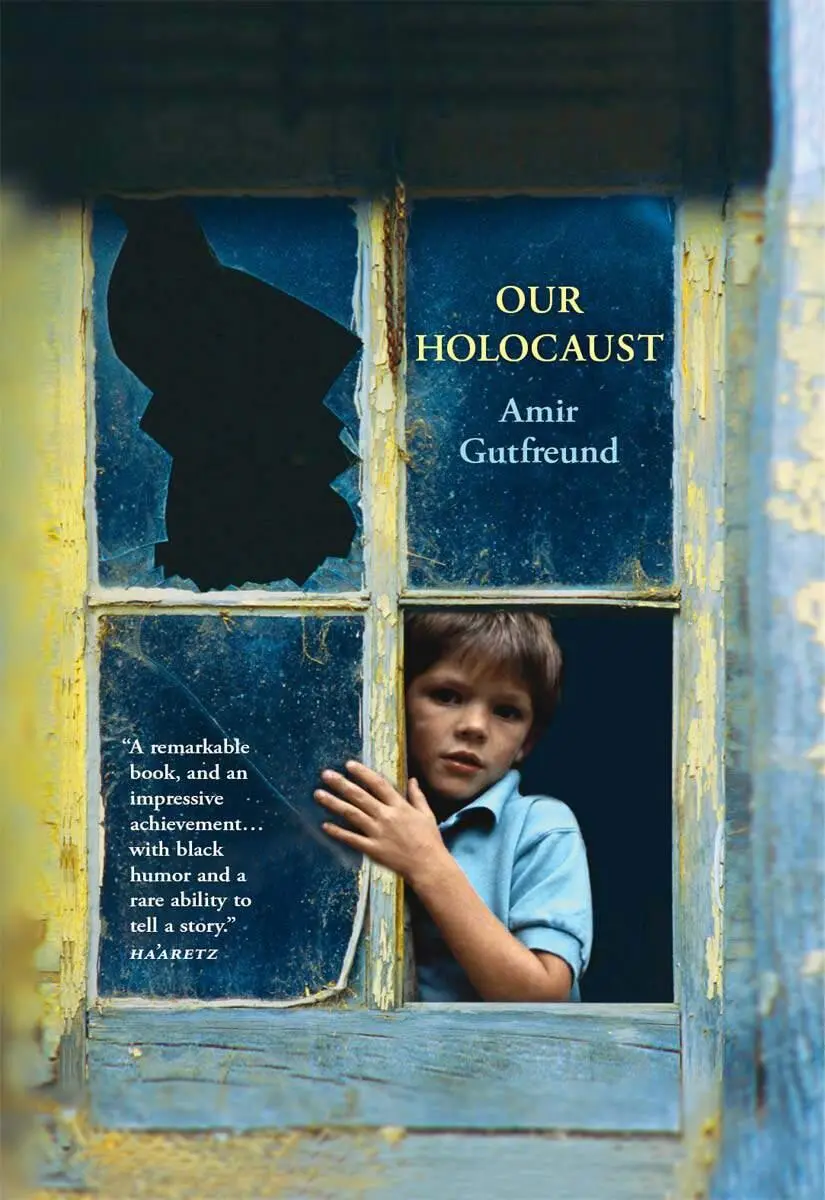
- Название:Our Holocaust
- Автор:
- Издательство:Toby Press Ltd
- Жанр:
- Год:2006
- ISBN:нет данных
- Рейтинг книги:4 / 5. Голосов: 1
-
Избранное:Добавить в избранное
- Отзывы:
-
Ваша оценка:
Our Holocaust: краткое содержание, описание и аннотация
Предлагаем к чтению аннотацию, описание, краткое содержание или предисловие (зависит от того, что написал сам автор книги «Our Holocaust»). Если вы не нашли необходимую информацию о книге — напишите в комментариях, мы постараемся отыскать её.
Our Holocaust — читать онлайн бесплатно полную книгу (весь текст) целиком
Ниже представлен текст книги, разбитый по страницам. Система сохранения места последней прочитанной страницы, позволяет с удобством читать онлайн бесплатно книгу «Our Holocaust», без необходимости каждый раз заново искать на чём Вы остановились. Поставьте закладку, и сможете в любой момент перейти на страницу, на которой закончили чтение.
Интервал:
Закладка:
From the front of the shop, Yariv’s voice reaches me in a wail. One of the customers was joking around and told Yariv he would buy him along with his bag of nails. Yakov the assistant played along and together they staged a complex negotiation. How-much-for-the-sweet-little-mama ’s -boy? At first Yariv sat quietly, following the negotiations in awe. But suddenly his sorrow broke through and he was washed over with great self-pity. He cried, “Where’s my daddy?” and shouted, and the customer apologized, red-faced, looking left and right to enlist other customers to attest to his innocence; he hadn’t meant any harm. There was no one on the right, and the two on the left nodded, trying to reassure Yariv, not knowing how difficult a task that would be. I arrive on the scene to find my son standing frozen on a bench, waiting for me helplessly. We have no choice but to leave the store. Off we go. Where to? Where do you want to go? To the lawn. We go to the big lawn at Memorial Park, with the white pillars. Yariv finds a line of ants and kneels down, enchanted. With a little twig he tries to pose dilemmas to the ants. I sit facing the sea. The bay of Haifa is spread out before us. I think about the beach, where they never go. Just over half a mile as the crow flies and yet never, never do they take their cheery flip-flops and varicose-veined legs onto the sandy shores. Only Grandpa Yosef, thanks to his righteousness and with the help of his bicycle (especially since returning from the Caribbean), dares to go that far. Later, he comes home from an idle hour at the beach with shells in his pockets.
One ant climbs onto Yariv’s twig. He shakes it, but the ant clings. Yariv lets go in a fright. He comes over to me, ready to go home. Already? Yes. Don’t you want to sit a little longer? No. We leave. People pass us by. They are happy here. The park assuages troubles, slows down the pace of life. People can come from downtown, from doing errands at City Hall across the way, from the army induction center, from the courthouse. Such a Haifa park, close to errands and shopping. You can walk around without feeling as if you’re wasting time, opposite Haifa’s round bay. You can sit on the benches, looking at the dirty pool and the swings that someone insists on constantly re-painting to make them look nice. (There’s always a patch of wet paint or a glossy new layer, and people know to check carefully before they put a kid down). Dad used to bring us here on Saturday afternoons in our good shoes, in the sixties. Thirty years apparently had to go by for me to notice the park’s name, “Memorial Park.” A strange name. I never paid attention to it before. We used to come here without thinking about names, to play and walk around. Once a year the park justified its name when the official memorial services were held here. First for Holocaust Remembrance Day, then for the IDF soldiers on Memorial Day. Then there would be fireworks set off for Independence Day. I remember people dancing in circles, and lots of people coming up to Dad, excited, shaking his hand as if they had won the Nobel prize together.
On Attorney Perl’s little cards there is mention of the Aktion in the small town of Koretz, on the holiday of Shavuot. When the Aktion was over, the Gestapo officer addressed the Jews whose family members had just been sent away in transports, saying, “The Aktion is over. Tomorrow morning all remaining Jews must arrive at their workplaces.” I think about the unbelievable passivity. To be a human being whose family has been sent to extermination and to be asked to show up to work on time the next day. Here, in Memorial Park, I think about the Aktion in Koretz and realize what it was that Dad was celebrating with us. The fireworks, the dances, the Nobel winners. The Independence Day I take Yariv to is not the Independence Day I went to with Dad. With us there is happiness, and wheeling and dealing among the various stalls — Yariv is only allowed to pick two things. But with Dad we would walk among the Nobel winners, everyone strolling happily, and a wild cry of joy — I-N-D-E-P-E-N-D-E-N-C-E — rose up from peoples’ bones to the stars, just like the fireworks. Green, red and yellow trails bursting like little thoughts that run out on their way down, making way for a new idea that erupts and is soon forgotten. Six million prosecutors in our Memorial Park, and young people dancing in circles, and Dad watching with us, buying falafel and little flags, and a Bedouin man from the Negev selling rides on his camel, and eating pita with spicy humus. I-N-D-E-P-E-N-D-E-N-C-E, I-N-D-E-P-E-N-D-E-N-C-E. Nobel prizes bursting through the holes in flimsy pitas, pickles dying like heroes, pale-pale green, I take them out and very quietly drop them to the ground. Food is Not Thrown Out.
Even in Grandpa Yosef’s neighborhood they celebrated Independence Day. It was quiet, with only the state flags sneaking out of the windows. But Grandpa Yosef assured us, “Oh, believe me, it’s very joyous here.” To prove that something exciting was hiding beneath the surface, on the morning of Independence Day he would walk to synagogue and pray loudly for Israel. He would come back from prayers sparkling and festive, and tell us how he had gone to see the celebrations in the center of Kiryat Haim the night before. He had watched the fireworks that were set off from where we live, from Memorial Park.

I finish writing, editing and typing the testimonies. I send each member of the family their testimony so they can make comments and corrections.
Uncle Lunkish phones. “Will you be sending me what you wrote about me too?”
“But you didn’t really say much…”
“But what I did say, will you send it?” And on second thought he adds, “Could you perhaps come again? I think I can talk now.” He voice grows stronger. “What’s the worst that could happen?”
The next day, with Yariv, we sit in his little home. Uncle Lunkish talks. First the childhood, the village, the square. Then the war. The hardships, the ghetto, the concentration camp. And finally, Hermann Dunevitz.
“That was the worst. He made me his helper, that bastard. He forced me. I had to write down on lists the people he named. He was Jewish, but he did not have the heart of a Jew. The Nazis liked him, and as soon as he got to the camp they made him half-prisoner half-officer. They didn’t give him a uniform but they let him walk around the camp wherever he wanted and be their detective. He wrote down punishments, gave out punishments himself, and issued all sorts of orders. I wore glasses before the war, but he took them away from me and I couldn’t see a thing. Everything I did with him afterwards, I didn’t see. I could still write. He made sure of that before he took them. He showed me a pile of glasses and laughed, and explained where the glasses came from, and then he threw mine onto the pile and said it was a great privilege for me that my glasses were on that pile but I was still standing. From that day on I was his assistant. He got me off work duty, and that’s why I’m still alive today, because my strength had already run out and I knew I would not make it through the next Selektion , that they would send me where they had sent the people with the glasses. I don’t know why he needed me. Maybe because they wouldn’t let him be a real officer with rank, because he was Jewish, so he wanted to at least have an assistant. I would walk around with him, seeing everything blurred, and when he stopped in front of someone to decide whether or not to punish them, I had to write down his decision. People would stand across from me, I could barely see them, and they would tell me their number and block number and the name of their block leader, who was the only one who had a name. I would hold the notebook up to my eyes and write everything down, afraid he would kill me if I made a mistake or changed their punishments, because for him, killing was nothing. I may have written down people I knew, who I used to know before they took my glasses. Once someone whispered to me, ‘Naftali, it’s me, Gotleib, get him to let me off.’ I wasn’t entirely sure who Gotleib was, as if for a brief moment the glasses of my memory had also been removed. I wrote down his number and the other stuff, and I wrote down thirty lashings, and in the evening he must have got them.
Читать дальшеИнтервал:
Закладка:
Похожие книги на «Our Holocaust»
Представляем Вашему вниманию похожие книги на «Our Holocaust» списком для выбора. Мы отобрали схожую по названию и смыслу литературу в надежде предоставить читателям больше вариантов отыскать новые, интересные, ещё непрочитанные произведения.







Обсуждение, отзывы о книге «Our Holocaust» и просто собственные мнения читателей. Оставьте ваши комментарии, напишите, что Вы думаете о произведении, его смысле или главных героях. Укажите что конкретно понравилось, а что нет, и почему Вы так считаете.