Amir Gutfreund - Our Holocaust
Здесь есть возможность читать онлайн «Amir Gutfreund - Our Holocaust» весь текст электронной книги совершенно бесплатно (целиком полную версию без сокращений). В некоторых случаях можно слушать аудио, скачать через торрент в формате fb2 и присутствует краткое содержание. Год выпуска: 2006, Издательство: Toby Press Ltd, Жанр: Современная проза, Прочая документальная литература, на английском языке. Описание произведения, (предисловие) а так же отзывы посетителей доступны на портале библиотеки ЛибКат.
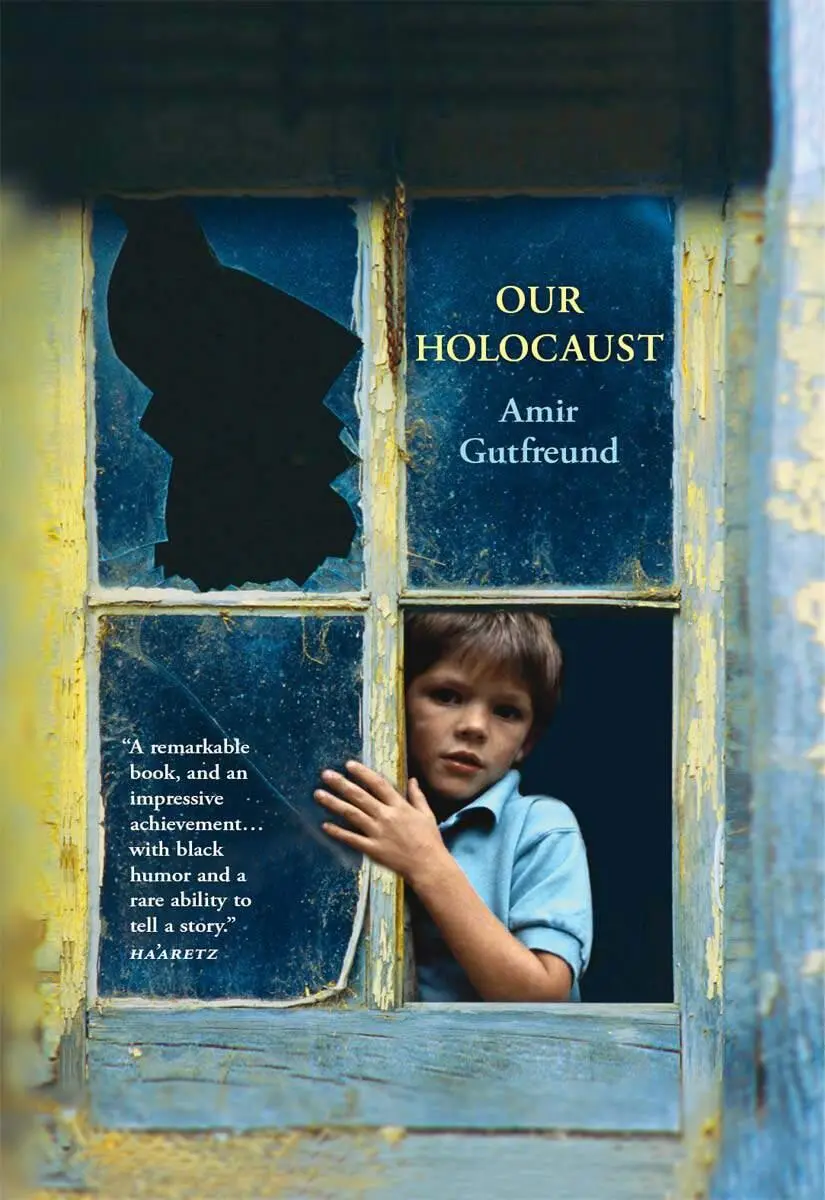
- Название:Our Holocaust
- Автор:
- Издательство:Toby Press Ltd
- Жанр:
- Год:2006
- ISBN:нет данных
- Рейтинг книги:4 / 5. Голосов: 1
-
Избранное:Добавить в избранное
- Отзывы:
-
Ваша оценка:
Our Holocaust: краткое содержание, описание и аннотация
Предлагаем к чтению аннотацию, описание, краткое содержание или предисловие (зависит от того, что написал сам автор книги «Our Holocaust»). Если вы не нашли необходимую информацию о книге — напишите в комментариях, мы постараемся отыскать её.
Our Holocaust — читать онлайн бесплатно полную книгу (весь текст) целиком
Ниже представлен текст книги, разбитый по страницам. Система сохранения места последней прочитанной страницы, позволяет с удобством читать онлайн бесплатно книгу «Our Holocaust», без необходимости каждый раз заново искать на чём Вы остановились. Поставьте закладку, и сможете в любой момент перейти на страницу, на которой закончили чтение.
Интервал:
Закладка:
It soon turned out that the magical era had not come to an end without incident. From all the commotion, the fluttering of days, the prophetic time, the oscillating eras, the minutes pushed back like the poles of a magnet, a single distortion of time blossomed into a deed: Brandy came back. But not in her familiar canine form. Grandpa Yosef’s neighborhood became filled with a plethora of dogs, passing transients of different breeds and different sizes. Each of them looked clearly like a particular aspect of Brandy — a rib of hers, something extracted from her wholeness and presented independently, developed into a whole dog, a barking puppy or a bitch pulled along on a leash.
We would see them and remember Brandy — because of a leg, because of an ear, because of a bark. It did not occur to us that the dogs were somehow related. Who was thinking of mysticism? We were thinking of what we missed. Even before Grandpa Yosef started battling the direction of time, if our thoughts went to Moshe, Brandy also waddled along and sat down to keep watch at his feet. Even in our thoughts, even after death, if Moshe was here, Brandy would come too, to make sure no harm came to him. Sometimes she turned up in our thoughts just like that, and we quickly conjured up a big lawn, butterflies, moles tunneling, even rabbits. Anything to make her happy. To excite her. To make her reach out with her ugly paws as she lunged, to make her run and jump, gaining full compensation for a life bound at Moshe’s feet.
But now her appearance was clearly real. We could not ignore the dogs surrounding the house as if by chance. Effi was the first to say, “That dog has a nose exactly like Brandy’s,” and from that moment the silence was broken. Brandy’s appearances were publicly discussed. It was Brandy — that much was clear. She was back. We simply had to explain how it could be that one dog could make such an exaggerated reappearance. We didn’t have to try very hard: in that period, thanks to Grandpa Yosef, the reason for anything odd was easily hovering within arm’s reach. The air disgorged explanations for any wonderment, logic defended even that which diverged from reason. For Brandy too, explanations gathered, and we could choose among them. We were persuaded by a particularly sobering explanation — Brandy was never a dog, but rather something intended to protect Moshe, which had taken on the form of a dog (probably so as not to raise any eyebrows). Now that Moshe was dead, the substance, which had planned on lasting for many more years of Moshe, was left uselessly out there somewhere, and had been summoned by the call of Grandpa Yosef. It had not found peace in the past, in the place where we had said goodbye to Brandy. All it needed was the moderate rocking which Grandpa Yosef gave time, to extract it from its unsuitable surroundings and fling it into our present-day, where it could re-embody Brandy. The new Brandy was only a drop of time splashed in our way, dismantled and multiplied into a host of dogs. And yet — it was Brandy.
We made do with Brandy in her reincarnated form, mystical and implausible, so long as she eased Grandpa Yosef’s loneliness. From our point of view, all was clear. But explanations kept following us, waiting for us to adopt them despite their dwarfish appearance and unfounded claims. In their unfortunate ownerless state, the explanations united into a theory that charged our thoughts with wild speculations: the dramatic loss of Brandy during Moshe’s shiva had been interpreted as death, but we had been mistaken. Brandy had disbanded into separate states. Her disappearance was not the result of death, but an act from the political sphere. Everything that had been held together, despite a genetic aversion, in order to serve the superpower that was Moshe, had been completely dismantled, eradicated, lost. The silent sitting at Moshe’s feet turned out to have been quite the opposite of restful. Rather, it had been a concerted and desperate effort to keep herself united against internal factionalism, against the divisions made greater by micro-politicians. (Only after her death did we comprehend the concept of being at Moshe’s feet to its full, cruel extent, a bound state of being, so difficult, so impossible.)
Brandy’s dismantled existence, which surrounded the house with a cloud of damp tongues, wagging tails and loud barks, made it easier for Grandpa Yosef to accept the total failure of his plan to reverse time. Grandpa Lolek went back home, the grandiose attempt was concluded, without Feiga and without Moshe. But Grandpa Yosef began to come to terms with his new life — the desert in which only Brandy accompanied him, there to protect strips of existence from the past. Trickles of hidden possibilities nourished Grandpa Yosef’s vacant hours and settled in as reality, as a restrained rendition of Feiga and Moshe. This was the garden in which Grandpa Yosef agreed to live.
There was no more tragedy.

From a speech given by Himmler, the Reichsführer, in October of 1943, to a group of senior officers:
“Most of you here know what it means when a hundred corpses lie next to each other, when five-hundred lie there or when a thousand are lined up. To have endured this and at the same time to have remained a decent person — with exceptions due to human weaknesses — has made us tough.”
I wrote down Himmler’s words on a white sheet of paper. I looked at them. The words were nothing new — I had copied them from one of Attorney Perl’s little index cards, and they have been recorded in books. But I wanted to write them down. To write them myself. As I read the words, they approached one by one like customers going up to a counter with tense and hesitant steps, each preparing to present itself.
“Yes,” said Attorney Perl, “the Nazi ideal was to create a human being who does his job without moral defects, without cruelty or harassment of his victims. In terms of the ideal, people like Kurt Franz, ‘Doll,’ or Amon Goeth, were utter failures, examples of the weakness of human beings engaged in an endeavor that is beyond their strength.”
Himmler’s speech continues:
“We have taken away the riches that they had…we have taken nothing from them for ourselves. A few, who have offended against this, will be judged in accordance with an order that I gave at the beginning: He who takes even one mark of this is a dead man…we have the moral right, we had the duty to our people to do it, to kill this people who wanted to kill us. But we do not have the right to enrich ourselves with even one fur, with one mark, with one cigarette, with one watch, with anything. That we do not have. Because at the end of this, we don’t want, because we exterminated the bacillus, to become sick and die from the same bacillus.”
Yes, Heinrich Himmler belonged to the genus of SS officers who fell in love with the persona of the clean, superior, moral man. His fellow senior leaders, particularly Goering, did not hesitate to plunder whatever property they could get their hands on. They did not care for Himmler’s theories. But countless SS officers viewed his ideas as a gold standard.
Attorney Perl’s cards contained quotes, speeches, orders, decisions made by the Nazi party. I dedicated a white sheet of paper to each sentence that caught my eye.
From an order issued by Generalfeldmarschall Erich von Manstein, dated November 20, 1941:
“Jewry constitutes the middleman between the enemy in the rear and the remainder of the Red Army Forces which is still fighting, and the Red leadership…. The Jewish-Bolshevik system must be exterminated once and for all…. The soldier must appreciate the necessity for the harsh punishment of Jewry.” Von Manstein oversaw the operations of the Einsatzgruppe D task force, commanded by Otto Ohlendorf. After the war, he claimed to have had no knowledge of the exterminations.
Читать дальшеИнтервал:
Закладка:
Похожие книги на «Our Holocaust»
Представляем Вашему вниманию похожие книги на «Our Holocaust» списком для выбора. Мы отобрали схожую по названию и смыслу литературу в надежде предоставить читателям больше вариантов отыскать новые, интересные, ещё непрочитанные произведения.







Обсуждение, отзывы о книге «Our Holocaust» и просто собственные мнения читателей. Оставьте ваши комментарии, напишите, что Вы думаете о произведении, его смысле или главных героях. Укажите что конкретно понравилось, а что нет, и почему Вы так считаете.