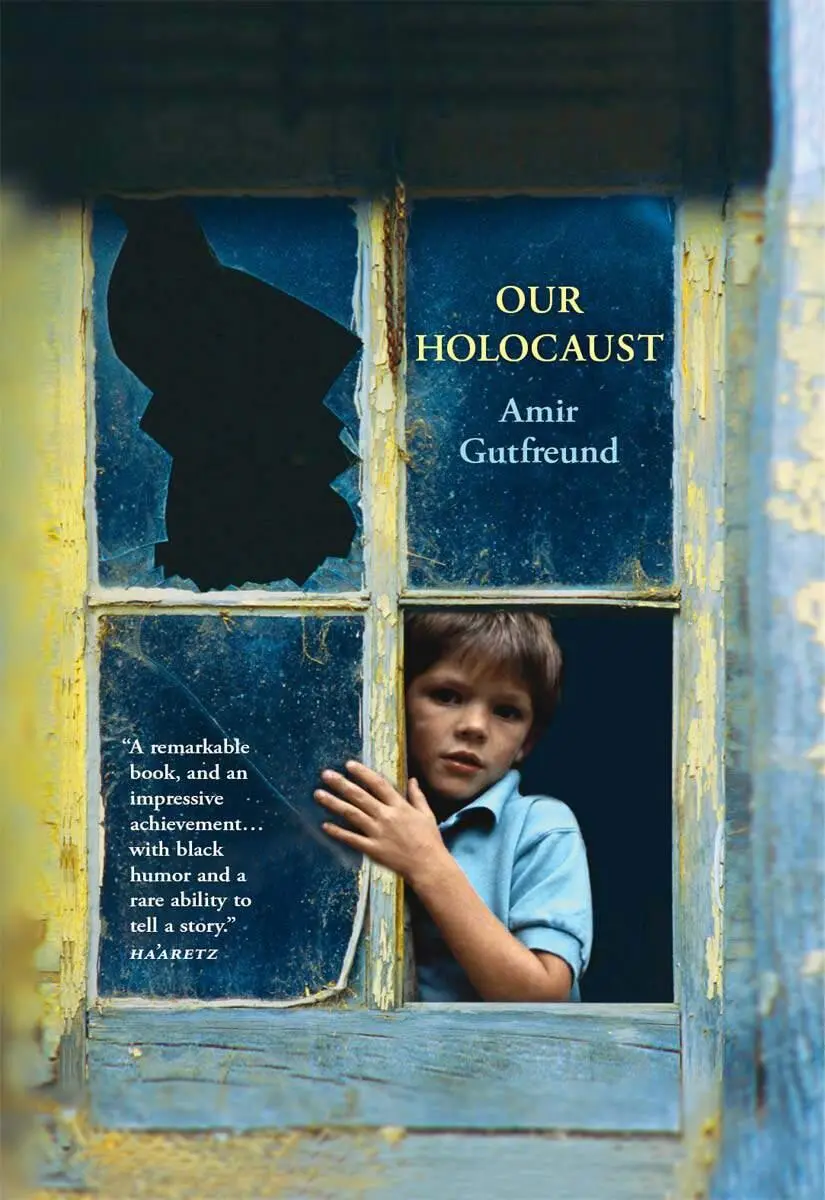
Amir Gutfreund - Our Holocaust
Здесь есть возможность читать онлайн «Amir Gutfreund - Our Holocaust» весь текст электронной книги совершенно бесплатно (целиком полную версию без сокращений). В некоторых случаях можно слушать аудио, скачать через торрент в формате fb2 и присутствует краткое содержание. Год выпуска: 2006, Издательство: Toby Press Ltd, Жанр: Современная проза, Прочая документальная литература, на английском языке. Описание произведения, (предисловие) а так же отзывы посетителей доступны на портале библиотеки ЛибКат.
- Название:Our Holocaust
- Автор:
- Издательство:Toby Press Ltd
- Жанр:
- Год:2006
- ISBN:нет данных
- Рейтинг книги:4 / 5. Голосов: 1
-
Избранное:Добавить в избранное
- Отзывы:
-
Ваша оценка:
Our Holocaust: краткое содержание, описание и аннотация
Предлагаем к чтению аннотацию, описание, краткое содержание или предисловие (зависит от того, что написал сам автор книги «Our Holocaust»). Если вы не нашли необходимую информацию о книге — напишите в комментариях, мы постараемся отыскать её.
Our Holocaust — читать онлайн бесплатно полную книгу (весь текст) целиком
Ниже представлен текст книги, разбитый по страницам. Система сохранения места последней прочитанной страницы, позволяет с удобством читать онлайн бесплатно книгу «Our Holocaust», без необходимости каждый раз заново искать на чём Вы остановились. Поставьте закладку, и сможете в любой момент перейти на страницу, на которой закончили чтение.
Интервал:
Закладка:
“And don’t forget,” he says, supervising my work, “that you wanted to document testimonies from your family too.”
I set up meetings with family members and come to demand their recollections. I bring Yariv, the representative of sweetness and charm. We work as a team. His role — to extort wonder, excitement, attention. To soften them up. As soon as we arrive he makes himself comfortable on the rug, takes out two balls, a motorized car, an old plastic car, a water pistol. He never turns down a cup of juice, cookies, more juice. He rejects biographical questions, like “How are you doing?” “Do you like your teacher?” “What’s your girlfriend’s name at kindergarten?” In the meantime, his accomplice begins asking questions, listening, encouraging. The people acquiesce and their memories begin to pour out. First, happy memories. Always childhood. Always a town or a village, always with a market square ( rynek , in their language). Mother. Father. Family. Sometimes the memories skip around, suddenly it is the post-war years. Pieces of family and fragments of encounters and life forces. At some undecipherable cue, the photo albums come out and great wings are spread. As the pages are turned, the storytellers are inspired to voice near-prophetic visions, although they are unable to belie the triviality of the photograph subjects — family displays and smiles in a row on chairs.
I let them talk. They roam through their memories, not always masters of their domain. Sometimes the storyline crosses the 1948 line, reaching the years of aliya to Israel and even as far as the Six Day War, in IDF uniforms with stories-you-wouldn’t-believe, and yet it always reverts in the end, retreating back to 1939, the year of truth, the Big Bang.
On the rug, Yariv concocts battle and chase scenes, staging accomplishments for an imaginary enemy soon to be cowed by his own great victory. In the meantime, they reminisce. Sometimes in a flow, a series, an effortful sprint. Sometimes there are breaks and jumps and refusals and darkness. They cry too. Real tears. Yariv cranes his neck to see, one hand clutching a plastic car, the other on the table top as he stares.
Sometimes they say, “You know what, why do you need all these stories?”
“Documentation,” I reply.
They ponder the word. It appeases them. Documentation. And they continue talking. Immortalized. Existing. Validated. Uncle Lunkish and Aunt Frieda and Aunt Riesel and Aunt Zusa and Uncle Antek and Mrs. Kopel and Uncle Menashe. Darkness and ignorance and physical adjustments and escape and terror and trees and huts and people who once were and prayers and children and market squares and shooters and fear and quiet and silence.
In the evening I sit down to put it all into some sort of order. To document. I also copy down details from Attorney Perl’s little cards. How do you form a coherent shape out of all this chaos?
Anat hovers around me, dissatisfied. “I’m telling you, you shouldn’t be spending too much time with this.”
Glowing embers.
“There’s no such thing as too much!”
Because Walter Haensch, an Einsatzgruppe leader, was sentenced to death, but his sentence was commuted to fifteen years and in the end he was released after serving seven years in prison.
Because Heinz Schubert, another Einsatzgruppen leader, was sentenced to death, but his sentence was commuted to ten years and he was eventually released after three years in prison.
Because of their beautiful little houses in the newly formed Germany. Because of the gardens, the red roofs, the lawns to mow. The children, the grandchildren. The long weekends in the cold winters of Saxony, the autumns bursting through in the Erz mountains and painting the forests of Bavaria. And I am welcomed with open arms into a closed world of hands reaching out from the tiny windows of train cars, and Yariv’s toothache, or maybe it was Anat’s, fade away in my mind. I have to go down, down into that world, to repair it — that will repair the world above. Uncle Lunkish, in the world down there, promises to talk on condition I don’t write it down, but in the end he doesn’t tell me anything. “With my family in Tarnow…” he begins, and can’t go any further. Mrs. Kopel went before Dr. Mengele’s with her sister. Her sister died, Mrs. Kopel survived. Strange, he only tested her eyes, and she had no trouble with her vision, she could see perfectly — it was her womb that didn’t work. Twice she got married, and twice went back to using Kopel, her maiden name, the name of her father, who died in the ghetto of a heart attack. Uncle Antek is surprised by my visit. Why don’t we come more often? He asks about Yariv, about Anat. And will there be another child? And how is Dad doing? He talks breezily about recent weddings, and remembers my briss , and Grandma Eva dancing. About Auschwitz he speaks slowly, not so lucid. “The winter in Auschwitz is hard, people don’t know, in summer harder, diseases, people will die.” I try to ask questions, to carefully turn back Uncle Antek’s arrow of time, to get him to say one sentence about Auschwitz in the past tense. I touch ancient shards as I speak. All he can do is scatter his sentences around. “The head of our block, Prucher, thinks he’ll survive because of his cruelty, but he’ll go too. In Auschwitz you go, no matter how you behave. I’ll end up going too, in the smoke. How long can you survive?” He warns me, “In the camps, even if you survive whole on the outside, thin as a skeleton, on the inside everything is finished. No dignity, no heart, no nothing.”
Uncle Menashe doesn’t want to talk in the evenings, before bed. He’ll talk in the morning. He closes up the butcher shop for me again. “I was a five-year-old kid, what did you think, how could a five-year-old kid live?” He tells me about days spent hidden among kindly farmers — hidden not only from the Nazis, but from his current self. To this day he can’t remember them, but he emphasizes, “The farmers were kind.” He talks about his father, who paid a farmer he knew, and later, he remembers, he was moved to a different farm, a quiet place. As Uncle Menashe talks, Mom’s story sneaks in. Her father also hid her with farmers, giving them all his money, and Uncle Menashe tells his story and I think about my mother, the prayers they made her learn in case the Germans interrogated her, the Hail Marys she kept on saying even when the war was over, even though they told her there was no need, and Uncle Menashe talks about the searches and the shootings in the village houses, he can’t remember anything else, just that the farmers were kind, they gave him tasty bread with fat, and Mom walked barefoot for a whole winter, she remembered that, and that she was afraid of something, Dad told us that. She used to flee to the fields because something scared her, and Uncle Menashe says, “The farmers were kind. Once the farmer said, ‘There’s going to be trouble,’ and he took me to another village for a few days, and there I saw a day-old lamb in a pen.” That, he remembers; most everything else is gone. There was a light on in the pen. The lamb was almost white. That’s all he can remember, and he apologizes for making me come all the way from Haifa to hear nothing. He says, “The main thing is that I turned out normal, right?” I smile. In our family, Uncle Menashe is one of the most normal people. He laughs, “Now, for thirty years, I’m the one who slaughters animals…”
Their stories collect and grow sharper. They tie into one another. I write and go back to ask questions, and write some more. Not infrequently, their memory betrays me. Something is related, but when I ask a question about it the next day, it’s no longer clear — did it happen or didn’t it? And when? With every passing day something is lost. Memory is like plaster — when you touch it, it crumbles. I struggle to leave as much as possible intact. Every evening at home the documentation continues like a stubborn battle. Grandpa Yosef’s rains knock on the windows to remind me that somewhere out there another battle is raging. Grandpa Yosef fights against time. I pore over the testimonies, sometimes only understanding what I’ve written when I reread it at night. Then, sometimes, I understand their happiness — yes, it is happiness that I see erupting from them. They sit with me, unburdening themselves of massive gourds of memory, the gourds lying at an angle on the earth (thin stalks, unbelievably thin, nourish the huge resting bodies through connections forged among the leaves, into the earth, all the way far down and deep). They tell their stories, transferring their words to my notes, and stand back, leaving me to fight alone, to find order, to find the way, to document. (I combat memory while Grandpa Yosef battles time. We are both about to lose, but both as happy as victors.)
Читать дальшеИнтервал:
Закладка:
Похожие книги на «Our Holocaust»
Представляем Вашему вниманию похожие книги на «Our Holocaust» списком для выбора. Мы отобрали схожую по названию и смыслу литературу в надежде предоставить читателям больше вариантов отыскать новые, интересные, ещё непрочитанные произведения.







Обсуждение, отзывы о книге «Our Holocaust» и просто собственные мнения читателей. Оставьте ваши комментарии, напишите, что Вы думаете о произведении, его смысле или главных героях. Укажите что конкретно понравилось, а что нет, и почему Вы так считаете.