Amir Gutfreund - Our Holocaust
Здесь есть возможность читать онлайн «Amir Gutfreund - Our Holocaust» весь текст электронной книги совершенно бесплатно (целиком полную версию без сокращений). В некоторых случаях можно слушать аудио, скачать через торрент в формате fb2 и присутствует краткое содержание. Год выпуска: 2006, Издательство: Toby Press Ltd, Жанр: Современная проза, Прочая документальная литература, на английском языке. Описание произведения, (предисловие) а так же отзывы посетителей доступны на портале библиотеки ЛибКат.
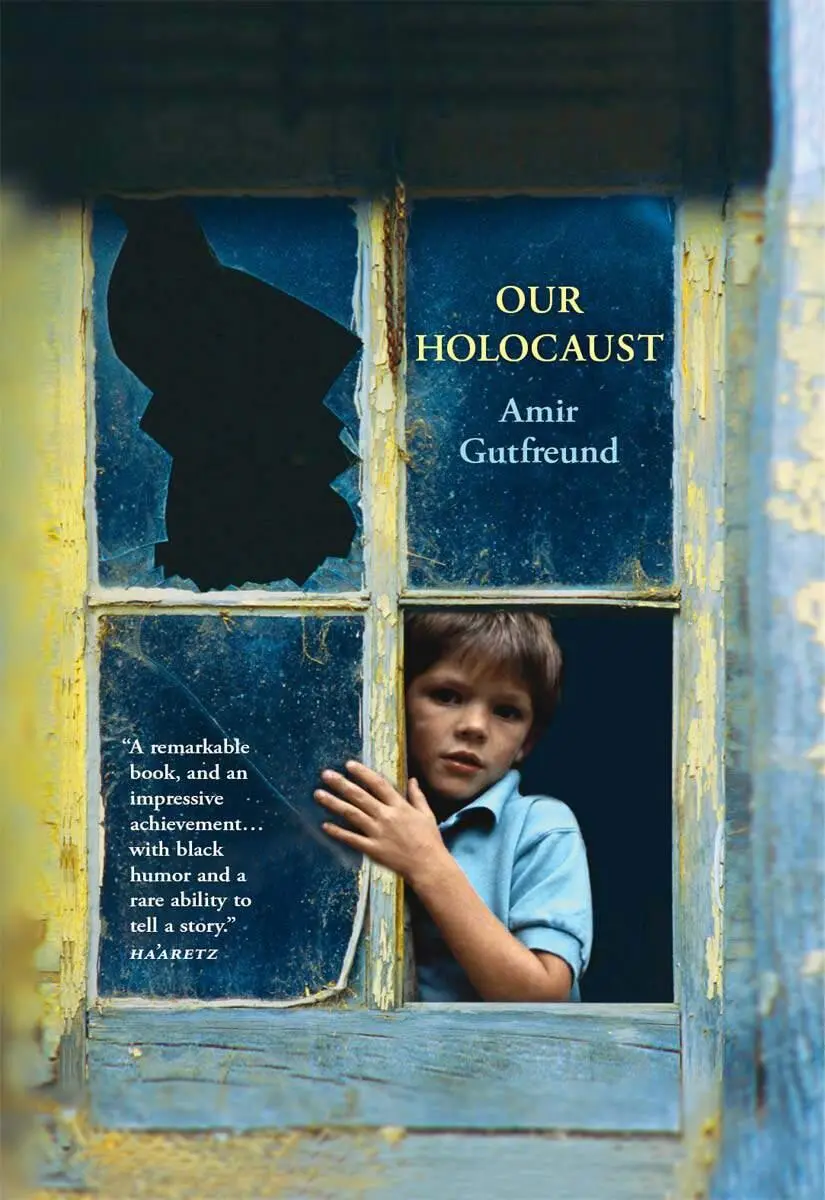
- Название:Our Holocaust
- Автор:
- Издательство:Toby Press Ltd
- Жанр:
- Год:2006
- ISBN:нет данных
- Рейтинг книги:4 / 5. Голосов: 1
-
Избранное:Добавить в избранное
- Отзывы:
-
Ваша оценка:
Our Holocaust: краткое содержание, описание и аннотация
Предлагаем к чтению аннотацию, описание, краткое содержание или предисловие (зависит от того, что написал сам автор книги «Our Holocaust»). Если вы не нашли необходимую информацию о книге — напишите в комментариях, мы постараемся отыскать её.
Our Holocaust — читать онлайн бесплатно полную книгу (весь текст) целиком
Ниже представлен текст книги, разбитый по страницам. Система сохранения места последней прочитанной страницы, позволяет с удобством читать онлайн бесплатно книгу «Our Holocaust», без необходимости каждый раз заново искать на чём Вы остановились. Поставьте закладку, и сможете в любой момент перейти на страницу, на которой закончили чтение.
Интервал:
Закладка:
I say, “No, they should have executed them. At least all the ones who were in SS units, not just the commanders. They should have executed everyone who took part in operations by army units and police. The Jewish collaborators too. No mercy. And all the clerks, the diplomats, the mayors, the volunteers. Everyone who knew that genocide was occurring and took an active part, even a small one. If they had executed all of them, we wouldn’t need to ‘understand’ now.”
Attorney Perl objects and grows slightly angry. He eagerly outlines a plan that will never come to fruition, things he tried to explain at the end of the war to ambassadors into whose offices he was able to sneak, to consuls who listened as they looked fearfully at this ghost of a man orating before them. When he talks about his plan, the thundering, lucid voice of Attorney Perl from before the war reawakens, recalling the way he sounded in the courts of Lvov and in his city of Stanislaw. Some time before 1939 he was sent to Bochnia for work and was trapped there when the war broke out. He was sent with his wife to the ghetto, to our house at 7 Leonarda. In the third Aktion he was sent to Szebnie camp, then transferred to Dora-Mittelbau. Between the lines, his own story emerges too. Sometimes he just starts talking about himself unprompted, then changes the subject. He mentions “Dora-Mittelbau” or “trains” and sighs, swept up in his own story again. He deposits his words at stops along the route, leaving me a sliver here and a morsel there, and they multiply and meld, as if Attorney Perl is challenging me to put the pieces of his story together.
At home, later, I edit the family stories and attempt to assemble his tale too. But in the shop, the story is the criminals, their restored lives after the war, the false identities, the borrowed personas. The lives dispersed among refuge countries — Argentina, Chile, Brazil, Canada, Syria. The irony of the diasporic dispersion of those who tried to destroy the diasporic nation. Their own Diaspora in Mexico, South Africa, Spain, Portugal, Bolivia. The germ cell of a new reconstruction. In the jungles of Brazil and in fenced suburbs of Buenos Aires, in wealthy South African homes and quiet villages in the heart of Germany. They were not killed and they continue to exist. The germ cell of a new reconstruction . We could have given them the great poet Yehuda Halevi’s poems of yearning, the lamentations, the nostalgic liturgies. They had sent themselves to the Second World War, after all, to achieve Lebensraum —living space — for the German people, and now there they were, scattered around the world, absorbed in faraway diasporas. Two thousand years from now the Germans will look proudly at their accomplishment — a small German community in every remote spot, conducting its German life, maintaining a little German culture in foreign surroundings, its children longing for the homeland from which their parents were exiled. How did they get there? Ah, such a wonderful story. And some day, one of the curious young people will set off on a journey to trace his roots, and will expose the amazing adventure that led his founding fathers to Brazil, to South Africa, to the remote regions of Australia.
Is that their punishment? Living under false identities in humid jungles and faraway villages — is that the punishment? No. Too many of them were not exiled and did not escape, but continued to live under their real names in Germany. Sometimes they were pestered by the courts, more often left alone. Sometimes they were imprisoned and then released, assimilating nicely into their reconstructed lives. The worst criminals, the architects of the extermination, were sometimes not even investigated — these were the smart ones, the farsighted ones, those whose fingerprints disappeared from all incriminating documents and deeds.
“Especially the legalists,” Attorney Perl said.
The talks with Attorney Perl do not finish when I leave his shop. I recreate them with Effi, with Dad, with Anat. Sometimes I come up against opposing opinions, reservations. Waving my papers and reading out lines, I explain what the people did, what they said, what they declared. I contend that they only tried the ones they could prove had committed murder or torture, or had been guards. But what about the ones who drafted laws? Recruited for the SS? Directed movies propagandizing the extermination of handicapped people? Testified to a trace of Jewish origin in a neighbor’s blood? They did not murder, torture, or lock anyone up in gas chambers, but without them? Who will judge the faceless masses, the ones who will never be convicted because between them and what they deserve there will always be the graceful giants of the law: “lack of evidence,” “reasonable doubt,” “lack of public interest.”
“Not everyone who spoke against the Jews is a Nazi who should be hanged,” Effi said.
“Don’t forget, there were and still are good Germans,” said Grandpa Yosef. And of course, the example soon follows. “Take Hans Oderman, for example.”
Faced with the kindheartedness of the orphan researcher Hans Oderman, accusations must bow. We cannot embrace opinions that do not consider the existence of the good German. Yes, I know, Hans Oderman is coming to Israel. The good German is coming back to serve as an example. Grandpa Yosef has already phoned me twice. “Hans said he’s coming!” And Effi called too, “Hans is coming!” I count the days until the volcanic eruption.
The existence of the Hans Odermans of the world seems to be attempting to erase the non-erasable — Attorney Perl’s index cards, every single one of them, and the declaration of Obersturmführer Moeser, Dora-Mittelbau’s commandant, while on trial for his acts: With the same pleasure as you shoot deer, I shoot a human being . Attorney Perl recalls, “There, in Dora-Mittelbau, in the tunnels, people dropped like flies. Bad food and beatings, and everything covered with dust and the smell of excrement. We weren’t allowed to use water. We had to pee on our hands and rub our faces just to get the dust off. That was forbidden too, but we did it anyway. If I had stayed there any longer, I wouldn’t have made it. No chance. Fortunately, I was moved. They took me to a camp not far from Dora-Mittelbau. There we dug pits, God knows why, and we sawed wood, maybe for heat.
“The commandant at that camp was Obersturmführer Sahl, but one day he was removed from the camp, literally taken away by the SS military police, and in front of us stood our Angel of Death, the new camp Commandant, Obersturmführer Jürgen Licht.”
I ask, “Did he kill lots of prisoners, this Licht?”
Attorney Perl is taken aback. “Obersturmführer Jürgen Licht,” he corrects me. Even from a distance of fifty years he stands on ceremony, noting the rank and name. But he replies, “Indeed he did. But he was always very quiet, as if the whole business of war had nothing to do with him. As if managing the camp was a necessary duty, beneath his true aspirations. He would shoot prisoners without losing his temper, and never gave punishments that took up time, like roll-calls in the snow all night. The Ukrainian and German staff members were afraid of him, but us prisoners…we trembled at the thought of him showing up. It would mean death. His eyes, oh the eyes! Quiet, almost bored. If you had been allowed to look into them, you would have seen grayness, but we couldn’t look. The Angel of Death!”
Attorney Perl is animated, his voice changes as he talks about SS-Obersturmführer Jürgen Licht, who killed people with his pistols, of which he was extremely fond, without a second thought. But more than his pistols, he was enamored with puppet theater, and every time he was transferred to a new camp he would bring a little truck lined with shelves of marionettes. Puppet theaters were officially banned by the Nazi party, and Obersturmführer Licht never considered disobeying the law, but a lengthy correspondence with indifferent supervisors finally resulted in a personal authorization to engage in his beloved hobby, and so at every camp he set up a small but active puppet theater. He never took harsh measures upon arriving at a new camp before enquiring whether any of the prisoners might be of use. Carpenters, engravers, arts and craftsmen, tailors, painters, and perhaps even a rare gem — a puppet maker. Attorney Perl was none of these, which meant that by rights he should have joined the grey herd destined to die, the herd at which Obersturmführer Licht shot on its way to work, often out of mere curiosity, to see who would fall. Would it be the tall man he was aiming at, or the yellowing one hunched next to him? Or someone else? Pistol bullets were so unpredictable at times. Attorney Perl should have waited his turn to be hanged from the gallows in the center of the camp; they were painted red, and the rope that hung from them swayed constantly like a live snake. Or else he should have crouched down and knelt on the muddy ground. Or perhaps he should have survived by simply working day after day in the trenches, with a pick, without dying, without making any noise, without meeting the fate of being shot and having his body dumped into cold water. Except that during the first inspection, he lifted a trembling hand — a hand stronger than he himself — and whispered right in Obersturmführer Licht’s face that yes, he too could be of use. Of use? Yes. He offered his singular contribution, which was his voice. The clear, sometimes thunderous tone that he had used to great advantage when representing his clients in court. Even if in his private life his voice was soft, withdrawn, in the courthouse he was taken over by some sort of spirit, a devil that gave him tremendous oration skills. As his words were barely whispered to Obersturmführer Licht through the lips of a skeleton, in fluent German, the devil grabbed hold of him and awoke his voice, which grew clear and loud. He boldly proposed to be the voice of the marionettes in the puppet theater.
Читать дальшеИнтервал:
Закладка:
Похожие книги на «Our Holocaust»
Представляем Вашему вниманию похожие книги на «Our Holocaust» списком для выбора. Мы отобрали схожую по названию и смыслу литературу в надежде предоставить читателям больше вариантов отыскать новые, интересные, ещё непрочитанные произведения.











Обсуждение, отзывы о книге «Our Holocaust» и просто собственные мнения читателей. Оставьте ваши комментарии, напишите, что Вы думаете о произведении, его смысле или главных героях. Укажите что конкретно понравилось, а что нет, и почему Вы так считаете.