Amir Gutfreund - Our Holocaust
Здесь есть возможность читать онлайн «Amir Gutfreund - Our Holocaust» весь текст электронной книги совершенно бесплатно (целиком полную версию без сокращений). В некоторых случаях можно слушать аудио, скачать через торрент в формате fb2 и присутствует краткое содержание. Год выпуска: 2006, Издательство: Toby Press Ltd, Жанр: Современная проза, Прочая документальная литература, на английском языке. Описание произведения, (предисловие) а так же отзывы посетителей доступны на портале библиотеки ЛибКат.
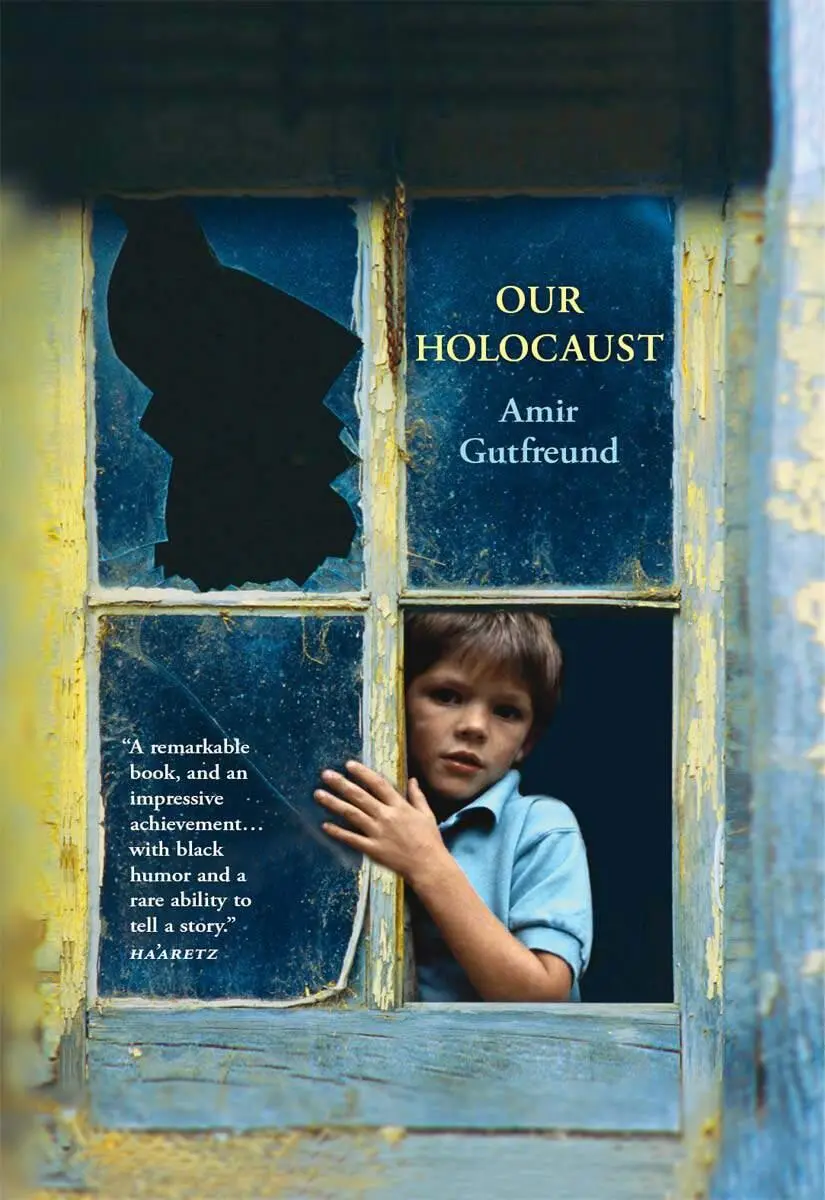
- Название:Our Holocaust
- Автор:
- Издательство:Toby Press Ltd
- Жанр:
- Год:2006
- ISBN:нет данных
- Рейтинг книги:4 / 5. Голосов: 1
-
Избранное:Добавить в избранное
- Отзывы:
-
Ваша оценка:
Our Holocaust: краткое содержание, описание и аннотация
Предлагаем к чтению аннотацию, описание, краткое содержание или предисловие (зависит от того, что написал сам автор книги «Our Holocaust»). Если вы не нашли необходимую информацию о книге — напишите в комментариях, мы постараемся отыскать её.
Our Holocaust — читать онлайн бесплатно полную книгу (весь текст) целиком
Ниже представлен текст книги, разбитый по страницам. Система сохранения места последней прочитанной страницы, позволяет с удобством читать онлайн бесплатно книгу «Our Holocaust», без необходимости каждый раз заново искать на чём Вы остановились. Поставьте закладку, и сможете в любой момент перейти на страницу, на которой закончили чтение.
Интервал:
Закладка:
She laughs, exhausted.
(Deep inside us our married life continues. Caution and apology and fragile affection. “Forget it” and “So what?” and “Go on.”)
She smiles at me so that I will smile back at her. (How angry I was when she bought a German washing machine. For months I lay in wait, hoping for it to break, hoping for one non-German instant to penetrate the mechanism, the wrong kind of soap to tear up its innards — even if it meant our clothes would be ruined. I was angry at the machine, not at Anat, and I waited for a short, a blockage, knitwear washed too hot, even an electrical fire right here in my home. But that died down too, and the machine kept working quietly, became something that simply washed our clothes.) I have to smile, this needs to be over, this thing between us that slowly slinks and does not rest. Someone has to bridge the banks and I am the only one who can, I am the one who has to stop thinking it’s important. But I was the one who saw Eva Lanczer on the lawn outside 12 Katznelson, and I saw Mr. Pepperman coming to Grandpa Yosef with his old bills to make sure his name was listed only to make sure he paid his bills. And I remember Finkelstein’s gold, Finkelstein who knew everything back in 1939 and whose letter is still hidden in Grandpa Lolek’s basement. I am the one who asks, why did Asher Schwimmer start slapping people? What did they do to him there , that made him forget all his Hebrew? Attorney Perl tries to calm me, to cancel out the affair, saying, “You have a good wife.” Yet at the same time he stokes the engine with hot coals, saying, “Here, read this.”
Orders issued by Reichsführer Heinrich Himmler concerning retaliation for the murder of six SS officers by Partisans near Kiev:
“I order that in the district of Kiev, ten thousand Jews shall die without regard to sex and age, for each of the six officers. Even a babe in the cradle must be trampled down like a poisonous toad…. We are living in an iron age, and there is no escape from using an iron broom.”
Karl Jäger, commanding officer of Einsatzkommando 3, from a report summarizing his activities in Lithuania, dated December 1, 1941:
“I can confirm today that Einsatzkommando 3 has achieved the goal of solving the Jewish problem in Lithuania. There are no more Jews in Lithuania, apart from working Jews and their families…. I am of the opinion that the male working Jews should be sterilized immediately to prevent reproduction. Should any Jewess nevertheless become pregnant, she is to be liquidated.”
I take the Karl Jäger index cards out of the drawers. What was his fate? The cards say nothing.
“Don’t worry about him. I don’t know how I could have forgotten to put it on the cards. After the war he hid, posing as a farmer. He was only exposed in 1959 and he committed suicide before his trial.”
Don’t worry about him. But there are others, and they cover the earth like weeds.

We finally took Grandpa Lolek to Hadassah Hospital. They promised he would only remain for a short while after the surgery, and then he could go home and be watched by Effi. The Lion of Life recited the terms to us and reminded me about the broken blender — what about my friend who fixed things for cheap? His blue eyes hinted at how lovely it would be if the repaired blender was waiting for him when he got back from his dangerous surgery.
Dangerous?
No.
They explained that the location of the tumor made Grandpa Lolek’s surgery a fairly easy case. Very easy. They had to operate so there wouldn’t be any more unpleasant surprises. Still, during evening phone calls, little drops of concern were voiced, fears for his well-being. We spoke our fears out loud so our hearts could make it through them. Here and there an explicit question was posed: Was there a chance he wouldn’t make it?
Effi did not allow anyone to go too far. “Don’t worry, he won’t die. Before he goes under, we’ll tell him the price of gravestones has gone up, and that will be that. No danger.”
She greeted us in a white coat when we got to Hadassah, not yet a staff member, and in any case brain surgery was not her field. But for Grandpa Lolek, Effi in a white cloak was a good sign, evidence that someone was looking out for him. He agreed to be hospitalized without protest, saving us several hours we had planned to waste on a sudden refusal in the parking lot. Grandpa Lolek dismissed us, asked Dad to stay, and agreed to send me back to Haifa. (Behind the glass window in the door, far away, he turned back to me and twirled his finger around fast, to remind me about the blender. I nodded.)
Two days later, with his head bandaged, everything was behind him. As promised, it had been very simple. Grandpa Lolek was convinced we had come to release him from the doctors, he was sick-of-doctors, there-is-life-outside, there-is-business-outside, and he believed we would devise an impressive rescue operation, a kidnapping, something that would conclude at his home with a cup of tea and news from the neighbor’s radio. His question for me was, “What about the blender?” He had been anesthetized for brain surgery, knives had sliced open his skull, blood infusions had been pumped into his veins, a tumor that had been pressing on a primary blood vessel had been cut out of him, and yet when he awoke, his desire to fix the blender on the cheap was still intact, having survived the procedure like a tightrope walker who tiptoes from one end to the other without losing his balance.
I looked at him and knew he would never die. He was the strength, the power. He had never come down from the peaks of Monte Cassino, and so he had no need for memories. He was the tree of life, and not only did he have no memories, he also had no hatred. No ball of loathing to roll around, only a large world full of profits and cups of tea, cigarettes to be smoked, and debts to accumulate. From him, from him I should be learning. Not bridges and not punishments. All I needed to do was ask, how do you get rid of the thoughts?
I did not forget his wish, and the next morning I turned up at his apartment to pick up the blender. (I was also there to move the Vauxhall back to Grandpa Yosef’s parking lot. Twice he had called. “Hans is coming. Where’s the Vauxhall?”) I opened the darkened house and instead of going to the kitchen, where the blender was, I walked into the living room. Just to sit for a while on the couch, above the rug that covered the opening to the cellar and the box of letters to Joyce the dancer, and the letter from Finkelstein who knew everything back in 1939. The house of wonders was at my disposal. I could have opened the cellar door and found, with adult eyes, what we had not found as children, when Grandpa Lolek had walked in with the Leica camera. But the magic of the cellar had been dampened. We had grown up. On the couch at Grandpa Lolek’s I could only rest and think, Yariv is an eighth of him . Who knew how many eighths like Yariv were running around in some kindergarten? Those eighths also had parents who, like me, had sat through Holocaust Remembrance Day ceremonies at school and recited words from black placards, and had learned to understand that we were the victims and that was it. Easy. We were the victims. We were. And that was that. Now life. Once a year our hearts would be sad, once a year we would remember what happened, and we would never look around us and realize that everything existed now too, here too. They did not see Mr. Pepperman checking his bills, they did not see Rachela Kempler. Itcha Dinitz, between the blinds, in the dark, living there; they did not see him either. They say I should build bridges, forget. But before the bridge-erectors came the abyss-builders. I am not willing to forget the abyss-builders. On Holocaust Day everyone stands for a moment of silence when the siren goes off, and everyone feels moved, and they all raise their children and do not know, and are sure of themselves, and do not understand. 1939, every year anew. 1939, and they do not know.
Читать дальшеИнтервал:
Закладка:
Похожие книги на «Our Holocaust»
Представляем Вашему вниманию похожие книги на «Our Holocaust» списком для выбора. Мы отобрали схожую по названию и смыслу литературу в надежде предоставить читателям больше вариантов отыскать новые, интересные, ещё непрочитанные произведения.









Обсуждение, отзывы о книге «Our Holocaust» и просто собственные мнения читателей. Оставьте ваши комментарии, напишите, что Вы думаете о произведении, его смысле или главных героях. Укажите что конкретно понравилось, а что нет, и почему Вы так считаете.