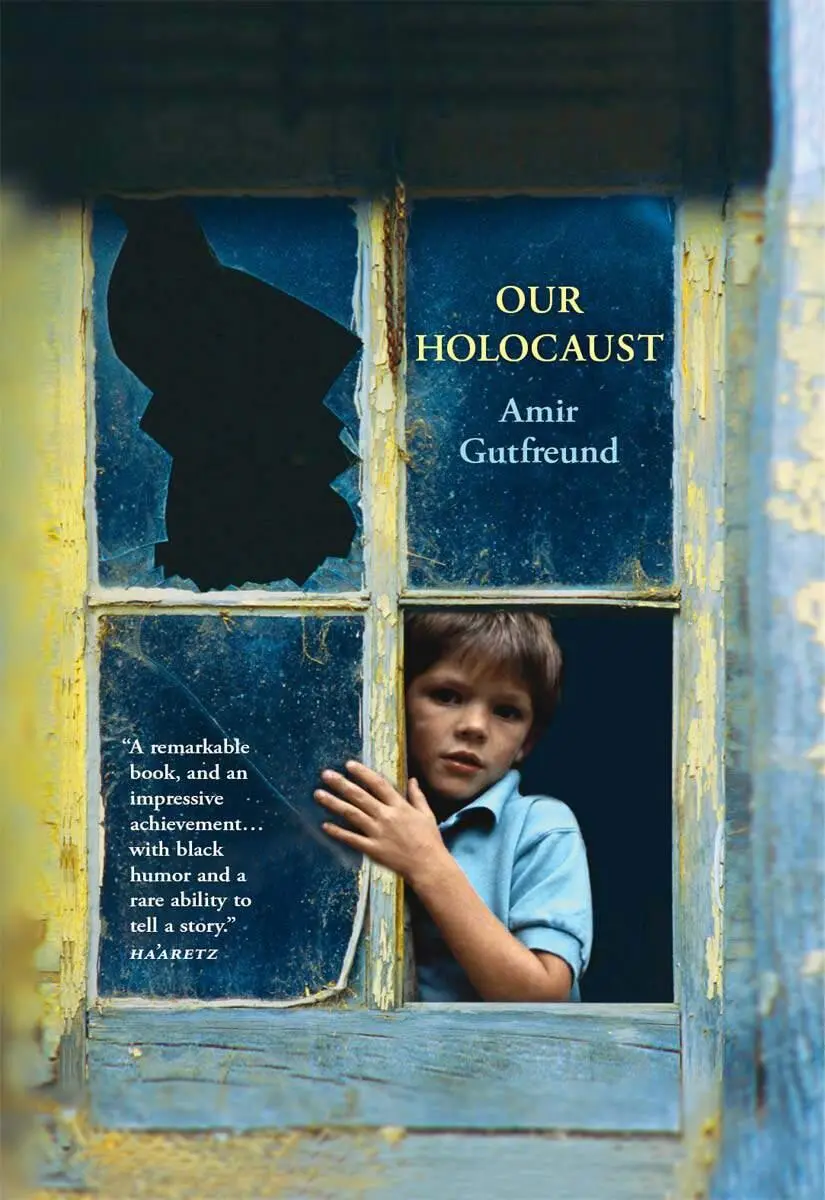
Amir Gutfreund - Our Holocaust
Здесь есть возможность читать онлайн «Amir Gutfreund - Our Holocaust» весь текст электронной книги совершенно бесплатно (целиком полную версию без сокращений). В некоторых случаях можно слушать аудио, скачать через торрент в формате fb2 и присутствует краткое содержание. Год выпуска: 2006, Издательство: Toby Press Ltd, Жанр: Современная проза, Прочая документальная литература, на английском языке. Описание произведения, (предисловие) а так же отзывы посетителей доступны на портале библиотеки ЛибКат.
- Название:Our Holocaust
- Автор:
- Издательство:Toby Press Ltd
- Жанр:
- Год:2006
- ISBN:нет данных
- Рейтинг книги:4 / 5. Голосов: 1
-
Избранное:Добавить в избранное
- Отзывы:
-
Ваша оценка:
Our Holocaust: краткое содержание, описание и аннотация
Предлагаем к чтению аннотацию, описание, краткое содержание или предисловие (зависит от того, что написал сам автор книги «Our Holocaust»). Если вы не нашли необходимую информацию о книге — напишите в комментариях, мы постараемся отыскать её.
Our Holocaust — читать онлайн бесплатно полную книгу (весь текст) целиком
Ниже представлен текст книги, разбитый по страницам. Система сохранения места последней прочитанной страницы, позволяет с удобством читать онлайн бесплатно книгу «Our Holocaust», без необходимости каждый раз заново искать на чём Вы остановились. Поставьте закладку, и сможете в любой момент перейти на страницу, на которой закончили чтение.
Интервал:
Закладка:
“I recall only one moment of the present. I leaned against a rod or a wagon shaft for a brief moment of contemplation. I suddenly thought about my journey with Ahasuerus. It was, after all, a journey to rescue Feiga, and I believed that the Kadosh Baruch Hu had given me this journey and the black car. I suddenly realized that I had not achieved a thing. Not Feiga, not anything. And in that moment, which memory is kind enough to illuminate to this day, I was filled with great desperation and confusion. I leaned hard against the wagon shaft. I remember the shaft well.
“At the end of 1944 the Germans decided it was time for me to move on again, to Gross-Rosen camp. At that time, all the camp Jews were being sent west, mass transports going with the Germans as they retreated from the Russians. But for some reason, I was sent east. To Gross-Rosen.
“At Gross-Rosen I received the usual welcome. A shower in the nude, pushing, shouting, a long roll-call in the snow. The Germans wore fur coats, protecting their bodies from the wind, while we stood naked. Night came, the cold took its victims, and the Germans too were tired of the roll-calls. It was cold. We were taken into huts, a hundred people shoved into a space big enough for ten.
“At Gross-Rosen there was no work. They kept us in huts and took us out to be counted or punished. Then back to the hut. I do not remember many people dying in the daily routine of Gross-Rosen; not like at Sachsenhausen, not like at Buchenwald. But those who did die stand out in my memory. After Rothschild’s death, I was lucidly aware of each and every subsequent man shot dead. To this day I think not only about Rothschild, who was not successful in all of his schemes and who ultimately died. I think about everyone who was executed in front of my eyes. In Ravensbrück, in Sachsenhausen, in Buchenwald, in Gross-Rosen. All those anonymous people drawn out from the end of their rows so a dog could tear through their flesh or they could be whipped to death. In their own eyes, these people were the whole wide world. They alone perceived the miracle of their salvation up until that moment, and at the instant before their death they surely thought in terror, ‘I have been marked, God help me,’ and they hoped for life, for one more miracle. They looked at our impenetrable faces, hoping salvation might come from us. Until the very last second they hoped, in their dying convulsions, in their memories, between the teeth of a dog, and could not imagine a world without themselves. Do you understand? They could not imagine a world without themselves in it. Every such person who knelt down to get a bullet in the back of his neck was a whole wide world. And not only because that is what the Scriptures say. Simply a whole wide world. Each man with his memories, his loves, his history. Just like me. And I am living, here, and they…
“In Gross-Rosen I came to see Rothschild and Adler and Rabbi Hirsch as chaperones who knew that liberation was close, that it would take just one more little effort, a stroke of luck. And indeed, near the end of the war I was transferred from Gross-Rosen to an auxiliary camp. Then to another camp. And another. Towards their end, damn them, as if the Germans did not know what to do with me, they transferred me again and again. Finally they put me in a little camp near the Polish town of Walbrzych, which was not far from Waldenburg camp, where your father was with his father. In that camp, things were relatively comfortable. I worked at a sort of carpentry shop. It was work for work’s sake, not for death’s sake, and the foreman was an elderly German man. There was little food and I was ill, but survival was possible. I spent a month there, no more. The Russians came, the Germans fled, and I was set free. With me, everything happened simply. No last minute torture, no death march, no burning huts with inhabitants still inside, no being buried alive in a pit. I was simply set free.
“Then there was a difficult period of freedom. The world was in shambles, and I was all sickness and hunger. But we overcame. Nu , there was life, the Kadosh Baruch Hu gave life and commanded that we live, and you cannot imagine my joy when, in Bochnia, I met Feiga. But before that, in the last camp, I had another encounter, a unique one. Of all the people I met in my days, none was as important as this brief meeting.
“In our camp I found a prisoner who drew my attention for some reason. He was a sick man, lying silently on a cot, barely able to get up. He walked softly to the latrine, conversing with no one. He was fairly young, around thirty, but his face was drawn and old. For some reason I felt pity for him, as if I somehow still contained pity, and one day I went to him and gave him a piece of bread. I was deathly ill, my condition no better than his, and yet I offered him my bread. He thanked me with a limp wave of the hand and rejected my offer. He motioned with his fingers — perhaps I had a cigarette? For some reason I rushed around as if commanded by a great Admor. I searched the camp for someone who would trade food for a cigarette, and went back to the patient to give him the gift. Two real Eckstein cigarettes.
“He smoked one cigarette. Then the next one. I sat waiting at his feet for the devil knows what. But from that day we became connected. I would sit at his side, looking into his pale face as he smoked cigarettes. I noticed that he did not eat, and I tried to entreat him. But he dismissed my pleas completely. Strange, I had yet to hear his voice or learn his name, and yet I felt that I had found a friend. He too bowed his tired head, welcoming my arrival. I found myself sensing an increased desire to help, to encourage the man, to tell him about Rothschild, about Adler, about Hirsch. And indeed I began to tell him my stories, the entire past. From day to day I could see the man weakening, as if he did not want his life and was actually beckoning death to approach. I implored him to gain strength. ‘Life is holy!’ I told him.
“One day I heard from some people that the man came from the village of Kalow. I tried to engage him in conversation. ‘His honor is from Kalow, so I hear? A long way his honor has traveled. Nu , these times… In Kalow, did you happen to know the ‘Fledgling Tree,’ the Rabbi of Kalow?’
“His lips whispered, ‘I am the Rabbi of Kalow.’
“I was stunned into silence. Not just for a brief moment, but for whole days. I continued to tend to him, kneeling at his feet. What were my stories, all my worthless tales of Hirsch and Adler? Who knew what this man was engaged in during his moments of silence, in what secret and wonderful worlds the Rabbi of Kalow, the Fledgling Tree, roamed, he and none other, while I intruded on his visions with my Feiga here, and Ahasuerus there. With my idle talk I was putting spokes in the wheels of a true holy man, the Rabbi of Kalow! The author of important new interpretations of Torah that had sent shockwaves from the farthest corner of Galicia all the way to the land of Lithuania. I looked into his pale face, which now appeared clean and pure, and I was overcome. The Rabbi of Kalow!
“The next day I moved to the cot next to his. I would be quiet and would be an aid. I would save the Rabbi of Kalow from the claws of death. I would feed him, give him water, guard him. But my longing to talk, to regale him with what was in my heart, would not let go. I was quiet but full of questions — about pirates, about their mitzvahs, about the diminished questions. I wanted to ask the Rabbi of Kalow, ‘Why, why the annihilation?’
“But the Rabbi was not there to be questioned. He silently smoked the cigarettes I brought him. Once in a while he posed a question and I responded as concisely as possible, so he would understand my answer correctly without a single superfluous word. He asked about Bochnia, about my family, my engagement. Then he surprised me by saying, ‘My wife Rachel and I were not blessed with children. It was not His wish, Hashem , blessed be He.’
Читать дальшеИнтервал:
Закладка:
Похожие книги на «Our Holocaust»
Представляем Вашему вниманию похожие книги на «Our Holocaust» списком для выбора. Мы отобрали схожую по названию и смыслу литературу в надежде предоставить читателям больше вариантов отыскать новые, интересные, ещё непрочитанные произведения.







Обсуждение, отзывы о книге «Our Holocaust» и просто собственные мнения читателей. Оставьте ваши комментарии, напишите, что Вы думаете о произведении, его смысле или главных героях. Укажите что конкретно понравилось, а что нет, и почему Вы так считаете.