Amir Gutfreund - Our Holocaust
Здесь есть возможность читать онлайн «Amir Gutfreund - Our Holocaust» весь текст электронной книги совершенно бесплатно (целиком полную версию без сокращений). В некоторых случаях можно слушать аудио, скачать через торрент в формате fb2 и присутствует краткое содержание. Год выпуска: 2006, Издательство: Toby Press Ltd, Жанр: Современная проза, Прочая документальная литература, на английском языке. Описание произведения, (предисловие) а так же отзывы посетителей доступны на портале библиотеки ЛибКат.
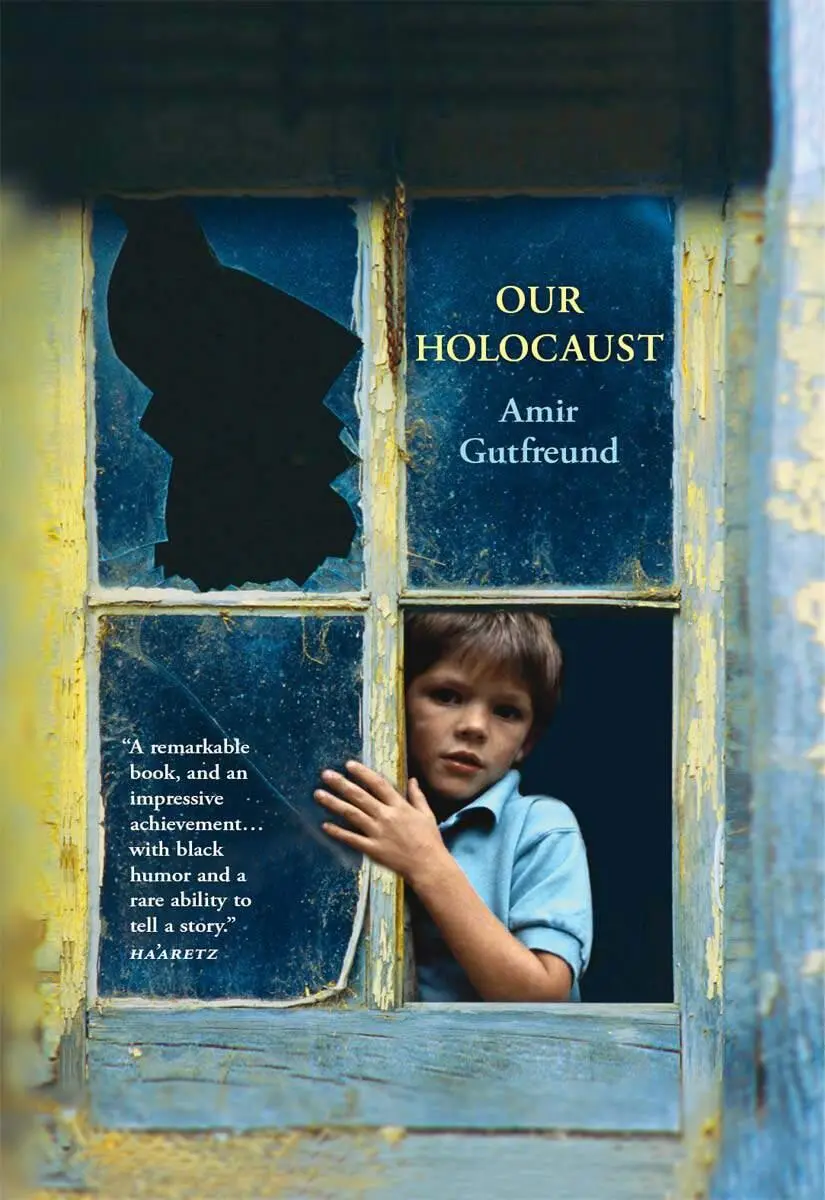
- Название:Our Holocaust
- Автор:
- Издательство:Toby Press Ltd
- Жанр:
- Год:2006
- ISBN:нет данных
- Рейтинг книги:4 / 5. Голосов: 1
-
Избранное:Добавить в избранное
- Отзывы:
-
Ваша оценка:
Our Holocaust: краткое содержание, описание и аннотация
Предлагаем к чтению аннотацию, описание, краткое содержание или предисловие (зависит от того, что написал сам автор книги «Our Holocaust»). Если вы не нашли необходимую информацию о книге — напишите в комментариях, мы постараемся отыскать её.
Our Holocaust — читать онлайн бесплатно полную книгу (весь текст) целиком
Ниже представлен текст книги, разбитый по страницам. Система сохранения места последней прочитанной страницы, позволяет с удобством читать онлайн бесплатно книгу «Our Holocaust», без необходимости каждый раз заново искать на чём Вы остановились. Поставьте закладку, и сможете в любой момент перейти на страницу, на которой закончили чтение.
Интервал:
Закладка:
“The next morning the gates of the camp opened. Liberation! Everyone ran to the gates and I rushed to check on the Rabbi of Kalow. He was still alive. I gave him the good news. The Kadosh Baruch Hu had provided for us. ‘Liberation!’ I told him. ‘Liberation!’
“‘Liberation,’ he whispered. He was free to go. He breathed into the depths of his lungs, as if taking a final taste of this world, and his soul departed. The Rabbi of Kalow was dead. Baruch dayan ha’emet . I was not able to ask, ‘Why, why the annihilation?’ And he was the last to be annihilated. He brought the people to freedom but did not see it. He came to the brink of Israel, but remained on Mount Nebo.
“From outside I heard the prisoners celebrating, shouting, cheering. Feet pattered this way and that, storehouses were raided, people roamed outside the fences. I sat in the shadows of the hut at the feet of the dead rabbi. I could not share in the happiness. I whispered my vow: ‘When I have a son, I will name him Moshe.’ The rabbi’s tortured face, now pure and bathed in the brilliance of the afterworld, seems to repeat his promise: ‘And he will be the savior of Israel!’”

During Atalia and Effi’s shift, Grandpa Lolek opened his eyes and lay facing the white ceiling, looking slightly bewildered, as if his deep blue eyes had left something behind. It soon became clear that it was his vision. Grandpa Lolek’s sight had not yet come back, but his eyes had taught themselves how to open again. He remained a still, helpless figure. His eyes opened with great desire, but his body would not yet cooperate.
The doctors told us that Grandpa Lolek’s body had made up its mind to get better, but there was a slight delay in the process. They still needed to remove the benign tumor pressing on his brain, although it was unclear if they should risk removing the entire tumor. In Switzerland there were experts on this kind of tumor. They may decide to remove only part of it. There were modern treatments that did not require surgery. They had to consider the risks, the dangers, the experts’ recommendations. In any case, Grandpa Lolek no longer needed the ward.
Somehow a decision turned out to have been made: Grandpa Lolek would move in with Grandpa Yosef for now, so he could take care of him. He needed this supervisory transition period before anyone took a risk and rushed into wasting money on some Swiss treatment that might not be the best solution. When the decision had been made, or when there had been discussions and deliberations, was unclear. That was how it worked with them. The decision materialized out of thin air without requiring any sort of debate or concrete words. The situation set its own course, and from the hospital Grandpa Lolek went straight to Grandpa Yosef’s house, for-a-supervisory-transition-period.
Grandpa Yosef put Grandpa Lolek in Feiga’s room. He laid his clothes and suits on the closet shelves (where he found a forgotten tie belonging to Hans Oderman). He scattered towels and toiletries in the bathroom. Cleared space on the kitchen shelves. Then he began sending us to Grandpa Lolek’s house on the Carmel to bring whatever he thought necessary for the recovering patient. He made us bring fine bed linen and fancy teacups, and the Leica camera. Each item we brought found its place, but did not satisfy Grandpa Yosef. He scanned the newly arranged room and found fault. Off he sent us for another item.
There seemed to be something overwrought about Grandpa Yosef’s conduct, but we did not bother to question him. We assumed he was simply being accommodating, trying to introduce a certain amount of grandeur to his modest home. We thought he was trying to fill the house up for his patient’s sake. We smiled and obeyed — it was unwise to refuse Grandpa Yosef’s requests at a time when the Caribbeanism seemed to be rearing its head again.
Out in the world, the rain finally began to fall. December took its revenge in the form of storms, and we drove back and forth between Kiryat Haim and the Carmel, on the seat beside us a transistor radio, sometimes a scarf, sometimes a vase.
“He’s emptying out my home!” Effi complained, already well entrenched in Grandpa Lolek’s empty house. (“Just for a while,” she explained, insinuating herself like a cuckoo.)
Grandpa Yosef would not rest. He declared his intent to vacate another shelf, the top one, which housed various useless antiques (an ivory elephant from Uncle Tulek, a backup menorah in case the regular one broke, a bag of Bonzo he hadn’t had the fortitude to throw out). He climbed up a ladder and passed the little treasures down to us. He grinned awkwardly when he found a bottle of rum he had brought back on a Caribbean whim. “Well, now you know…” he mumbled. “The doctorate. I went there because of Adler, to research the Jewish pirates.”
He seemed to feel the need to tie up loose ends and lift the veil off whatever still remained mysterious. We were struck by an odd sensation — a slight aversion to Grandpa Yosef. His life was suddenly deciphered, suddenly clear, all the way down to his most recent secret, the journey to the Caribbean, a dream dreamt by another. That, and Moshe’s name, and the doctorate, were all spread out before us. It was hard to look at Grandpa Yosef without feeling uncomfortable. This Grandpa Yosef was too open, too broken down into factors. The bare facts of his life story had become just that — bare. Something had been exposed which should have remained hidden. A bright light had come and flooded with clarity what had thus far squirmed inside towers of clues, fractures of truth that had come together into the form we loved: mysterious Grandpa Yosef, who goes to university despite his age, who writes a doctoral thesis, who rises from sitting shiva and sets off for the Caribbean. Everything was exposed — everything. Even the fog tormenting his soul, his son Moshe and the names he was not given — demons which, according to his belief, had taken their revenge.
We had to fight to reconstruct a Grandpa Yosef free of this aversion. There commenced an era of clearing away shards. We fought. But the feelings grew more complicated, emerging in an opposite form to the one we had envisioned. We were unable to look lucidly at this man into whose house once again flowed the needy and the troubled, demanding that Grandpa Yosef give them solutions, assistance, shelter. His good deeds were depicted in a new light. Against our will we saw Grandpa Yosef having to persist, to do only good, without ceasing. If he stopped even for a moment, his old deeds would catch up with him and crush him under their wheels.
The world filled with rain and we fought inside it, against the mist, the dragons, the aversion. One day Grandpa Yosef sent me for Grandpa Lolek’s files that contained his bills and the certificates for the land in Gedera and his other property. He thought the recovering patient needed the files to be present beside him on the bedside table. When I returned I found Green the Mechanic in the little parking lot, bringing the Vauxhall at Grandpa Yosef’s demand. Then suddenly Hirsch emerged, the almost-deciphered Hirsch, but a chasm still stretched between the end of his story in Grandpa Yosef’s voyage and the filthy old man now standing on Katznelson and enquiring theologically,
“Only saints were gassed?”
The root of evil had been revealed: Grandpa Yosef’s unfinished voyage. From within the voyage, from one end to the other, questions erupted, movements stirred. What had happened to Hirsch after he left the Lodz ghetto? What happened to Farkelstein? What happened to Ahasuerus? Fragments had been born so that we could contemplate them and think of everything we had not had time to ponder during his hurtling voyage. And Grandpa Yosef’s voyage began to roam inside me. All the days he had casually mentioned (“Sometimes I ate nothing but a turnip leaf for a whole day”) sprawled out before me. Whole days depicting the events and suffering that had surrounded Grandpa Yosef. A tiny dot with a world around it. I had to fight. If not the dragon, at least its wings.
Читать дальшеИнтервал:
Закладка:
Похожие книги на «Our Holocaust»
Представляем Вашему вниманию похожие книги на «Our Holocaust» списком для выбора. Мы отобрали схожую по названию и смыслу литературу в надежде предоставить читателям больше вариантов отыскать новые, интересные, ещё непрочитанные произведения.







Обсуждение, отзывы о книге «Our Holocaust» и просто собственные мнения читателей. Оставьте ваши комментарии, напишите, что Вы думаете о произведении, его смысле или главных героях. Укажите что конкретно понравилось, а что нет, и почему Вы так считаете.