Amir Gutfreund - Our Holocaust
Здесь есть возможность читать онлайн «Amir Gutfreund - Our Holocaust» весь текст электронной книги совершенно бесплатно (целиком полную версию без сокращений). В некоторых случаях можно слушать аудио, скачать через торрент в формате fb2 и присутствует краткое содержание. Год выпуска: 2006, Издательство: Toby Press Ltd, Жанр: Современная проза, Прочая документальная литература, на английском языке. Описание произведения, (предисловие) а так же отзывы посетителей доступны на портале библиотеки ЛибКат.
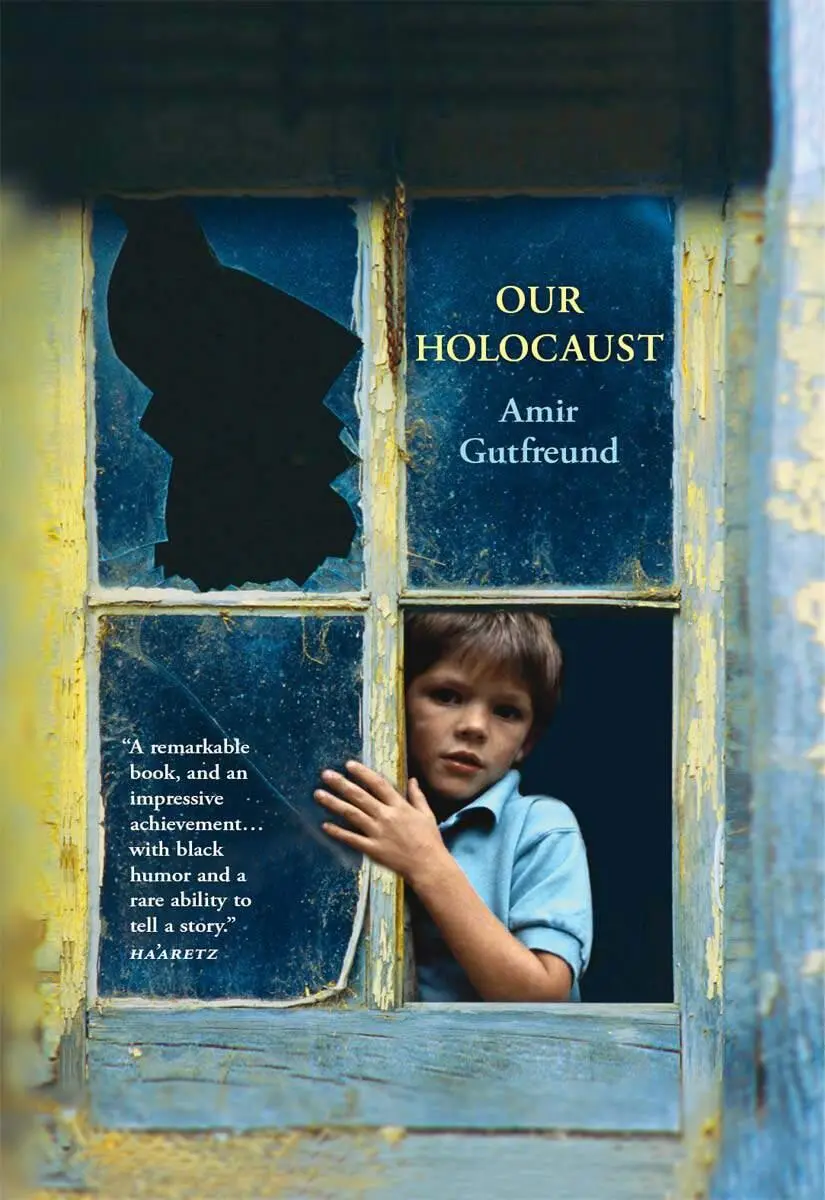
- Название:Our Holocaust
- Автор:
- Издательство:Toby Press Ltd
- Жанр:
- Год:2006
- ISBN:нет данных
- Рейтинг книги:4 / 5. Голосов: 1
-
Избранное:Добавить в избранное
- Отзывы:
-
Ваша оценка:
Our Holocaust: краткое содержание, описание и аннотация
Предлагаем к чтению аннотацию, описание, краткое содержание или предисловие (зависит от того, что написал сам автор книги «Our Holocaust»). Если вы не нашли необходимую информацию о книге — напишите в комментариях, мы постараемся отыскать её.
Our Holocaust — читать онлайн бесплатно полную книгу (весь текст) целиком
Ниже представлен текст книги, разбитый по страницам. Система сохранения места последней прочитанной страницы, позволяет с удобством читать онлайн бесплатно книгу «Our Holocaust», без необходимости каждый раз заново искать на чём Вы остановились. Поставьте закладку, и сможете в любой момент перейти на страницу, на которой закончили чтение.
Интервал:
Закладка:
My father had a barbershop, and at some point there came orders that everyone had to work. The luxury of school came to an end and I was allowed to work with Father in the barbershop. I studied hairdressing, learned how to shave, lather, that sort of thing. I worked there for quite a long time. It was a kind of village life, where people traded with each other. There were some people who did business, made money, and there were still some connections outside the ghetto, but the economic situation really began to deteriorate. That was until the first Aktion in the summer of ’42.
In the summer of 1942 all the Jews of Bochnia were ordered to appear at the military base, except those who were given stamps in their work cards permitting them to stay. Anyone who wanted to stay tried to find a respectable workplace, because they thought if they sent people away, it would be those who did not have work. In that Aktion, virtually all the Jews who were originally from Bochnia went to Belzec. Well, we didn’t know that Belzec was a death camp. We thought they were being sent to work in the East. My sister did not get a stamp, and she was already prepared with a bag and everything to go east. But at the last minute she was able to get a stamp. I remember we were standing next to our home in the ghetto when the Gestapo head, Schomburg, walked by with my Uncle Yanek, who was in the Judenrat. Yanek pointed out my sister to Schomburg, and that was all she needed. After that she got a stamp. Yanek himself was not helped by his ‘status’; he was sent with his wife and his son Sigmund, three years old, to Belzec, stamps and all.
There was a hospital in the ghetto, and the head of the hospital was my uncle, Anatol Gutfreund. Since they said patients would not be sent east but would stay in Bochnia, my uncle hospitalized his mother. People found ways. But the Germans, as usual, did not keep their word, and they took all the hospital patients to the Baczkow forest and shot them, all of them, including my grandmother. That was apparently not enough for the Germans, because afterwards all the people who had been given permits to stay in Bochnia were ordered to come to the Judenrat courtyard, and they took us to the military base and had another Selektion . They asked each person what he or she did. My father said he was a barber. They said, “Good, we need a barber.” They let him go. Then my sister came up. She had two jobs, at the bakery and in the street sanitation department. Then my mother said she worked with Father, so somehow they let her go. My mother took me by the hand so we could pass through together, but the man stopped me with his Peitsche , his horsewhip, putting it between my hand and Mother’s. I was a twelve-year-old boy. At that moment a commotion broke out over by the main transport, I don’t know what it was about. He looked over to see what was going on, and Mother quickly pulled me away and I went over to the other side and joined the group of people permitted to stay. That was my first Selektion and, as in dozens of cases, it was a matter of a split second this way or that.
After the Aktion was over they took us to collect the dead from the streets. I saw murdered rabbis lying there, and I asked Father, “Father, tell me, what is this? Rabbis…why? Where are they and where are we…?” So my father said something like, “Because of sins, for what has happened…penance for the People of Israel,” and so forth. I said to him, “Yes, but there are children here too. What about these children?” Then Father started crying. What could he say?
In that Aktion , the main core of the Bochnia Jews disappeared. We went back to the ghetto. Then they started bringing Jews in from all sorts of towns and villages in the area, and concentrated them all in the ghetto. What happened was that all the people who had hidden during the Aktion and had been found, they shot them right on the spot. Those they didn’t find stayed hidden in the ghetto, then they let them out. There was no problem, they came out, they got a stamp, and they stayed. Then they divided the ghetto into Ghetto A and Ghetto B. In Ghetto a were people who worked, in Ghetto B people who didn’t work. The Germans had a long-term plan to liquidate Ghetto B.
The second Aktion was in the winter of 1942, in November. The Jews were fairly confused and did not know what to do. We got permits to stay again, but we were afraid by then, because we had seen that there were Selektionen . And we saw that all the people who had hidden the first time were still there. So my father decided we would hide. He set up a bunker in the attic of a storehouse in our back yard. There was another family there, the Marsends. They had a little girl of about four, Etinka. That little girl was not just educated, but really trained. They trained her to stay quiet, not to open her mouth, and she could sit for hours without making a sound. They taught her that if she was put into a backpack and someone hit the backpack, she mustn’t open her mouth. She was well trained. She was also a very fearful girl, very frightened. I admit that I tormented her quite a bit. I was bigger than her, and I used to tease her. I would tell her scary stories and she would stare at me without saying a word for a long time, then suddenly burst into tears. Whatever you did to her she would stay very quiet, until she suddenly started crying. That poor little girl.
We hid with the Marsends, and Grandma was also with us, my mother’s mother. We hid and the searches began. We heard that every time they found people in a house, they shot them. They went from house to house and we heard yelling and shots. They shot and shot and shot. The house next-door to us too, they found a family there who we knew, and they killed them. We heard all the shouts. Then they reached our house. I remember that on the front door it said ‘ Ordnungsdienst Hollander. ’ He was our neighbor. I remember that it was in the evening and they called his name out. They searched, turned things upside down, but they didn’t find the storehouse where we were hiding. It must have been too dark for them to see. We were in a sort of attic, the entrance was through the storehouse. My father had put some heavy objects against the door, so it couldn’t be opened from downstairs. At least we thought it couldn’t. The next day we heard them starting the search all over again. They went through again and we heard shots fired. They were getting closer to us. They came right up to our storehouse. They looked at it and said, “There must be an attic here.” They started searching. They pushed against the door with a pole and the things Father had put there started to shift. The German said, “There must be people here.” They brought a ladder and sent people in through the roof. A Jewish man came in, a locksmith they had brought to open doors, and a Polish policeman.
Before the war we had lived in a building that belonged to the police, and all the policemen knew us. The policeman saw Father, and yelled, “Dear God, Mr. Gutfreund, what are you doing here?”
What are you doing here…
In any event, the policeman started trying to cover Father up, and the locksmith, who knew the Marsends, tried to cover them up. Then they opened the door. I was standing closest to the door, so they took me and threw me down. Mother screamed because she was afraid I would be hurt in the fall. She didn’t consider that we were about to be shot. I came out of the warehouse and stood in the yard. The German called me over. There was one German there, and all the rest were Polish police. He told me to stand by the fence. He asked how many people were up there, but I didn’t tell him. I knew they had covered up Father and the other family, so I said, “There’s my mother, my sister, and my grandmother.” I knew they had already been found, because they had been in the same place with me. Then he stood me up against the wall, took his rifle off his shoulder and put a bullet in it. And all I could think of was that I hoped it wouldn’t hurt, because I knew it was the end. At that moment a messenger arrived on a motorcycle and shouted something at him in German. The German took the bullet out, put it back into the magazine, slung his rifle over his shoulder and went over to the messenger. They spoke in German, I couldn’t hear what they were saying, and he signed an order for the messenger. In the meantime they had brought down Grandmother and Mother. And the German said, “Search, there are more people there. Search, there are more people up there.” They searched and found the Marsends and Father.
Читать дальшеИнтервал:
Закладка:
Похожие книги на «Our Holocaust»
Представляем Вашему вниманию похожие книги на «Our Holocaust» списком для выбора. Мы отобрали схожую по названию и смыслу литературу в надежде предоставить читателям больше вариантов отыскать новые, интересные, ещё непрочитанные произведения.




Обсуждение, отзывы о книге «Our Holocaust» и просто собственные мнения читателей. Оставьте ваши комментарии, напишите, что Вы думаете о произведении, его смысле или главных героях. Укажите что конкретно понравилось, а что нет, и почему Вы так считаете.