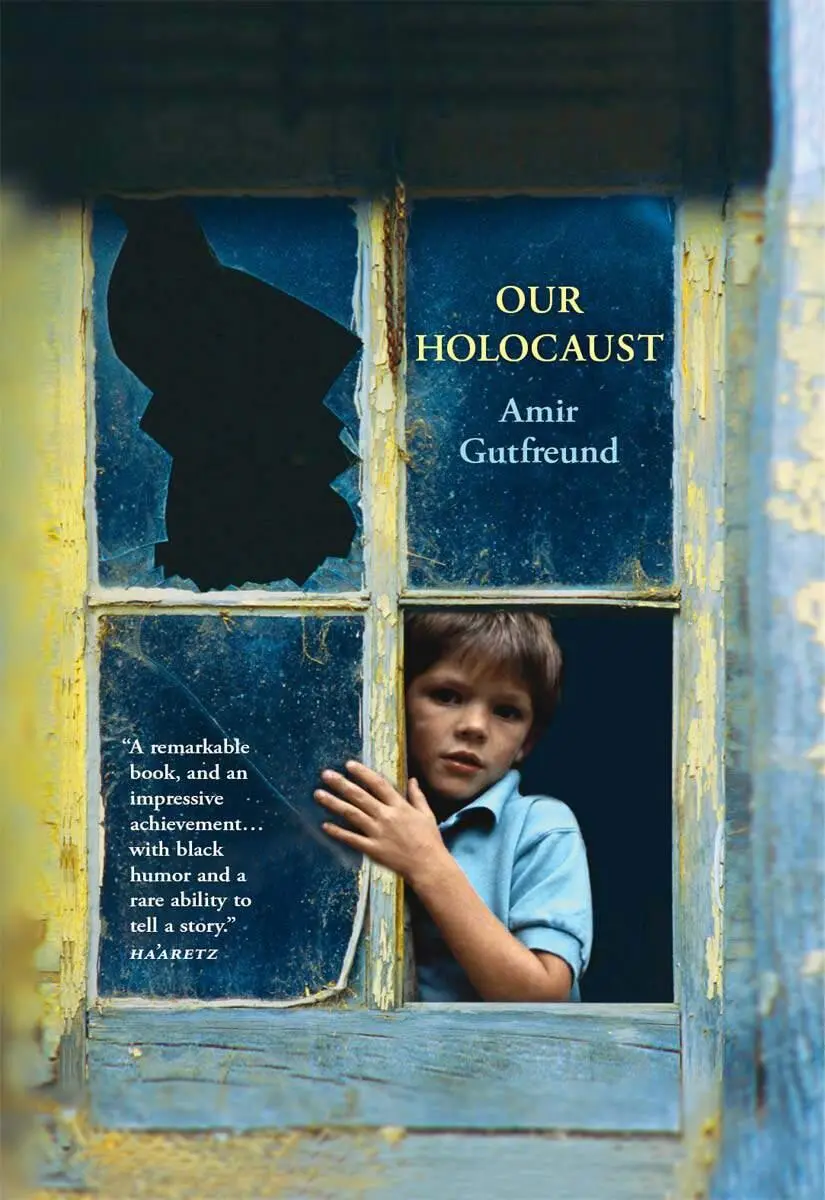
Amir Gutfreund - Our Holocaust
Здесь есть возможность читать онлайн «Amir Gutfreund - Our Holocaust» весь текст электронной книги совершенно бесплатно (целиком полную версию без сокращений). В некоторых случаях можно слушать аудио, скачать через торрент в формате fb2 и присутствует краткое содержание. Год выпуска: 2006, Издательство: Toby Press Ltd, Жанр: Современная проза, Прочая документальная литература, на английском языке. Описание произведения, (предисловие) а так же отзывы посетителей доступны на портале библиотеки ЛибКат.
- Название:Our Holocaust
- Автор:
- Издательство:Toby Press Ltd
- Жанр:
- Год:2006
- ISBN:нет данных
- Рейтинг книги:4 / 5. Голосов: 1
-
Избранное:Добавить в избранное
- Отзывы:
-
Ваша оценка:
Our Holocaust: краткое содержание, описание и аннотация
Предлагаем к чтению аннотацию, описание, краткое содержание или предисловие (зависит от того, что написал сам автор книги «Our Holocaust»). Если вы не нашли необходимую информацию о книге — напишите в комментариях, мы постараемся отыскать её.
Our Holocaust — читать онлайн бесплатно полную книгу (весь текст) целиком
Ниже представлен текст книги, разбитый по страницам. Система сохранения места последней прочитанной страницы, позволяет с удобством читать онлайн бесплатно книгу «Our Holocaust», без необходимости каждый раз заново искать на чём Вы остановились. Поставьте закладку, и сможете в любой момент перейти на страницу, на которой закончили чтение.
Интервал:
Закладка:
I came to Grandpa Yosef. “I want you to tell me your whole story again.”
“What for?”
“So I can document it.”
“What do you want to do that for?” Anat asked.
“What’s the point of that?” Effi asked. She was sitting in Grandpa Lolek’s house on a new couch she had bought “to make him happy when he comes home.” She had placed it exactly above the opening of his secret cellar, opposite her newly purchased television; she had even paid for cable TV (“it’s instead of men”). She would leave everything for Grandpa Lolek, to make him happy when he came home.
“We have to document, to understand,” I reply.
Grandpa Yosef’s voyage kept rambling, great bright landscapes around every small section of his story.
Grandpa Yosef acquiesced. “All right, if you think it’s important.”
We sat together night after night, him talking and me writing. Every so often he got up, leafed through what I had written, reviewed his own story on the pages, pleased with what he saw. As if every letter wore a little tie, and his duty was to walk among the rows and inspect them, correcting little imperfections in their appearance.
Night after night, I acquired Grandpa Yosef’s memories.
Dad was also willing to talk. I was Old Enough.
This time, I was the emotional one. His style was short and simple, with no inexpedient words. His life, his memories. The lost world in which he had been left to wander among ruins, people-who-would-no-longer-be, places-that-were-gone, a culture that had left only pointy headstones in little cemeteries and monuments at the edges of train tracks, and now the whole world that had once convened at the edge of the tracks was gathering its memories into the monuments, enlarging them, and so my father turned the years back, slowly retelling.
His words were clear. Simple. He had the talent to remember, a talent I inherited. Sometimes he struggled, “ Nu …what was the name of Einhorn’s son from the furniture store?” But he did not give in to the fifty years. I tried to comprehend how deeply he was casting these moments of concentration as I sat beside him, unable to help. In the evenings I transcribed his story, documenting, without changing a single word. I left it just as Dad said.
I was born in Bochnia, Poland, in 1930. My father was a barber, my mother a housewife. Before the war I completed the third grade in a regular Polish school, the Jachowicza School. My family was middle class. My father was a Zionist. My mother had a Jewish National Fund collection box like all good Jewish women did. Father was very active in the Jewish community. He was involved in building a large synagogue in Bochnia. Until then there were many small synagogues, known as stiebelech . The Jews in Bochnia were divided. Some were very Orthodox, some traditional, and some were not religious. My grandfather on my father’s side was traditional. On Mother’s side I only knew Grandmother, and she was very religious. My mother was also very religious.
Our lives were ordinary. That was, until the war. I played with Polish kids and felt like a Polish patriot. I knew I was Jewish, and after school I went to the cheder, which I was a little bitter about, but I had no choice…[Dad tells me, “In the Cheder we studied the Chumash and translated from loshen koidesh (Hebrew) into Yiddish. I did not know Hebrew or Yiddish, so for me it was like translating Chinese into French. I didn’t understand a word. One day I came home and told my father proudly, ‘ doszedłem do shlishi! — I reached the third!’ I had no idea what ‘ shlishi ’ was, but I usually reached only sheini —the second.”] I was not in a youth movement myself, I was too young, but Father used to take me sometimes to a Zionist youth movement. I can’t remember which one, but since Father was a socialist and a Zionist, it must have been a Zionist socialist youth movement.
In 1939 the war broke out. About a week later the Germans entered Bochnia. We saw the German might and had not believed that such a thing existed. We lived on the main street, and we saw the Germans coming in with tanks and artillery and infantry riding on armored vehicles. Before the Germans came, there was a battle with a small Polish force, which was destroyed by air strikes in the morning. The Germans had no difficulty getting in. The bombardments were not in the center of town, so we did not suffer from them.
When the Germans arrived, at first they paid no attention to the Jews. After a while, the first prohibition was that Jews were not allowed to walk down the main street. When they did anyway, they were beaten. Then they set up a sort of Jewish police, the Ordnungsdienst , or OD. They posted guards at the entries and exits of the street so Jews would not pass through. After a while, we were instructed to put a sort of band on our sleeves. Not a yellow patch, but white with light blue. It was obligatory from age thirteen, but I also started to wear one at some point. The summer break came to an end and we went back to school. After about a week the teacher called us to the front. There were five of us Jewish children in the class, and he said to us, “Goodbye and not farewell.” He simply kicked us out. We left.
The Judenrat had already been established by then, and they set up a Jewish school. There were no advanced studies, it was mainly to keep the children busy. My father’s shop was not confiscated — on the contrary, he was instructed to open the shop and make it available to the German army. At first they paid well. The soldiers knew he was Jewish, and that was fine. Father kept running the shop, but after a while the Germans went elsewhere. That was until ’41. Of course, during that period there were all sorts of Kontributionen —levies. You had to give so many pounds of copper, lead, all sorts of materials. You would buy the material and hand it over. They would publish a notice that everyone had to bring a certain amount, and no one dared not to.
We kept on living in our apartment. In the same building, they set up a residence for German soldiers. I don’t know if they knew we were Jews, but in any case they treated us fine. Some of them were anti-semites who spoke about Jews, and others took no notice. In fact our landlord, who was a Polish anti-Semite and wanted to inform on us, was treated badly by them because they had been taught that wealthy landlords were Jews. We actually developed good relationships with some of the soldiers. They would hang around when they were on duty, and once in a while they came to visit. Father spoke excellent German, and it was nice for them to have someone to talk to far from home. Once, I remember, it was a Jewish holiday, and we had a festive meal at home. Suddenly we heard their vehicle stop outside. They had come to visit. Father quickly gathered everything up from the table, with the tablecloth, and threw it all into the next room. The soldiers came in and saw us sitting at an empty table. They asked why. Father said times were hard, and we just couldn’t afford anything. They were moved and wanted to help, so they drove off and brought us back lots of food and other things.
That was how it was with those soldiers. They were just people. During that time there was some activity going on, they say there were Polish Partisans or some sort of underground. There was shooting at night, and they killed two or three Germans. The Germans hanged the two men who had done it. Then they took everyone who was in prison, and “just to be sure,” they added in a few Jews. They led them all the way through town, we watched it, and executed them in a spot near the woods, and that was in fact the first execution in Bochnia.
In 1941 we received an order to move to the ghetto. We left our home and found an apartment in the ghetto. Father was given a permit to transfer his business to the ghetto. Poles were taken out of the ghetto area. There was still a school then, to keep the children occupied. At that time we didn’t think much about escaping. There were no thoughts of extermination. There was no talk about extermination. People knew there would be trouble, they knew the Germans did not like Jews, but they thought it would be like in Germany, where Jews were restricted and their freedom of movement was curtailed, but there was no talk of extermination. Even when they talked about transports to the East, they knew the Jews were being sent to work. No one knew it was to be killed. Everyone thought they would somehow get through. Jews were always optimistic. Germans reached as far as Moscow and still people said, “These are extraordinary circumstances.” Perhaps that was what kept them going, because otherwise people might not have survived.
Читать дальшеИнтервал:
Закладка:
Похожие книги на «Our Holocaust»
Представляем Вашему вниманию похожие книги на «Our Holocaust» списком для выбора. Мы отобрали схожую по названию и смыслу литературу в надежде предоставить читателям больше вариантов отыскать новые, интересные, ещё непрочитанные произведения.


Обсуждение, отзывы о книге «Our Holocaust» и просто собственные мнения читателей. Оставьте ваши комментарии, напишите, что Вы думаете о произведении, его смысле или главных героях. Укажите что конкретно понравилось, а что нет, и почему Вы так считаете.