Amir Gutfreund - Our Holocaust
Здесь есть возможность читать онлайн «Amir Gutfreund - Our Holocaust» весь текст электронной книги совершенно бесплатно (целиком полную версию без сокращений). В некоторых случаях можно слушать аудио, скачать через торрент в формате fb2 и присутствует краткое содержание. Год выпуска: 2006, Издательство: Toby Press Ltd, Жанр: Современная проза, Прочая документальная литература, на английском языке. Описание произведения, (предисловие) а так же отзывы посетителей доступны на портале библиотеки ЛибКат.
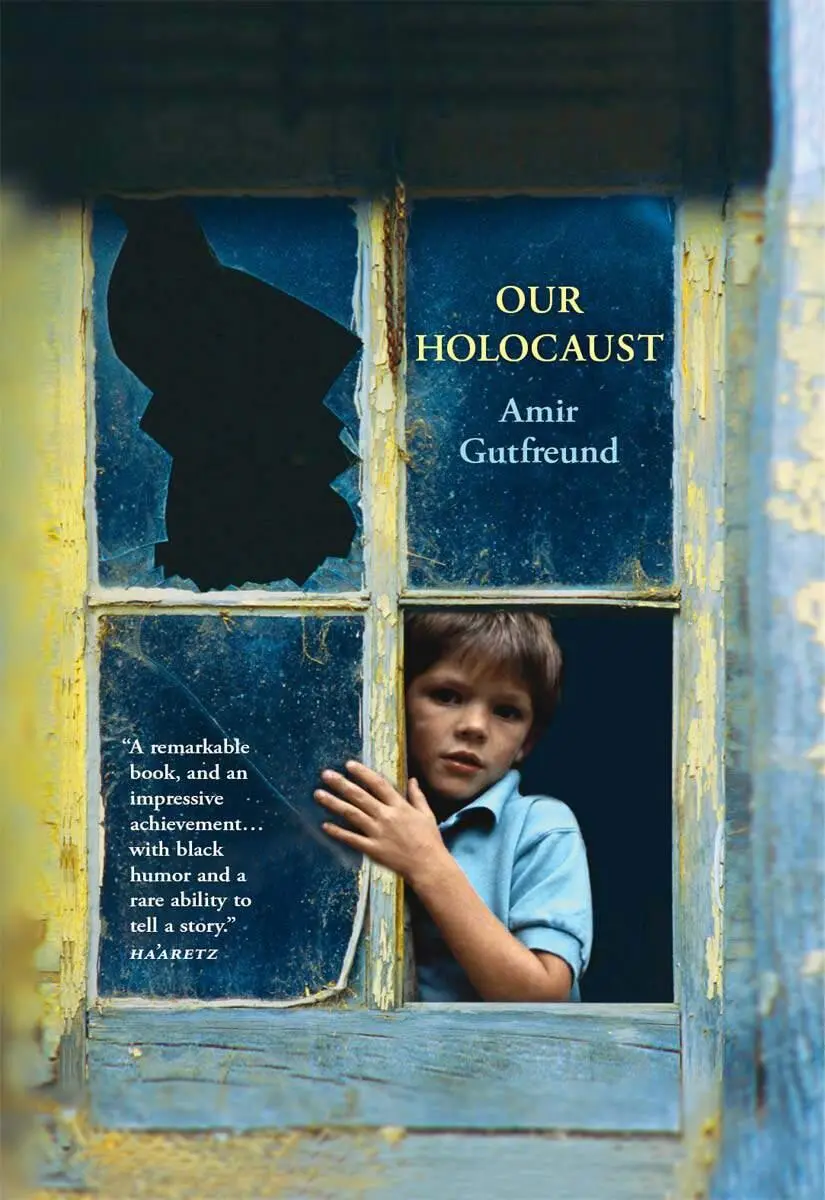
- Название:Our Holocaust
- Автор:
- Издательство:Toby Press Ltd
- Жанр:
- Год:2006
- ISBN:нет данных
- Рейтинг книги:4 / 5. Голосов: 1
-
Избранное:Добавить в избранное
- Отзывы:
-
Ваша оценка:
Our Holocaust: краткое содержание, описание и аннотация
Предлагаем к чтению аннотацию, описание, краткое содержание или предисловие (зависит от того, что написал сам автор книги «Our Holocaust»). Если вы не нашли необходимую информацию о книге — напишите в комментариях, мы постараемся отыскать её.
Our Holocaust — читать онлайн бесплатно полную книгу (весь текст) целиком
Ниже представлен текст книги, разбитый по страницам. Система сохранения места последней прочитанной страницы, позволяет с удобством читать онлайн бесплатно книгу «Our Holocaust», без необходимости каждый раз заново искать на чём Вы остановились. Поставьте закладку, и сможете в любой момент перейти на страницу, на которой закончили чтение.
Интервал:
Закладка:
“That night, two of my neighbors died suddenly, one from beatings, taken from bed to be punished and never returned, and the other from exhaustion. The one who died of exhaustion would be removed in the morning with all the dead, but in place of the one who was beaten to death they tossed in a new neighbor, a diminutive Jew. And this Jew, as if he did not see how miserable my condition was, as if neither bothered by the body that separated us, nor deterred by the death sentence awarded to those who whispered in their cots, immediately began trying to get acquainted, asking questions, telling me about himself. I, in the twilight of death, was somewhat taken aback. It seemed strange that this little Jew was unafraid of Adler’s command, talking freely about his past, his history. When morning came, I got up from the cot despite myself, rising to a new day of death, and I knew my Jewish neighbor’s entire story by heart.
“Until the war started my new neighbor had been a tramp and a beggar. He ate in soup kitchens and at rich people’s houses. In summers he played the violin at weddings, and in winters he was hungry for bread. He stole. A dangerous sort of Jew, he was. And indeed, I feared him, but I was also drawn to his companionship. How can I put it? I sensed that with him I might survive. When he told me his name, Rothschild, I did not know if he was joking or truthful. I dared not ask. I soon discovered that my intuition about Rothschild was correct. He always knew where they were secretly giving out another portion, where they were selling something, which work group was better off. I tell you this without shame: I put my trust in Rothschild. Incredibly, he put his in me. One day he caught me in the latrine, or, forgive me, the crapper, which served as a general market in the camps, and he stood up close to me. Whispering, he proposed a deal. He would keep me going, look out for me, and I would pray for him. He had seen me praying for Adler and he wanted me to pray for him too, so his sins would not be counted against him. I was taken aback. Such a deal, nu . But he shoved a piece of cooked potato into my hand and I quickly stuffed it in my mouth. We had a deal.
“From that day on, Rothschild really did take care of me. He was cunning and seemed to be without conscience. He stole and tricked and cheated and lied. And he brought me half of his earnings, or so he assured me. Everything gained through his wheeling and dealing, I swallowed up; my body wanted it. Every evening he came to me and asked pragmatically, ‘Have you prayed for me yet today, Rabbi?’ As if we had not a general agreement, but a detailed contract.
“He insisted on calling me ‘Rabbi.’ No matter how many times I told him I was not a rabbi, Rothschild explained that for him I was. In any case, he said, he had seen the rabbi of his town being dragged through the snow by his beard. His entire congregation had already died in the crematoria. Only he was left. So he was a congregation, and I — a rabbi.
“So we remained, the pair of us. Every day I prayed for myself, for him, and for Israel. I dared to bring Feiga’s name to my lips, pleading. He brought to me from his takings, and saved me twice from prisoners who wanted to slaughter me for my portion of soup. So small, he was, and so bold. A savage. At the end of every day he checked, making sure I hadn’t forgotten to pray for him. I did not know what sort of a trap I had fallen into, and did not give it much thought because my body was surviving thanks to another radish, another bit of soup, another potato. Many times, when the food was in my stomach, I grew terrified of this partner, a thief and a robber — how had I joined up with this burglar? But hunger came and pierced through my thoughts, and when Rothschild passed me a potato I did not ask where it came from, whether from the prisoners’ kitchen or the jailors’ kitchen or the hoard of another miserable prisoner. I grabbed it and ate.
“One day there was a special roll-call. There were shouts, and a group of us was sent to work in the woods. There, we knew, death was waiting. You did not come back from working in the woods with those villains. I was to be annexed to the group, separated from fortunate Rothschild. I had already began marching with the rows of people, extremely frightened, when suddenly Rothschild slid into our group and squeezed in next to me. ‘Right behind you, Rabbi!’ I no longer knew who this Rothschild was — a villain or a righteous man. For he had sentenced himself to death.
“After many hours of walking, we were hurried into a wooded area and ordered to chop down the trees. Our hands grasped dull axes and broken saws, and the supervisors made sure the work was done according to certain rules and with the requisite energy. Every so often, one of the supervisors lost his patience, burst into the group, chose himself a victim, and that victim had no recourse. Why did they not shoot us and be done with it? Who can tell. For days, they worked us from morning to night. They themselves were bored. The woods made them irritable and we paid the price. We bowed our heads and continued to work. There was no Adler to come to my help here. Rothschild, in the woods, was also waning. We were both losing our strength. Around us people collapsed, unresponsive to thrashes, beatings. Anything was better than another hour of work. Each one who gave up his life, we regretted, because we would have to carry his body back to the camp. The Germans could not tolerate inaccurate numbers or a discrepancy between the number that set off and the number that returned.
“Rothschild, it turns out, was not idling. Every night when we were brought back to the camp, shattered, he did not lie down on his bed as I did, one foot in the grave. He ran around stirring things up, investigating, lobbying. A few days later he found himself a job in the kitchen and was also able to get me out of the woods group and back to the boot-marchers. One night he woke me up and dragged me out of the hut, unafraid of the supervisor and the SS outside. He stealthily gave me a piece of meat, a real piece of meat, which if not for the freezing cold would have probably sent a stench throughout the entire camp. I swallowed it. My stomach ached for two days, having forgotten the taste of meat. And the pain, well. Nu , like a new baby that keeps you from sleeping. Like Yariv, your Yariv, when he was born. He wouldn’t let you sleep, but the joy, the joy!”
(Suddenly, my Yariv, in the middle of the camps.)
“And of course, he said, ‘Don’t forget to pray for me, Rabbi.’ He took me back to the hut but did not go in. For Rothschild, night was the time for doing business. He was always busy with intrigues and commerce. As if he meant to get rich in this place. For one whole month he tormented himself with a major secret transaction. He twitched on his cot at night, hitting and kicking the planks. He hit me too, thrashing this way and that. He was seeking reprieve from the calculations he labored over all day, skipping among his confidants, hiding, helping, bribing, slipping away. I was not let in on the secret and had no idea what kind of transaction could be so worthy of these torments. Apart from life, what asset could he gain here? Perhaps that was his business. Life. Saving his own life in some way. Escaping was not his intention. Not a simple escape. He was derisive of escape plans, and often mocked some poor garrulous rookie boasting of his idea. He would tell him dismissively, ‘ Nu , so you escape. What then? What afterwards?’ Perhaps Rothschild was plotting a large-scale plan. What he was scheming, I do not know. But one day it was all over. His strength suddenly ran out. He went back to the little transactions, a stub of salami here, a potato there, cigarettes. At night his sleep was restful again.
Читать дальшеИнтервал:
Закладка:
Похожие книги на «Our Holocaust»
Представляем Вашему вниманию похожие книги на «Our Holocaust» списком для выбора. Мы отобрали схожую по названию и смыслу литературу в надежде предоставить читателям больше вариантов отыскать новые, интересные, ещё непрочитанные произведения.










Обсуждение, отзывы о книге «Our Holocaust» и просто собственные мнения читателей. Оставьте ваши комментарии, напишите, что Вы думаете о произведении, его смысле или главных героях. Укажите что конкретно понравилось, а что нет, и почему Вы так считаете.