Amir Gutfreund - Our Holocaust
Здесь есть возможность читать онлайн «Amir Gutfreund - Our Holocaust» весь текст электронной книги совершенно бесплатно (целиком полную версию без сокращений). В некоторых случаях можно слушать аудио, скачать через торрент в формате fb2 и присутствует краткое содержание. Год выпуска: 2006, Издательство: Toby Press Ltd, Жанр: Современная проза, Прочая документальная литература, на английском языке. Описание произведения, (предисловие) а так же отзывы посетителей доступны на портале библиотеки ЛибКат.
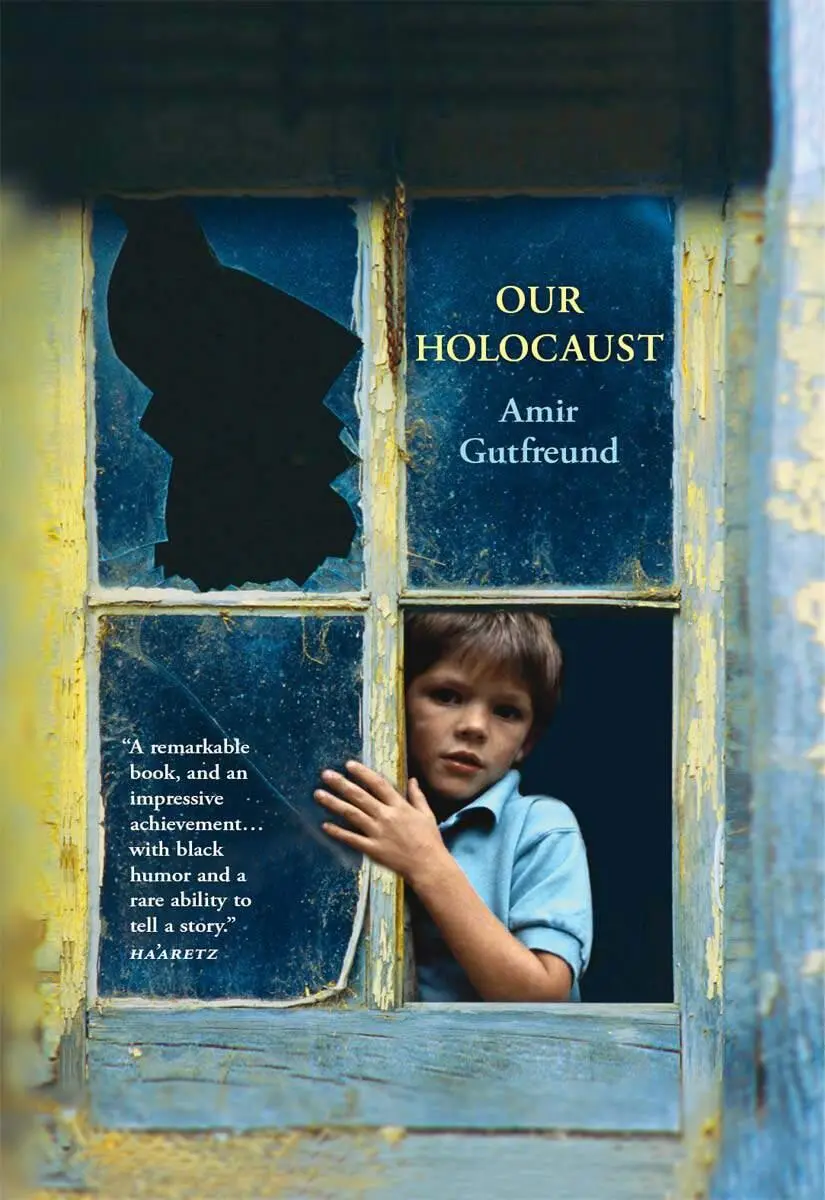
- Название:Our Holocaust
- Автор:
- Издательство:Toby Press Ltd
- Жанр:
- Год:2006
- ISBN:нет данных
- Рейтинг книги:4 / 5. Голосов: 1
-
Избранное:Добавить в избранное
- Отзывы:
-
Ваша оценка:
Our Holocaust: краткое содержание, описание и аннотация
Предлагаем к чтению аннотацию, описание, краткое содержание или предисловие (зависит от того, что написал сам автор книги «Our Holocaust»). Если вы не нашли необходимую информацию о книге — напишите в комментариях, мы постараемся отыскать её.
Our Holocaust — читать онлайн бесплатно полную книгу (весь текст) целиком
Ниже представлен текст книги, разбитый по страницам. Система сохранения места последней прочитанной страницы, позволяет с удобством читать онлайн бесплатно книгу «Our Holocaust», без необходимости каждый раз заново искать на чём Вы остановились. Поставьте закладку, и сможете в любой момент перейти на страницу, на которой закончили чтение.
Интервал:
Закладка:
Grandpa Yosef stops. He breathes heavily, clearly searching for the right words. He wants to paint me an accurate picture of Adler, as great as the man himself, but not ordinarily great like memorial statues.
“The head of the prisoners in the camp was called Farkelstein. Adler, on his part, stayed away from him. He could easily have become head of the prisoners, but he avoided that role. The SS themselves, damn them, although they did not appoint Adler to Farkelstein’s position, used to come to him, recognizing his authority over the prisoners. They let Farkelstein bear the official title, a sort of badge of respect invented in the camps, but much to Farkelstein’s chagrin, they ignored him and his title. Farkelstein could have designated Adler for the hard jobs, the more injurious ones, or handed him over to the Germans with a wink, but more than he hated Adler, he feared him, and more than he feared him, he was trapped in a superstitious conviction that without Adler there would be no Farkelstein. Where did this belief come from? What was the logic? But then, where did places like Ravensbrück come from; what logic was behind them? There was none. Farkelstein dealt every day with his hatred and his envy and his fears. And it was into this river of flames that I slid. Because for some reason, Farkelstein immediately began to hate me and harass me. And harassment by the head of the prisoners was tantamount to a death sentence.
“A few days had passed since I arrived in the camps, and already I was half-dead. The work was grueling. My body, sensing death, suffered from dysentery. Inside the rags of my trousers the excrement dribbled over my body. The end was nearing. I no longer had the strength to work. There were moments, my mind dizzied, when I was drawn to the whip, especially the one with the silver knob. To offer my head, to kiss the whip. Shut off the whole world, no strength, no desires, only the whip, that whip, sharp and clear. That silver knob was like a rimon —like the finial that decorates a Torah scroll.
“How did I not die?
“Adler.
“Was there any other way?
“During work he protected me. When food was distributed he looked out for me. He got hold of clean clothing for me. At night, in the hut, he fed me the secret soup which a few prisoners cooked up somewhere in the distance every night. Only a few were lucky enough to get a few drops of it.
“Strange. So many were dying. Vernichtung durch Arbeit . Extermination through work. On every bed, every night, a Jew fought for his life. No justice and no mercy. Here died the son of a rabbi, there a tailor, a father of ten. Here was a boy dying, no one knew his name, there an elderly man — who knew how he had survived that long? Jews were dying everywhere and yet Adler took pity on me, visiting my bedside as if I alone were a patient among vacationers. A spoiled tourist with a bad stomach on a pleasure cruise, and the captain making himself personally responsible for his health, embarrassed by the regretful mishap. Because of such a trivial problem, the traveler might miss the best of the itinerary.
“Every night Adler sat on the edge of my bed, untouched by tiredness, by hunger. And do you know what Adler did before the dying body of Yosef Ingberg? He recited his studies. He told me about the theories he investigated, the matters on which he had almost completed a conclusion or two that were important for humanity, before the world had lost its mind. I lay at his feet, deathly ill, with only a spark remaining in my soul, a small candle’s light not yet extinguished. And to that flame, it seems, Adler talked, night after night. What little remained of me was there in the core of the flame, and each night I had to regain strength for the next day, another day of Vernichtung durch Arbeit . During work too, between the trenches of dirt we dug only to fill up again — the purpose, after all, was extermination — Adler recited his studies softly, as if leafing through pages he had left only a moment ago on his desk at Lvov University. He was respectful of his only student, the dying Yosef Ingberg, as I lay on the side of the trench while he himself worked a double quota. The supervisor turned a blind eye, and against the background noise of the picks softly tapping, only Adler’s voice could be heard. Every day he took a book off the shelf and taught me its content. The great Khans of Mongolia and the travels of Attila the Hun. The history of the Ancients and the mystery of the Danube. The ascendance of Jewish agriculture and the travels of Alexander the Great. He spread before me everything he had studied of the past and the present, until the war had snatched him away from his desk. And he revealed a new topic to me, which he had only just begun to explore, a study on the true nature of pirates. Every night when we returned from work, after he had fed me the extra soup, Adler told me of his preliminary conclusions, and in those moments it seemed that for him the Holocaust was merely a slight nuisance, as if he had been called away from his office to discuss a tedious memorandum with the faculty treasurer. He was not pained by the whip that cut through his flesh, nor by the hangings in the center of the camp, nor the bad food. His spirit fell because of the pirate Subatol Deul, who was waiting for him, unexplored, on the deck of the Costa Negra . There he stood, the skull-and-bones flag above him, while Adler carried baskets of dirt from the trenches to the mounds.
“What can I say? My soul was tiny, practically devoid of life, but Adler’s words penetrated it and brought health. Slowly but surely, thanks to his lectures, I recovered. And Adler? From the moment it became clear that I would live, it was as if I had graduated to the next class, and he added advanced topics to the curriculum. Adler taught me — to survive. He taught me the ruses of existence and the customs of the camp and what was required if one wished to live. Every day one had to wage a careful war against the SS, against the Ukrainians, against the Jewish police — God help us — and do not forget Farkelstein and his gang. Among all these troubles and hardships, Adler roamed like a king, a lion, directing justice, obtaining here and giving there, and all in aid of the weak, the sick, to save one more soul from death. Not that Adler was able to help much. Prisoners died every day, and every day new ones came, and there was no clear law dictating what saved a man from death, what brought him to death. But Adler did not give up. His dealings were many and dangerous, always engaged in quick transactions intended to maintain human dignity.
“It is very difficult to describe the greatness of a man like Adler in such a place. Many prisoners ended up in the Ravensbrück men’s camp, rabbis and intellectuals, community leaders and public figures. You cannot imagine how quickly one’s soul declines in a place like that, and if it does not decline, the body withers. It is hard, hard to survive, to remain human. Many struggled to save their lives, to save a human soul, and some managed, but someone like Adler… nu , how can I describe him?
“One day I told him I would like to be like him. Adler smiled, waved his pick, and kept on digging the trench.
“He dug twice as many trenches as he needed to, completing quotas for the sick and the weary, in return for the supervisors’ silence. His Jewish soul burst through like a young lion. Sometimes he said nothing, and I was enveloped by a silence of awe. I examined this marvelous man closely, wondering if bad memories tormented him, as they did me, or if perhaps he was plowing ahead, making inroads in his research. My eyes examined, my ears mined. And slowly I noticed a series of grumbles escaping silently from his lips, kind of furious mumbles, as if he were conducting a bitter negotiation with someone. The anger and mumbling did not go on for long. A short time later he taught me about the Pharaonic kings, the education of children in Sparta, the customs of the Greek Olympics. But I was intensely curious — what went on during those silences? What was the cause of Adler’s bitterness? I had already learned that it was best to stay away from the truth, better not to know of peoples’ wounds. Had he lost six children like Hirsch had? Had some other disaster befallen him? Curiosity has a way of triumphing, so one day I dared to ask about the meaning of his mumblings and anger.
Читать дальшеИнтервал:
Закладка:
Похожие книги на «Our Holocaust»
Представляем Вашему вниманию похожие книги на «Our Holocaust» списком для выбора. Мы отобрали схожую по названию и смыслу литературу в надежде предоставить читателям больше вариантов отыскать новые, интересные, ещё непрочитанные произведения.







Обсуждение, отзывы о книге «Our Holocaust» и просто собственные мнения читателей. Оставьте ваши комментарии, напишите, что Вы думаете о произведении, его смысле или главных героях. Укажите что конкретно понравилось, а что нет, и почему Вы так считаете.