Amir Gutfreund - Our Holocaust
Здесь есть возможность читать онлайн «Amir Gutfreund - Our Holocaust» весь текст электронной книги совершенно бесплатно (целиком полную версию без сокращений). В некоторых случаях можно слушать аудио, скачать через торрент в формате fb2 и присутствует краткое содержание. Год выпуска: 2006, Издательство: Toby Press Ltd, Жанр: Современная проза, Прочая документальная литература, на английском языке. Описание произведения, (предисловие) а так же отзывы посетителей доступны на портале библиотеки ЛибКат.
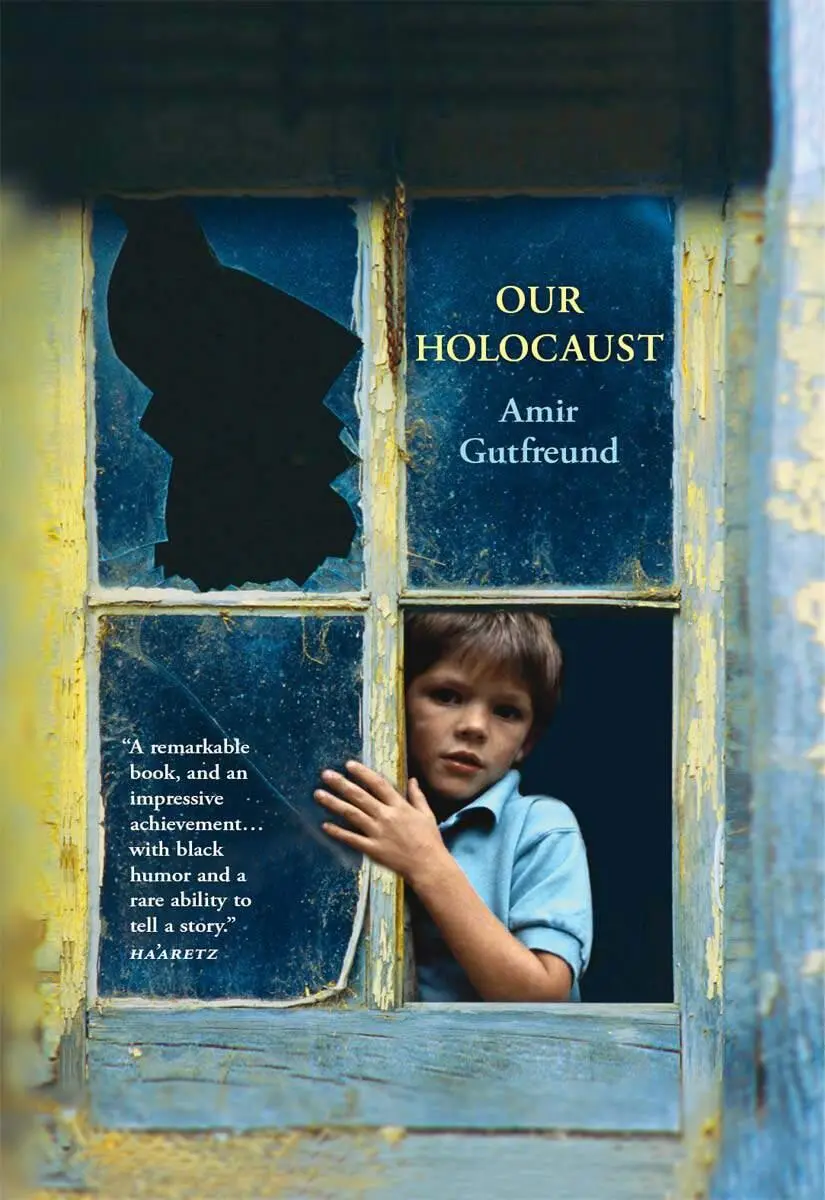
- Название:Our Holocaust
- Автор:
- Издательство:Toby Press Ltd
- Жанр:
- Год:2006
- ISBN:нет данных
- Рейтинг книги:4 / 5. Голосов: 1
-
Избранное:Добавить в избранное
- Отзывы:
-
Ваша оценка:
Our Holocaust: краткое содержание, описание и аннотация
Предлагаем к чтению аннотацию, описание, краткое содержание или предисловие (зависит от того, что написал сам автор книги «Our Holocaust»). Если вы не нашли необходимую информацию о книге — напишите в комментариях, мы постараемся отыскать её.
Our Holocaust — читать онлайн бесплатно полную книгу (весь текст) целиком
Ниже представлен текст книги, разбитый по страницам. Система сохранения места последней прочитанной страницы, позволяет с удобством читать онлайн бесплатно книгу «Our Holocaust», без необходимости каждый раз заново искать на чём Вы остановились. Поставьте закладку, и сможете в любой момент перейти на страницу, на которой закончили чтение.
Интервал:
Закладка:
“He turned and looked at me. ‘It’s hard…It’s hard for everyone…’
“And silence. Emptiness around us. He had not spoken only to me. Around us were woods, and behind them camps, and somewhere in the distance the Lodz ghetto, and more camps, and the whole world was at war. It was hard, it was hard for everyone.”
Grandpa Yosef stops talking. He gets up and goes to the window. He looks at the clouds. No rain, no rain. What will be the end? Clouds gather, the sky presses down to the earth, the cold deepens and still the rain does not come. Grandpa Yosef stays by the window but his story does not wait. Behind his back, details slip through, little pieces of morse code that he has already told me an era ago, and they take me through the rest of the story without him.
Ahasuerus starts the car and drives it up to the camp gates. In the women’s camp of Ravensbrück there is hunger and disease. The inmates are exhausted. Those who do not join a group, die. Any woman who makes the mistake of standing out in front of the murderous female SS officers is killed. Death is a method, a solution. In the heart of the camp, the “bunker” provides a solution for those whose death the SS murderesses want to slow. But the main point for us — for Grandpa Yosef, for me, for Ahasuerus — is that the Little Lover is there, serving at Ravensbrück.
The car crosses through the gates. There is not even a moment’s delay before the meeting. Ahasuerus walks into the staff building. Then he goes to one of the huts. A conversation takes place there for a moment or two. A fair young woman emerges and walks away with heavy, angry steps. He follows her, pleading. She pushes his hands away, speeding up. She is not tall. Pretty, let us say. Her face is flushed with anger. She disappears behind a hut.
“There, in the savagery, they were not bound by their rules of etiquette,” Grandpa Yosef mumbles. “I had not imagined such a thin little thing. She wasn’t huge or red-faced, like so many of the cruel SS female officers. And it was clear that she was unhappy with Ahasuerus’s advances. Unaccustomed to such crudeness. She had been taught that a woman should be treated politely. Gently. And he, the villain, would not let her alone.
“In the car I could see little and hear nothing. The minutes passed and I felt a strong desire to get out and look for my Feiga. But it was good that I didn’t, because here was Ahasuerus marching towards me, getting into the car, slamming its door. He started the engine in a fury, in a storm. His face was red, evil, as if nothing else mattered in the world. The car’s tires screeched on the road, burst through the gates, the sentries barely had time to fling them open. Ahasuerus made the car gallop. Imposing the roar of his heart upon it, he strained the engine to its limits. His face was determined, as if there were great intent in his driving, but I sensed that our journey was over. He looked right and left, his driving seemed very purposeful, but I could sense the truth in the regal car. She acquiesced to having her pedals pressed, her wheel turned, but her senses had been weakened, and she was no longer searching for a route but rather she was fleeing. It was over and done with — the search for Feiga had failed.
“Again I believed he would kill me. But he did not. And what did he do with me? I will tell you the truth. All the horrors of the Shoah that I saw, everything that is best forgotten, lives on lucidly in my memory. The memories are clear and transparent, like a beautiful landscape. But the end of Ahasuerus is dim. When did we part ways? I vaguely remember someone walking me down a path of wet gravel. That was probably no longer Ahasuerus, but an officer, I think. And then the memory is swallowed up. Rain drenches the world and I am in a suffocating space. Figures around me, prisoners. I too am a prisoner. I awake in the men’s camp of Ravensbrück. A merciful figure comes up to me, shoves at me some sort of thing which I shall call a blanket, although that is not what it was. A hard, cold sheet. It was barely flexible enough to be placed on one’s body, it was useless for heat. The memories return. I am completely frozen, a cut on my head and a deep gash from ankle to knee. The merciful man, the head of the hut, whose name is Adler, whispers in my ear that I will feel better by morning. Although I had not yet been a prisoner in any camp, only ghettos and strange journeys, my voyage with Ahasuerus had taught me plenty about camp life. I would not feel better in the morning. In the morning there would be slave labor. I would starve. They would beat me ceaselessly. They would rob me of my bread, the other inmates too. It would not be better in the morning.
“Do you know what they called the camp system there, in the north? Vernichtung durch Arbeit . Extermination through work.”
(He finds strange pleasure in rolling the German words off his tongue, tasting them on his lips. Vernichtung durch Arbeit .)
“But this man, Adler, tries to lift my sprits. From somewhere they bring hot soup, as if a restaurant is open not far away. The soup is a bland concoction, but I sip it, inhale the broth, and sense that without this Adler I will have no life.
“And indeed, I was right. Adler was one of the saints. My days of Ravensbrück had begun. Vernichtung durch Arbeit . Extermination through work. In the morning, still dark, roll-calls that last for hours. Shouting, beating, physical punishments. People murdered right beside you. The living go off to work. A moribund mass of prisoners sets off shoulder to shoulder. The work is exhausting, our brains dizzied from fear. The German supervisors do not spare the rod. One of them had fit a silver knob on the end of his whip. Everyone knew that all that whip needed was one thrash. Prisoners were murdered over mistakes, over nothing, over boredom that took hold of a German. The Ukrainian guards were not allowed to kill. Only the Germans had that right, and there was much jealousy. We, the prisoners, worked. All we did was work. At lunch there was a hard hunk of bread and soup. A stench rose from it, but the prisoners fought over one more spoonful and stole each other’s slices of bread. Simple people, everyday Jews, became murderous and loathsome. They would rip a piece of bread away from you and laugh in your face, crazed. There are no depths of hell lower than that. And in the midst of it all was Adler.
“This man, Adler, revealed himself from the first as a sort of Judah the Maccabi. A courageous Jew, he did not fear the prisoners, and even found courage in front of the SS. He knew his limitations and exercised caution, but he guarded the prisoners like a Hasmonean. His work was exhausting. There was no shortage of villains among the prisoners, and even those who were not villainous had been driven mad by hunger and were capable of anything. Even in the heart of suffering, on the brink of death, the power-hungry still lust for power, the traitorous still hand over their brethren, and the informants still collaborate.
“Among all these, with infinite dedication, stood Adler. He pronounced verdicts like King Solomon, separated the Jewish hawks from one another like Moses, and brandished a sword like David. He was as kind as — to whom can I compare his kindness? It was infinite. Incredibly, before the war he was a Doctor of Humanities at the university of Lvov. A scholar, a researcher of history, an author of books on theories of the soul. A Jew who had forgotten his Judaism, wrapped up in the world of the goyim , and that was how he liked it. He researched Jewish history too, but in the way that a geologist studies rocks or a geographer the patterns of streams. It was in the camp that his Jewish soul was revealed. By the time I, Yosef Ingberg, arrived at Ravensbrück men’s camp, which was attached to the infamous women’s camp, Adler was already positioned as a leader of the people, one to guide them through the desert for forty years. Nu , I am exaggerating a little…”
Читать дальшеИнтервал:
Закладка:
Похожие книги на «Our Holocaust»
Представляем Вашему вниманию похожие книги на «Our Holocaust» списком для выбора. Мы отобрали схожую по названию и смыслу литературу в надежде предоставить читателям больше вариантов отыскать новые, интересные, ещё непрочитанные произведения.








Обсуждение, отзывы о книге «Our Holocaust» и просто собственные мнения читателей. Оставьте ваши комментарии, напишите, что Вы думаете о произведении, его смысле или главных героях. Укажите что конкретно понравилось, а что нет, и почему Вы так считаете.