Amir Gutfreund - Our Holocaust
Здесь есть возможность читать онлайн «Amir Gutfreund - Our Holocaust» весь текст электронной книги совершенно бесплатно (целиком полную версию без сокращений). В некоторых случаях можно слушать аудио, скачать через торрент в формате fb2 и присутствует краткое содержание. Год выпуска: 2006, Издательство: Toby Press Ltd, Жанр: Современная проза, Прочая документальная литература, на английском языке. Описание произведения, (предисловие) а так же отзывы посетителей доступны на портале библиотеки ЛибКат.
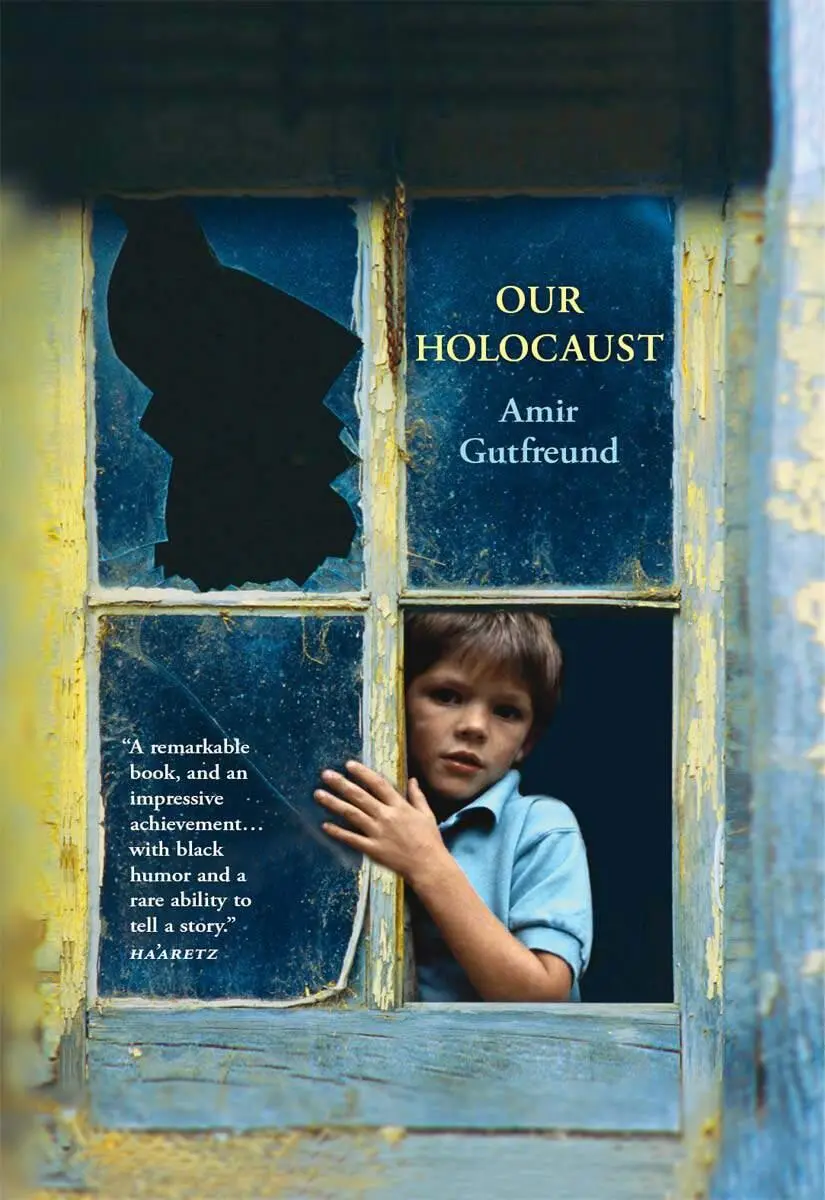
- Название:Our Holocaust
- Автор:
- Издательство:Toby Press Ltd
- Жанр:
- Год:2006
- ISBN:нет данных
- Рейтинг книги:4 / 5. Голосов: 1
-
Избранное:Добавить в избранное
- Отзывы:
-
Ваша оценка:
Our Holocaust: краткое содержание, описание и аннотация
Предлагаем к чтению аннотацию, описание, краткое содержание или предисловие (зависит от того, что написал сам автор книги «Our Holocaust»). Если вы не нашли необходимую информацию о книге — напишите в комментариях, мы постараемся отыскать её.
Our Holocaust — читать онлайн бесплатно полную книгу (весь текст) целиком
Ниже представлен текст книги, разбитый по страницам. Система сохранения места последней прочитанной страницы, позволяет с удобством читать онлайн бесплатно книгу «Our Holocaust», без необходимости каждый раз заново искать на чём Вы остановились. Поставьте закладку, и сможете в любой момент перейти на страницу, на которой закончили чтение.
Интервал:
Закладка:
“He spoke the holy language, and it was so beautiful to hear it in the tortured ghetto, but his words were intolerable and I did not know how to respond, and at night the words mingled and Feiga appeared in a dream, and the infants of Amalek, and in the morning I ran to him to hear more.
“And so it went every day. I did not know the tragedy Hirsch bore in his heart, and I did not know that already then his soul was dismantled, that he was then the persona you know today, but under the authority of the Rabbi of Tipow, his Admor, all his parts were held together as one. To the outside he was still an elegant rabbi, the beadle of the Admor, and on the inside he was falling apart, betrayed, seeking revenge. Today, all that I did not know at the time is known and can be told. Today I know that during the Sperre , the Tipow group was required to hand over some of its members. The Admor of Tipow pronounced the names — these shall live, those shall die. And right in the midst of the Sperre days, he discovered that a relative of his wife’s had recently arrived in the ghetto but had not yet joined the cohesive community, and all of his children were listed for deportation. The Admor ordered that the names be changed. Two of Hirsch’s six children were put on the list. The searchers burst into Hirsch’s house and pulled out all six of his children, although he had been promised that only two would be taken. By the time Hirsch learned of this awful affair and rushed to save his children, they had already been given to the Germans, from whose claws even the Admor of Tipow could not rescue them.
“And so his six children were lost, and his wife was lost — she jumped onto the wagon that took her children away. After the Sperre , Hirsch was left on his own, and the Rabbi commanded him, ‘Jew, take strength in the test that our Father in Heaven is giving you.’ The Admor’s authority was enough to strengthen the outer shell. But inside, Hirsch’s soul was weeping, it did not want to live, and it was ashamed of its cowardice — his wife had thrown herself to death, and he? But Hirsch had no choice. Life had to go on. Even in the ghetto, the Admor’s court carried on, and no words of mourning could be voiced because everyone had lost loved ones. Thoughts of revenge and heresy were forbidden. Then Rabbi Hirsch found me, Reb Yosef Ingberg of Bochnia, a Jew from the outside, and to me he released his thoughts — the question of destruction, the question of justice. Thanks to me, that which was confined within him could survive, and I served as a vessel for his anguish.
“I had no idea whatsoever of what was going on in Hirsch’s soul, and was utterly unaware of my role, that by talking to me, a stranger, he was draining his embitterment just a little. I only knew that I heard wonders of wonders from him, terrible things. He would put his face close to mine and quote to me from the sages: ‘Even if an Amalekite converts, we are commanded to smite him.’ He would wag his finger in my face and ask, ‘Where are these laws from?’ And continue walking as if having spoken calmly, as if his words had not beaten my Jewish heart like a mallet, and I stayed behind him in the heart of the bustling ghetto. And the next day, the same thing.
“One morning something happened. It became known in the ghetto that the Admor of Tipow had escaped. To where, or how he did it, was not clear. But that morning his disciples awoke orphaned. Imagine to yourself what a betrayal that was, without warning, without a hint. The Admor had simply fled with his family. The disciples were not given much time to mourn. Rumkowski’s people immediately saw their chance to nullify agreements, break up power, send the poor men off to work groups and deportation lists. They took the Admor’s cronies out of the best places in the hospitals, out of the comfortable factories. All at once their privileges were revoked and given to those who found favor with the Judenrat. But worst of all was Hirsch. The Admor of Tipow had disappeared, and Hirsch’s dismantled soul, which had been held together by the power of his authority, shattered into smithereens. Why go into detail? In short, nu , he completely lost his mind. From the moment the Admor abandoned them, not only did Hirsch’s mind weaken, and not only did the Tipowik group’s power fall apart, but all its secrets blossomed and spread through the ghetto, including the story of Hirsch. Only then did I learn of the fire that had been eating away at his heart. I was regretful — perhaps I could have offered him some consolation.
“One week later, Hirsch was taken away. I thought he was killed, but as you know, he was not lost in the camps; he is here with us in Eretz Yisrael. And it was the Admor of Tipow, may the memory of this tzaddik be a blessing, who did not survive. He was caught and taken with all his loved ones, may God avenge their blood, to Treblinka. He was captured near the town of Shedlitz, and instead of Chelmno, where the Lodz ghetto inhabitants were sent, he went to the gas chambers in Treblinka.”
(Treblinka. Untersturmführer Kurt Franz, Doll.)
Grandpa Yosef seems to read my mind. “Yes, that was where that ‘Doll’ was, Lalka , but what difference does it make, one way or the other. Hirsch went, as did many others. And I too, just as I was getting used to life in the Lodz ghetto, I was grouped with some Jews sent to slave labor in a camp near Poznan. Someone dared put my name on the list and kick the chief agent out of the ghetto. And I, Yosef Ingberg, not an agent and not a chief, found myself leaving the Lodz ghetto forever. I cannot recall the name of the camp. How could I? As soon as we arrived, battered from our ride in a truck, after they whipped me and pulled out two teeth, and after two men were shot in front of my eyes (Why? No way to know), my gaze fell briefly on the camp personnel standing in the distance, and I saw the figure of Ahasuerus.
“There he stood, next to the camp commandant, and he seemed to be tutoring him, teaching the inexperienced commandant. I stared. I must have stood out from the distance — a Jew looking straight at death. Suddenly his eyes met mine. I saw him give the commandant an instruction and then all the personnel came up to us. Terror fell upon our group. All around me people sensed the shadow of death approaching. Only rarely did the senior officers interfere with the Jews’ lives. They left that job for junior officers, sergeants, the Ukrainians and the volunteers, damn them.
“I whispered to the Jews, ‘Do not worry, he is a decent man.’ They looked at me as if I had lost my mind. They could not have imagined the storm raging in my heart as a thought that was all but forgotten began to reappear: Feiga. We must set off on the road again. Here, the Kadosh Baruch Hu was renewing my voyage! I had no doubt of Ahasuerus’s intentions. He might not have remembered me at all, but simply been astonished at this Jew staring at him. And yet he might have recognized me, only to wonder how I had not been killed in the Sperre as planned. Still, I was certain he would not kill me.
“Ahasuerus came closer. He stopped some six steps away from us. The personnel stood behind him. In front of him the Ukrainians and the sergeants, they too were frozen. They had ceased kicking us, cowed by the presence of authority. What did the general want? They did not know of my Feiga. Perhaps they did not conceive of his Little Lover either. We stood there, everyone around us completely unaware of the true significance of the situation, only Ahasuerus and myself in the center as he stared at me with steely eyes. A brief moment of human expression flitted over his face, a wrinkle that perhaps came from the heart, and an instant later there was nothing but frozen wilderness. He turned back and disappeared into the distance, and with him, like the wings of a crow, went the personnel. Silence lingered in the air for a moment, then all erupted. The whips began again. The shouts picked up. We were pushed, whipped. We were rushed into flimsy wooden huts without windows. We knew neither the name of the camp, nor what they would do with us.
Читать дальшеИнтервал:
Закладка:
Похожие книги на «Our Holocaust»
Представляем Вашему вниманию похожие книги на «Our Holocaust» списком для выбора. Мы отобрали схожую по названию и смыслу литературу в надежде предоставить читателям больше вариантов отыскать новые, интересные, ещё непрочитанные произведения.







Обсуждение, отзывы о книге «Our Holocaust» и просто собственные мнения читателей. Оставьте ваши комментарии, напишите, что Вы думаете о произведении, его смысле или главных героях. Укажите что конкретно понравилось, а что нет, и почему Вы так считаете.