Amir Gutfreund - Our Holocaust
Здесь есть возможность читать онлайн «Amir Gutfreund - Our Holocaust» весь текст электронной книги совершенно бесплатно (целиком полную версию без сокращений). В некоторых случаях можно слушать аудио, скачать через торрент в формате fb2 и присутствует краткое содержание. Год выпуска: 2006, Издательство: Toby Press Ltd, Жанр: Современная проза, Прочая документальная литература, на английском языке. Описание произведения, (предисловие) а так же отзывы посетителей доступны на портале библиотеки ЛибКат.
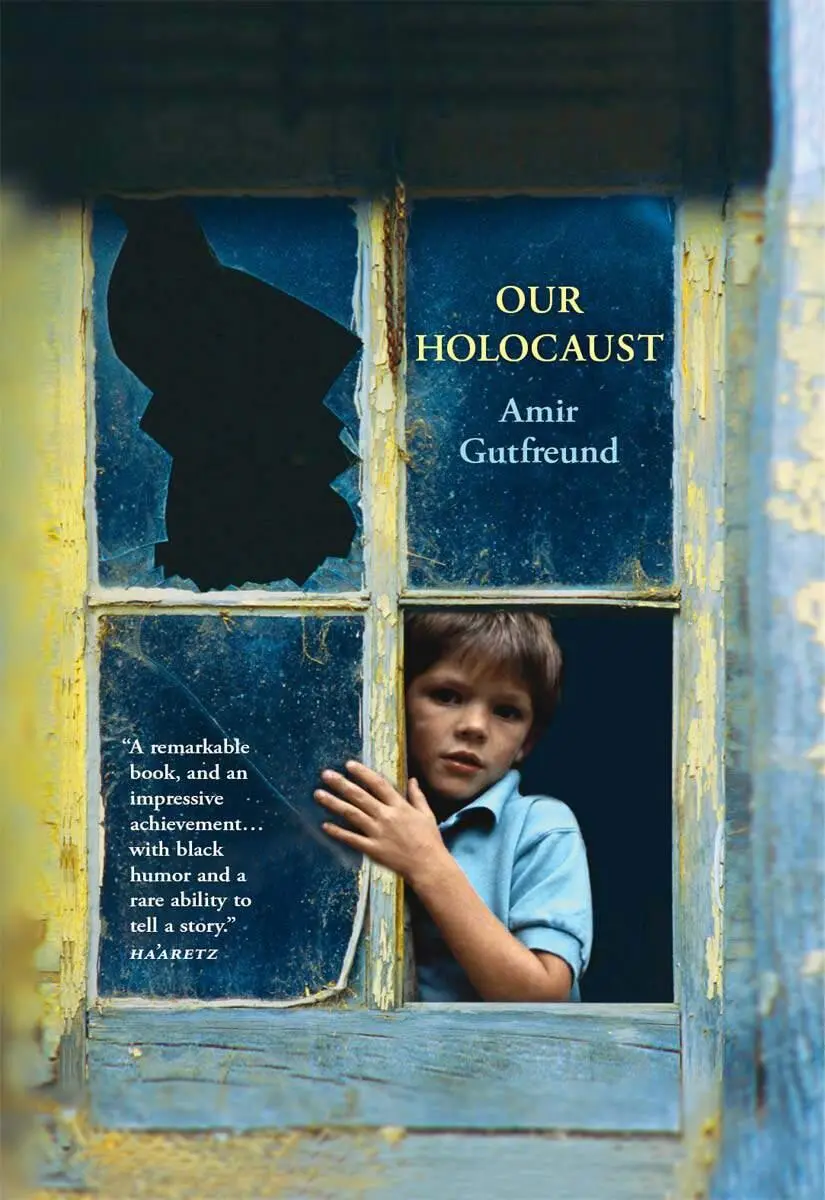
- Название:Our Holocaust
- Автор:
- Издательство:Toby Press Ltd
- Жанр:
- Год:2006
- ISBN:нет данных
- Рейтинг книги:4 / 5. Голосов: 1
-
Избранное:Добавить в избранное
- Отзывы:
-
Ваша оценка:
Our Holocaust: краткое содержание, описание и аннотация
Предлагаем к чтению аннотацию, описание, краткое содержание или предисловие (зависит от того, что написал сам автор книги «Our Holocaust»). Если вы не нашли необходимую информацию о книге — напишите в комментариях, мы постараемся отыскать её.
Our Holocaust — читать онлайн бесплатно полную книгу (весь текст) целиком
Ниже представлен текст книги, разбитый по страницам. Система сохранения места последней прочитанной страницы, позволяет с удобством читать онлайн бесплатно книгу «Our Holocaust», без необходимости каждый раз заново искать на чём Вы остановились. Поставьте закладку, и сможете в любой момент перейти на страницу, на которой закончили чтение.
Интервал:
Закладка:
“A whole day and night passed. We were not sent to work. Twice we were brought some disgusting soup, and once we were allowed to use the latrine. Then, from the edge of the window, I saw the car. It had a new hood ornament, a statue of an eagle with its talons digging into the flesh of the car, its bird-legs lifting up behind. And as my heart had foreseen, we were quickly forced out of the hut for a roll-call. The reason for the roll-call was me. A sergeant took hold of me and removed me from the group. They washed me again. And again the bridegroom’s clothes. They put me in a closed room.
“Ahasuerus had tormented himself for a whole day and night. All those months, while I was in the Lodz ghetto, he had managed with great effort to banish the Little Lover from his heart, to devote himself to his duties, damn him, and now here I was. He agonized for a whole day and night but was unable to put out the fire kindled by the sight of me, and early the next morning we set off again. This time it was winter. Cold. Ahasuerus’s face was strained. Who knew what obligations he had abandoned hastily, and what his punishment would be, how determined he was to be swallowed up in the black abyss of this unrequited love? For four months, more than a third of a year, we had not seen each other. I wondered, should I report anything? He had deposited me in the ghetto and the deposit had been returned. I should say something, should I not? But reality quickly reminded me who I was, and who he was. The months of hunger in the ghetto had mistreated my body and he, the king of evil, now had a higher rank, and it seemed he had also grown taller. He did not talk to me, my existence did not bother him at all. I was an object, like a comb found at the bottom of the sheets, bringing up forgotten emotions. We were driving to his Little Lover, or so he believed. Storing up energy for a decisive conversation with her. Perhaps he would beg. The devil would kneel before the she-devil and weep. He did not know who Feiga was, for whom he was urging his heart, straining his eyes, squeezing out the power from his car. I permitted myself a pause for thought. Leaning back in my seat, I asked myself like a merchant, should I give him back his money? I had spent almost none of it. But that nonsensical thought soon disappeared.
“What more can I say? For two days we drove. The routine of the journey was much like the previous one, but there were no break-downs, no chance for a word to be uttered. Two people driving. Thus far we had accumulated only one spoken sentence, uttered by Ahasuerus before he closed his eyes to sleep. The landscape changed. Flat lakes, black trees. The sky drizzled constantly. We crossed huge rivers and one massive Tigris, which in retrospect I believe was the Wisla, that same Wisla that crossed through Krakow, on to Warsaw, and all the way to Danzig on the North Sea. I was afraid — was Feiga here? In this terrible cold? Here, in such a barren landscape? The car drove on and on as if Ahasuerus could not interfere with its maneuvers. She knew her way, the car. Bilaam’s donkey.
“We stopped at a camp. It was entirely black. Black trees and black fences, and all the huts were black, dipped in freezing cold and puddles. The gates opened for us, the camp guards practically danced around in fear. We made a strong impression on them. The camp personnel hurried to welcome Ahasuerus, and I, knowing my role, stayed in the car. I was left in a large square beside the command house. My eyes were glued to the hunched, black images walking to and fro. Jews rotting away from cold and torture, while I sat in a royal car and fine clothing, looking for lovers. I dared not get out and ask the Jews about Feiga. I reprimanded myself — after all, that was what I had come for — but caution held me back. Slowly my silhouette became apparent to the inmates, and Jewish faces began to stare at me. From afar I saw them, but sensed them coming closer. I did not dare get out, and they dared not approach. There was terror in the air, I could sense it. Their caution taught me caution. Ukrainian guards in black uniforms, similar to the SS uniform, walked around the camp arrogantly. They passed by the car, pretending not to notice me. Darkness fell. Calls were heard in the distance. Many footsteps. My body had been freezing for two hours in the car. Inside, Ahasuerus was still meeting with the officers. They were probably presenting their fine achievements to him, boasting of impressive killing quotas, damn them. And then a Jew tapped on the car window. I could tell immediately that it was a Jew. I was horrified by his skeletal face, his body wrapped in rags, but I knew it was a Jew. Afraid, I opened the window a crack.
“‘Give me!’
“His Yiddish was crude. His eyes darted around. Black knobs on his face, bruises and cuts. His flesh was covered with wounds. I reached into my clothes. I had no food and was hungry myself, but I still had Ahasuerus’s money. I asked about Feiga.
“‘No woman here. Give!’
“And then, disaster. From the darkness a figure emerged. A Ukrainian guard. Before I knew what was happening, the whip had landed. The Jew fell. Right beneath my window, he disappeared from my eyes. The Ukrainian went up to him and raised his whip. He thrashed and then turned the whip around and beat the Jew’s body with the handle. Another figure came out of the command house. The noise had disturbed the convening gentlemen. The Ukrainian took one step back as an SS officer approached. He looked at me first and my blood curdled. I thought about Yanek’s lion whisper from the ghetto. The officer looked away from me — I was nothing to him. In the dark he aimed his pistol downwards. The pistol was hidden from me, but not the flash of lightening followed by a bang. All beneath my window, a step away from me, on the other side of the door, and I could not see a thing. The SS officer straightened up and examined his handiwork. He turned to the headquarters, where Balshazar’s feast was going on. The Ukrainian went up to finish the job. He dragged the body away, which was then revealed to me. My heart sunk.
“In the dark, in the silence, I stayed shut in the car. I barely noticed Ahasuerus coming out, throwing himself onto the seat next to me, starting the engine, far from my world. He drove the car, cold, quiet, and I thought of Feiga. For a moment I felt angry at her. What was this journey for? The torture. Jews were dying, for God’s sake, and she was holding back. Where was she? Why did she not make an effort, as I was doing, to traverse the distance? A gloom took hold of me, not only anger. I remembered that in the distant days before the war, too, I had sensed a speck of something amiss. My time with her was enjoyable, and she had agreed to marry me, but the balance, how shall I put it…for her I would have run through half of Bochnia, but she? No telling. She had a rich world inside of her, she was quiet, noble. She had many suitors. And yet she had chosen me. That was her way, her world was shut off under lock and bolt, no emotions escaped, no closeness.”
Grandpa Yosef tries to explain Feiga. Ahasuerus can wait. The journey can wait. The Shoah can wait. Now, Feiga.
“You know, long before I was bold enough to speak to her, my entire life was devoted to Feiga. In Bochnia, before she even knew of my existence, I would keep track of her daily routine. She walked down Zandetzka Street every day to visit her friend Gittel. And there, on Zandetzka, lived Jozi, a classmate of mine. Not a smart fellow, not a likeable man, in fact. But every day at three forty-five I would turn up at his house and try to tempt him with stamps to trade. That was his only hobby, and for Feiga’s sake I began to collect stamps too. There was no better place in the whole street than Jozi’s window, where I would sit and wait for her while Jozi crumpled the stamps I had brought, displeased. He would haggle and try to bring my prices down, negotiating back and forth with me, without knowing that it was time that I was buying. Only time. It was not easy to find stamps for Mr. Jozi. Your father used to get hold of some for me, I did not ask how. And I stole from Uncle Marek’s collection. I did business with the Polish mailman, helping him out with our maid, Marushka, with whom he was head over heels in love. It was hard to believe how such a great love was possible for that Marushka of ours. Spoiled and sickly, all she ever did was complain.
Читать дальшеИнтервал:
Закладка:
Похожие книги на «Our Holocaust»
Представляем Вашему вниманию похожие книги на «Our Holocaust» списком для выбора. Мы отобрали схожую по названию и смыслу литературу в надежде предоставить читателям больше вариантов отыскать новые, интересные, ещё непрочитанные произведения.








Обсуждение, отзывы о книге «Our Holocaust» и просто собственные мнения читателей. Оставьте ваши комментарии, напишите, что Вы думаете о произведении, его смысле или главных героях. Укажите что конкретно понравилось, а что нет, и почему Вы так считаете.